
Choosing between a two-plate vs three-plate mold is an important decision when developing an injection molded plastic part. Mold structure affects gate location, runner design, tooling cost, maintenance, cycle time, automation, and ultimately the quality of the finished component.
A two-plate mold is the most common and straightforward injection mold structure. A three-plate mold adds another parting surface, providing greater flexibility for gate placement and runner separation.
However, a three-plate mold is not automatically better. For many plastic parts, a well-designed two-plate mold can provide the required quality at a lower tooling cost. For other products, the additional flexibility of a three-plate injection mold may justify its higher complexity.
This guide explains the key differences between two-plate vs three-plate mold designs, their advantages and disadvantages, and how to select the right mold structure for your injection molding project.
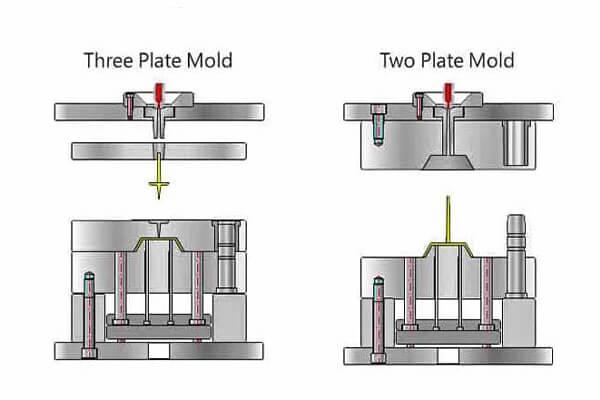
What Is a Two-Plate Mold?
A two-plate mold is the most common type of injection mold. It generally consists of two main mold halves that separate along one primary parting line.
The two sides are commonly referred to as the:
- Fixed half
- Moving half
The mold contains the cavity, core, runner system, gates, cooling channels, and ejection system required to produce the plastic part.
When the injection molding machine closes the mold, the two halves form the mold cavity. Molten plastic is then injected through the sprue, runner, and gate into the cavity.
After the plastic cools and solidifies, the mold opens and the ejector system removes the finished part.
Two-Plate Mold Structure
A typical two-plate injection mold may include:
- Top clamping plate
- Cavity plate
- Core plate
- Support plates
- Ejector plates
- Guide pins and bushings
- Sprue
- Runner system
- Gate
- Cooling channels
- Ejector pins
The exact configuration depends on the part geometry and production requirements.
How Does a Two-Plate Mold Work?
The molding cycle is relatively straightforward:
- The mold closes.
- Molten plastic enters through the sprue and runner.
- Plastic flows through the gate into the cavity.
- The part cools and solidifies.
- The mold opens along the main parting line.
- The ejector system removes the molded part.
- The mold closes for the next cycle.
Because the structure is relatively simple, two-plate molds are widely used for both standard and high-volume plastic injection molding applications.
What Is a Three-Plate Mold?
A three-plate mold contains an additional plate and parting surface compared with a conventional two-plate design.
Instead of separating at only one main parting line, a three-plate injection mold can separate at two different levels during mold opening.
This additional movement provides greater flexibility for runner and gate placement.
Three-plate molds are particularly useful when the gate needs to be positioned away from the conventional parting line or when a point-gate configuration is required.
Three-Plate Mold Structure
A typical three-plate mold may contain:
- Top clamping plate
- Sprue plate
- Cavity plate
- Core plate
- Support plates
- Ejector plates
- Guide components
- Runner system
- Point gates
- Cooling channels
- Ejection system
The actual structure varies depending on the product geometry and required gating system.
How Does a Three-Plate Injection Mold Work?
During mold opening, the three-plate structure separates at two parting surfaces.
A simplified sequence is:
- The mold closes.
- Molten plastic enters through the sprue.
- Plastic flows through the runner system.
- The melt enters the cavity through the selected gates.
- The plastic cools and solidifies.
- The mold begins to open.
- The runner system separates from the molded part.
- The molded component is ejected.
- The mold closes for the next cycle.
The exact opening sequence depends on the specific mold design.
Two-Plate vs Three-Plate Mold: What Is the Difference?
The main difference between two-plate vs three-plate mold structures is the number of mold plates and parting surfaces used to control the runner and part separation.
| Feature | Two-Plate Mold | Three-Plate Mold |
|---|---|---|
| Mold structure | Simpler | More complex |
| Primary parting surface | Usually one | Usually two |
| Tooling cost | Generally lower | Generally higher |
| Gate flexibility | More limited | Greater |
| Runner system | Simpler | More complex |
| Maintenance | Easier | More involved |
| Mold size | Usually more compact | Can be larger |
| Automation | Straightforward | Possible but more complex |
| Cycle time | Often shorter | Can be longer |
| Point gate | Less typical | Common application |
| Complex gating | More limited | Better suited |
These are general comparisons. The actual mold design should be selected according to the specific product and production requirements.
Two-Plate Mold Advantages and Disadvantages
A two-plate mold is often the first option considered because of its relatively simple structure.
Advantages of Two-Plate Molds
Lower Tooling Cost
A two-plate mold generally requires fewer plates, components, and machining operations than a comparable three-plate design.
This can reduce the initial mold investment.
Simpler Mold Design
The simpler structure can make mold design, manufacturing, assembly, and maintenance more straightforward.
For parts with straightforward gating requirements, this can be a major advantage.
Easier Maintenance
A simpler mold generally contains fewer moving components.
This can make inspection, cleaning, troubleshooting, and replacement of wear components easier.
Good for Automated Production
Two-plate molds can work effectively with automated injection molding production.
The simpler runner and ejection arrangement can make part removal and downstream automation easier.
Suitable for Many High-Volume Parts
If the product can be filled effectively with a conventional gate arrangement, a two-plate mold can provide reliable long-term production without unnecessary mold complexity.
Disadvantages of Two-Plate Molds
The main limitation is gate flexibility.
Depending on the product geometry, a conventional two-plate mold may not provide the ideal gate location.
This can affect:
- Weld lines
- Filling balance
- Cosmetic appearance
- Flow length
- Part deformation
- Gate marks
Therefore, the simplest mold is not always the best mold.
Three-Plate Mold Advantages and Disadvantages
A three-plate mold adds complexity, but that complexity can provide important benefits for specific applications.
Advantages of Three-Plate Molds
Greater Gate Location Flexibility
The additional parting surface provides more freedom when positioning the gates.
This can be valuable when the conventional parting line does not provide a suitable gate location.
Suitable for Point Gates
A three-plate injection mold is commonly associated with point-gate systems.
Point gates can be useful when a specific filling pattern or gate location is required.
Better Options for Complex Gating
For some complex components, the additional design flexibility can make it easier to control where plastic enters the cavity.
This can help engineers manage:
- Filling balance
- Weld lines
- Cosmetic areas
- Flow paths
- Gate locations
Runner Separation
Depending on the design, the runner system can separate from the molded part during mold opening.
This can help simplify runner removal in suitable automated applications.
Disadvantages of Three-Plate Molds
Higher Tooling Cost
The additional plates, mechanisms, components, and machining can increase the initial mold cost.
More Complex Construction
A three-plate design requires careful engineering, manufacturing, and assembly.
The additional moving components also require proper alignment.
More Maintenance
More components can mean more inspection and maintenance requirements over the life of the mold.
Potentially Longer Cycle Time
The additional mold-opening movement can increase the cycle time in some designs.
However, actual cycle time depends heavily on cooling, machine settings, material, part geometry, and automation.
Two-Plate vs Three-Plate Mold: Which Is More Expensive?
In general, a three-plate mold is more expensive than a two-plate mold.
The reasons include:
- Additional mold plates
- More machining
- More standard components
- More complex movement
- Additional mold design work
- More complicated assembly
However, the lowest initial mold price should not always determine the final choice.
For example, a two-plate mold may have a lower initial cost, but if its gate location creates serious filling or cosmetic problems, the overall project cost may increase.
A three-plate mold may cost more initially but provide a better technical solution for a complex part.
The correct comparison should therefore include:
- Mold investment
- Production volume
- Part quality
- Cycle time
- Maintenance
- Automation
- Scrap risk
- Expected mold life
Two-Plate vs Three-Plate Mold: Which Is Better for Your Project?
There is no universally better solution when comparing two-plate vs three-plate mold designs.
The best choice depends on the part and its manufacturing requirements.
Consider Part Geometry
Complex parts with thin walls, large surfaces, deep features, or difficult flow paths may require more careful gate planning.
A relatively simple component may not need the additional complexity of a three-plate mold.
Consider Gate Location
Gate location is one of the most important factors in mold selection.
Engineers should consider:
- Where the gate can be placed
- Whether the gate mark is visible
- Where weld lines will occur
- How plastic will flow
- Whether filling will be balanced
If the required gate location is difficult to achieve with a conventional two-plate mold, a three-plate structure may be worth considering.
Consider Production Volume
Production volume affects the economics of mold construction.
For high-volume production, investing more in the mold may be justified if it improves:
- Part quality
- Cycle time
- Automation
- Scrap rate
- Mold reliability
For lower-volume projects, a simpler mold structure may provide better overall economics.
For early-stage products, Prototype Injection Molding can also be considered when design validation is needed before committing to full production tooling.
Consider Mold Cost
A two-plate mold is generally less expensive.
However, the lowest-cost tooling option is not necessarily the most cost-effective solution.
The mold should be evaluated against the expected production volume and total manufacturing cost.
Consider Automation
Both two-plate and three-plate molds can be automated.
However, the mold should be designed so that the molded part, runner, and other material can be reliably separated and removed.
For larger production programs, the automation requirements should be considered during mold design rather than added later.
Consider Part Appearance
Cosmetic parts often have stricter requirements for gate placement.
A visible gate mark may not be acceptable on an exterior surface.
In these situations, the additional gate-placement flexibility of a three-plate mold may be beneficial.
When Should You Choose a Two-Plate Mold?
A two-plate injection mold is often the better choice when:
- The product geometry is relatively simple
- A side or edge gate is acceptable
- Gate location is not highly restricted
- Tooling cost needs to be controlled
- A simple runner system is preferred
- Easy maintenance is important
- Automated production is required
For many standard plastic components, there is no reason to add unnecessary mold complexity if a two-plate design can meet the required quality and production targets.
When Should You Choose a Three-Plate Mold?
A three-plate injection mold may be appropriate when:
- Gate location is critical
- A point gate is preferred
- Conventional gates are difficult to position
- Cosmetic requirements restrict gate placement
- The part requires a specific filling pattern
- Multiple gate locations may be beneficial
- Runner separation is important
The additional cost and complexity should be justified by a clear manufacturing advantage.
How to Choose Between Two-Plate and Three-Plate Molds
When comparing two-plate vs three-plate mold designs, use the following decision process.
Step 1: Review the Part Geometry
Start with the 3D model and determine whether the geometry can be filled effectively using a conventional mold structure.
Step 2: Determine the Best Gate Location
Evaluate gate position based on:
- Flow direction
- Weld lines
- Cosmetic surfaces
- Wall thickness
- Filling pressure
- Part deformation
Step 3: Check Production Volume
Determine how many parts will be produced annually.
A higher production volume can justify additional tooling investment when the more complex mold improves production performance.
Step 4: Compare Tooling Cost
Compare the complete mold cost rather than only the cost of individual components.
Step 5: Evaluate Automation
Consider how the part and runner will be removed and whether the mold can operate reliably in the planned production environment.
Step 6: Review the Complete Mold Design
A professional injection mold design review should consider the parting line, gating, runner balance, cooling, ejection, draft, sliders, lifters, and venting.
The goal is to select the simplest mold structure that can reliably produce the required part.
Can a Three-Plate Mold Reduce Gate Marks?
A three-plate mold can provide greater flexibility for gate placement, which may allow the gate to be positioned in a less visible area.
However, a three-plate mold does not automatically eliminate gate marks.
The gate type and location should be selected according to:
- Part geometry
- Plastic material
- Wall thickness
- Filling requirements
- Cosmetic requirements
- Production volume
For complex products, mold-flow analysis can also help evaluate different gate locations before tooling begins.
Why Mold Design Matters More Than Mold Type
Choosing between a two-plate and three-plate mold is only one part of the overall mold design process.
Other factors can have an equally important effect on mold performance:
- Parting line
- Gate position
- Runner balance
- Cooling system
- Ejection system
- Draft angles
- Wall thickness
- Mold steel
- Sliders
- Lifters
- Venting
A well-designed two-plate mold can outperform a poorly designed three-plate mold.
For this reason, the goal should be to choose the simplest mold structure that meets the part quality, production, and cost requirements.
For production programs requiring consistent output, Injection Molding Production should be considered together with the mold structure from the beginning.
Two-Plate vs Three-Plate Mold: Quick Decision Guide
| Requirement | Recommended Mold |
|---|---|
| Simple product geometry | Two-plate |
| Lower tooling cost | Two-plate |
| Simple runner system | Two-plate |
| Easy maintenance | Two-plate |
| Standard side or edge gate | Two-plate |
| Flexible gate location | Three-plate |
| Point gate required | Three-plate |
| Difficult conventional gate location | Three-plate |
| Strict cosmetic requirements | Often three-plate |
| Complex filling requirements | Depends on design |
| High-volume production | Either, depending on the part |
| Automated production | Either, depending on the design |
This table is a starting point rather than a universal rule. The final mold structure should be determined after reviewing the actual product design.
How Fentormold Can Help Select the Right Mold Structure
Selecting a mold structure before tooling begins can help control both technical risk and tooling cost.
Fentormold can review:
- Part geometry
- Plastic material
- Gate location
- Production volume
- Cosmetic requirements
- Mold complexity
- Automation requirements
- Expected tooling life
The goal is to recommend a practical mold concept rather than automatically choosing the more complicated option.
If you already have a 3D model or engineering drawing, you can contact Fentormold to discuss your project and mold requirements.
Frequently Asked Questions
What is the main difference between a two-plate and three-plate mold?
The main difference is the mold structure and parting arrangement. A two-plate mold generally uses one primary parting surface, while a three-plate mold uses an additional parting level to provide greater flexibility for runner and gate placement.
Is a three-plate mold better than a two-plate mold?
Not necessarily. A three-plate mold provides more flexibility for certain gating requirements, but it is also more complex and generally more expensive. A two-plate mold is often the better choice when it can meet the product requirements.
Which mold is cheaper?
A two-plate mold is generally less expensive because its structure is simpler and requires fewer components and machining operations.
Why use a three-plate injection mold?
A three-plate injection mold is often selected when greater gate-placement flexibility is required, particularly for point-gate applications or products where conventional gate locations are unsuitable.
Which mold is easier to maintain?
A two-plate mold is generally easier to maintain because it has a simpler structure and fewer moving components.
Can a three-plate mold be used for high-volume production?
Yes. Three-plate molds can be used for high-volume production when their gating and part-separation advantages justify the additional tooling complexity.
How do I know which mold structure my project needs?
The decision should be based on part geometry, material, gate location, production volume, cosmetic requirements, automation, and target tooling cost. Reviewing the 3D model before tooling is the best way to determine the appropriate mold structure.
Conclusion
The choice between two-plate vs three-plate mold depends on the specific requirements of the injection molding project.
A two-plate mold is generally simpler, more economical, easier to maintain, and suitable for a wide range of standard injection molded parts.
A three-plate mold provides greater flexibility in gate placement and can be valuable for products requiring point gates, specific filling patterns, or stricter cosmetic requirements.
The best solution is not necessarily the more complicated mold. In most cases, the goal should be to select the simplest mold structure that can reliably produce the required part quality at the target production volume and cost.
If you are unsure whether your project needs a two-plate or three-plate mold, send Fentormold your 3D model, material specification, and estimated production volume. We can review the part and recommend a practical mold concept before tooling begins.