In injection molding, some parts need only a short ejection stroke but require faster local ejection.
An accelerated ejector can solve this problem.
It uses a simple mechanical structure to increase the ejection stroke or speed of selected ejector pins.
It is especially useful for short-stroke applications.
Its main advantages are low cost, simple operation, and easy maintenance.
1. What Does an Accelerated Ejector Do?
An accelerated ejector uses the movement of the ejector plate to increase the movement of an ejector pin or a group of pins.
For example, the ejector plate may move 5 mm, while the accelerated mechanism makes the selected ejector pins move farther.
It is useful when:
- A short, fast ejection is needed
- Local pins need more travel
- Ejector plate travel is limited
- Several pins need to move faster
- A small area needs early ejection
The key benefit is simple:
More ejection movement without adding a complex hydraulic or pneumatic system.
2. Two Common Accelerated Ejection Methods
There are two common mechanical designs.
Method 1: Lever-Type Accelerated Ejector
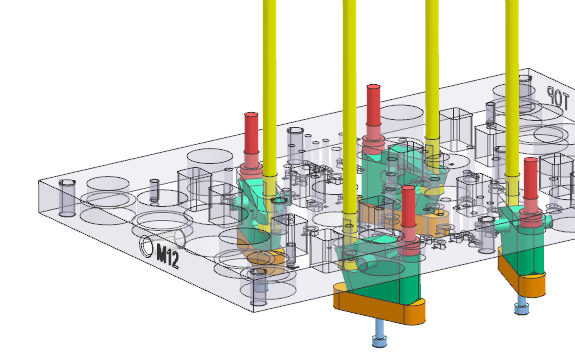
This is a common solution for short-stroke acceleration.
A lever mechanism is mounted in the ejector system. A pivot pin connects the lever and controls its movement.
The lever converts ejector plate movement into a larger movement of the selected ejector pin.
For this type of mechanism, a 5–10 mm acceleration stroke is usually a practical range.
The rotation angle should also be controlled.
As a general design guideline, it is better to keep the rotation angle below 20°.
A larger angle can increase:
- Contact stress
- Friction
- Wear
- Pin load
- Movement instability
Make the Pivot Pin Strong Enough
The pivot pin is one of the most important parts of a lever-type accelerated ejector.
If the pin is too small, long-term use can cause:
- Wear
- Excessive clearance
- Lever movement
- Reduced ejection accuracy
When space allows, the pivot pin should be as large as practical.
The pin and its mounting hole should also have suitable clearance and good wear resistance.
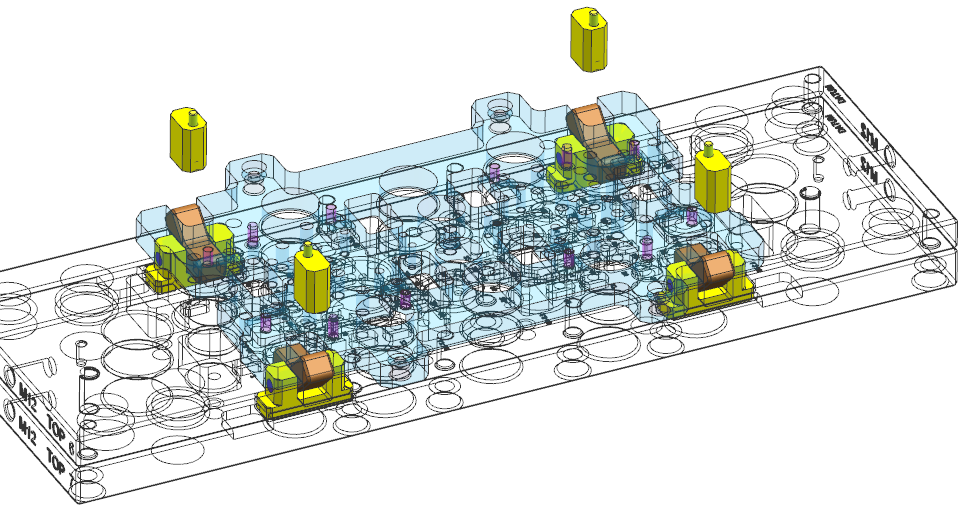
Method 2: Accelerating an Independent Ejector Plate
Another design uses the accelerated mechanism to drive a separate ejector plate.
This method is useful when multiple ejector pins need to accelerate together.
Instead of accelerating one pin, the mechanism moves a group of pins at the same time.
This design can achieve an acceleration stroke of 15 mm or more, depending on the mold structure.
Typical applications include:
- Multiple pins requiring synchronized acceleration
- Large local ejection areas
- Parts that need to release quickly from the core
- Applications where normal ejector plate travel is not enough
This design can provide more stable force distribution and reduce the need for multiple individual acceleration mechanisms.
3. Do Not Make the Stroke Too Large
A larger acceleration stroke is not always better.
For a lever-type mechanism, a larger stroke means a larger rotation angle.
This can increase:
- Friction
- Pivot pin wear
- Lever load
- Contact stress
- Movement instability
Therefore, a standard lever-type accelerated ejector is better suited to short-stroke applications.
If a larger acceleration stroke is required, an independent accelerated ejector plate is usually a better solution than simply increasing the lever angle.
4. Material and Wear Resistance Matter
An accelerated ejector is simple, but it is still a moving load-bearing mechanism.
Special attention should be given to:
- Pivot pins
- Levers
- Sliding surfaces
- Ejector pins
- Ejector plate interfaces
The pivot pin is especially important.
Good wear resistance helps maintain the original clearance and movement accuracy during long-term production.
For production molds, the material and heat treatment should be selected according to the actual load and service requirements.
5. Key Design Points
Ensure Sufficient Rigidity
The lever, pivot pin, and mounting area must withstand the ejection load.
A weak structure can cause deflection, wear, or unstable movement.
Check for Interference
The design should be checked throughout the full movement range.
Pay attention to:
- Maximum rotation angle
- Lever movement path
- Ejector plate position
- Available mold space
- Nearby ejector pins and screws
The mechanism must not interfere with other mold components at full stroke.
Provide Proper Lubrication
The pivot and sliding surfaces need proper lubrication.
Poor lubrication can increase friction and wear and may eventually cause sticking.
Check the Return Movement
The accelerated mechanism must return smoothly after ejection.
The ejector pins and plates should fully return to their original positions before the next molding cycle.
6. Why Use an Accelerated Ejector?
The biggest advantages are low cost, simple structure, and easy maintenance.
Unlike hydraulic or pneumatic systems, a mechanical accelerated ejector does not require additional hydraulic circuits, air lines, or complicated controls.
For molds that only need several millimeters of additional ejection movement, a mechanical solution is often enough.
If the requirement is simply:
“Make this group of ejector pins move faster than the normal ejection system.”
A mechanical accelerated ejector can often solve the problem with a much simpler design.
Conclusion
An accelerated ejector is a simple and cost-effective solution for local fast ejection.
For short strokes around 5–10 mm, a lever-type accelerated ejector is often suitable. The pivot pin should be strong and wear-resistant, and the rotation angle should generally stay below 20°.
For larger strokes or multiple ejector pins, an accelerated ejector plate can be used. Depending on the mold structure, the acceleration stroke can reach 15 mm or more.
The goal is not to maximize the stroke.
The goal is to choose the right mechanism for the required ejection movement.
When designing an accelerated ejector, pay close attention to stroke, rotation angle, pivot pin size, material, rigidity, lubrication, and return movement.
At Fentormold, ejection systems are designed according to the part structure, demolding requirements, and production conditions. From standard ejector pins and sleeves to lifters and accelerated ejection systems, the right solution can help achieve reliable molding performance while keeping mold costs under control.