
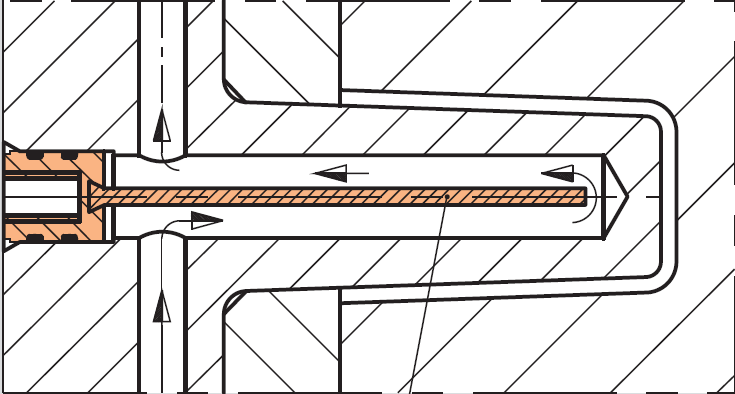
Cooling is one of the most important parts of injection mold design. When a mold has deep cores, narrow inserts, or areas that are difficult to reach with conventional cooling channels, a baffle vs bubbler injection mold solution may be considered.
Both baffles and bubblers improve cooling in restricted areas. However, they work in different ways. A baffle divides a cooling passage and changes the direction of water flow. By contrast, a bubbler uses a tube to direct cooling water into a deeper section of the mold.
Therefore, the right choice depends on mold geometry, available space, water flow, cooling requirements, and production cycle.
What Is a Baffle in an Injection Mold?
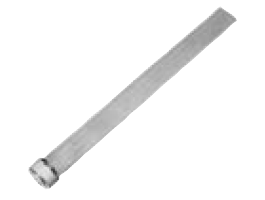
A baffle divides the cooling channel and redirects water flow through the injection mold core.
A baffle is an insert installed inside a cooling channel to divide the passage into two flow paths. Cooling water travels down one side of the channel, changes direction at the end of the baffle, and then returns through the other side.
A typical flow path is:
Cooling inlet → Baffle channel → Change of direction → Return channel → Cooling outlet
Baffles are useful when a long or narrow mold core cannot accommodate two separate cooling channels.
Instead of allowing water to follow the easiest path, the baffle forces it to circulate through the intended cooling area.
How Does a Baffle Work?
The baffle separates the incoming and outgoing water.
For example, a long core may contain one drilled cooling hole. A baffle can divide this hole into an inlet passage and a return passage.
Its cooling performance depends on:
- Cooling channel diameter
- Baffle thickness
- Baffle clearance
- Water flow rate
- Cooling channel length
- Mold steel
- Cooling water temperature
- Pressure loss
Therefore, a baffle should be designed together with the complete injection mold cooling circuit.
What Is a Bubbler in an Injection Mold?
A bubbler is a small tube installed inside a larger cooling channel. It is commonly used to bring cooling water into a deep or narrow area of a mold core.
Water flows through the bubbler tube and reaches the deeper section. Then, it exits the tube and returns through the space between the tube and the surrounding cooling channel.
The basic flow path is:
Cooling inlet → Bubbler tube → Deep core area → Return around tube → Cooling outlet
As a result, a bubbler is especially useful when a conventional cooling channel cannot get close enough to the area that needs cooling.
How Does a Bubbler Work?
The bubbler tube directs water toward the bottom or deeper section of the core.
After reaching the end of the tube, the water changes direction and flows back around the outside of the tube.
This creates circulation inside the deep cooling passage.
However, the clearance between the tube and the surrounding channel is important. If the passage is too restrictive, pressure loss can increase and water flow may become inadequate.
Baffle vs Bubbler Injection Mold: Key Differences
When comparing a baffle vs bubbler injection mold, the main difference is how cooling water is directed through the mold.
A baffle divides an existing cooling passage. A bubbler, however, uses an internal tube to direct water into a deep area and then returns it through the surrounding passage.
| Factor | Baffle | Bubbler |
|---|---|---|
| Basic structure | Flat or spiral insert | Tube inside cooling channel |
| Water flow | Divided flow path | Through tube and back around it |
| Typical application | Long or narrow areas | Deep cores and inserts |
| Installation | Relatively simple | Requires tube and fittings |
| Cooling direction | Redirects water inside channel | Directs water toward deep areas |
| Space requirement | Needs suitable channel space | Useful in deep, narrow cores |
| Maintenance | Relatively simple | Tube inspection may be required |
| Cost | Usually economical | Can be slightly higher |
| Main advantage | Simple flow division | Better access to deep areas |
Neither solution is automatically better. Instead, mold geometry should determine which cooling structure is more suitable.
Baffle vs Bubbler Injection Mold: Cooling Performance
Cooling performance is usually the most important factor in the baffle vs bubbler injection mold decision.
A well-designed baffle can cool a long and narrow area effectively because it forces water through the intended path.
A bubbler is often more useful when the cooling problem is concentrated at the bottom of a deep core.
For example, consider a tall cylindrical core. A conventional cooling channel may not reach close enough to the bottom. In this case, a bubbler can extend deeper and direct cooling water toward the hot area.
On the other hand, a long core with a suitable drilled passage may be better served by a baffle.
Therefore, the important question is not simply which component provides better cooling.
The better question is:
Which design places cooling water closest to the area that needs heat removal?
Baffle vs Bubbler Injection Mold for Deep Cores
Deep cores are a common application for bubblers.
For example, a tall core used to form a deep hole may retain heat after injection. If the core does not cool efficiently, the molding cycle may need to stay longer before ejection.
This can lead to:
- Longer cycle times
- Uneven shrinkage
- Dimensional variation
- Warpage
- Lower production efficiency
A bubbler can direct cooling water deeper into the core and improve heat transfer.
However, a baffle can also work well if the core has enough room for a divided cooling passage.
For deep cores, the baffle vs bubbler injection mold decision should be based on cooling distance, available space, and required water flow.
Therefore, the final choice should be based on actual core dimensions rather than choosing a bubbler simply because the core is deep.
Baffle vs Bubbler Injection Mold: Space Requirements
Available mold space is another important consideration.
A baffle requires enough room for the cooling channel and baffle insert. In addition, the designer must leave sufficient steel around the passage.
A bubbler requires an outer cooling channel and enough space for the internal tube.
The cooling layout also needs to avoid other mold components, including:
- Ejector pins
- Guide pins
- Screws
- Inserts
- Core features
- Cavity surfaces
- Mold plates
Therefore, cooling design should be reviewed before the mold structure is finalized.
For projects that require complete tooling design and manufacturing, Fentor Mold provides custom injection mold manufacturing from DFM review and mold design through machining, trial, and delivery.
Baffle vs Bubbler Injection Mold: Water Flow and Pressure Loss
A cooling system only works well when water can circulate at an appropriate flow rate.
Both baffles and bubblers can create pressure loss if they are designed incorrectly.
In a baffle vs bubbler injection mold design, pressure loss can directly affect cooling efficiency.
Common causes include:
- Cooling passages that are too small
- Insufficient baffle clearance
- Unsuitable bubbler tube diameter
- Excessively long cooling circuits
- Too many bends
- Restricted fittings
Therefore, a cooling channel should not be evaluated only by its diameter.
Instead, the designer should review the complete circuit, including inlet, outlet, flow direction, pressure loss, and number of circuits.
Baffle vs Bubbler Injection Mold: Machining and Installation
Baffles and bubblers also have different manufacturing requirements.
A baffle normally requires a drilled cooling passage and a suitable insert that divides the passage.
A bubbler requires a deeper cooling hole and an internal tube positioned correctly inside it.
The machining method for a baffle vs bubbler injection mold also depends on core depth, channel diameter, and installation space.
In both cases, installation must be reliable. Leakage or incorrect positioning can reduce cooling performance.
For complex tooling, cooling components also need to avoid ejector systems, inserts, guide components, and other mold features.
Baffle vs Bubbler Injection Mold: Maintenance
Cooling components may operate for thousands or millions of molding cycles. Therefore, maintenance should be considered during the initial design.
A baffle vs bubbler injection mold should also be designed with long-term cleaning and maintenance in mind.
For baffles, maintenance may include checking:
- Baffle condition
- Water passage blockage
- Corrosion
- Scale buildup
- Leakage
For bubblers, maintenance may also include checking:
- Tube condition
- Tube blockage
- Corrosion
- Leakage
- Tube position
Water quality is another important factor.
Mineral deposits, rust, and contamination can gradually reduce the effective flow area. As a result, a mold that initially cooled well may show longer cycle times after extended production.
Baffle vs Bubbler Injection Mold: Cost Comparison
A baffle is often an economical cooling solution because its structure is relatively simple.
A bubbler may require additional components and more careful installation. Therefore, its initial cost can be slightly higher.
However, comparing only component price can be misleading.
For example, suppose a bubbler improves cooling in a deep core and reduces cooling time by several seconds. In high-volume production, those cycle-time savings may be much greater than the extra tooling cost.
Therefore, buyers should compare:
- Initial mold cost
- Cooling performance
- Cycle time
- Maintenance
- Part quality
- Production volume
The cheapest cooling component is not always the most economical solution for the complete project.
Baffle vs Bubbler Injection Mold: Effect on Cycle Time
Cooling often accounts for a large part of the injection molding cycle.
After filling and packing, the molded part must remain in the mold until it becomes rigid enough for ejection.
If one core remains much hotter than the surrounding mold, the total cooling time may need to increase.
A properly designed baffle or bubbler can help remove heat from these difficult areas.
However, the actual cycle-time improvement depends on:
- Plastic material
- Part thickness
- Mold temperature
- Cooling water temperature
- Water flow
- Overall mold design
Therefore, the cooling component alone does not guarantee a shorter cycle.
If the mold will remain with the supplier for volume production, cooling performance should also be reviewed together with the planned injection molding production process.
Common Cooling Design Mistakes
Using the Same Cooling Solution Everywhere
Different areas of an injection mold may require different cooling methods.
For example, a flat cavity may work well with conventional channels. A deep core may require a bubbler, while another narrow area may be better suited to a baffle.
Using one cooling method throughout the entire mold can create unnecessary complexity or poor cooling performance.
Placing Cooling Channels Too Far From the Cavity
A cooling channel that is too far from the molding surface may not remove heat efficiently.
However, moving a channel too close to the cavity can weaken the mold structure.
Therefore, the designer needs to balance cooling performance with mold strength.
Ignoring Water Flow
A cooling channel can be positioned correctly but still perform poorly if water flow is insufficient.
As a result, flow rate and pressure loss should be considered during the design stage.
Creating Uneven Cooling
The goal is not simply to make the mold colder.
Instead, the goal is to remove heat consistently from the areas that need it.
Uneven cooling can contribute to:
- Warpage
- Sink marks
- Dimensional variation
- Longer cycle times
- Surface defects
For more information, see our Injection Mold Cooling System Design guide.
How to Choose Between a Baffle and a Bubbler
The choice between a baffle and a bubbler should start with mold geometry.
Choose a baffle when:
- The cooling area is long and relatively narrow
- A divided cooling passage is practical
- There is enough room for the baffle
- A simple cooling structure is preferred
- Water flow can be maintained effectively
Choose a bubbler when:
- The core is deep
- Cooling needs to reach a specific deep area
- A conventional straight channel cannot provide enough coverage
- Available space is narrow
- The cooling circuit can accommodate the bubbler tube
In some molds, both methods can be used.
For example, conventional cooling channels may handle the cavity, baffles may cool long narrow cores, and bubblers may cool deeper inserts.
This combined approach can provide better temperature control than trying to use only one cooling method.
Baffle vs Bubbler Injection Mold: Which One Should You Choose?
There is no universal winner in the baffle vs bubbler injection mold comparison.
A baffle is generally a practical choice when the goal is to divide and redirect water through a suitable cooling passage.
By contrast, a bubbler is often more suitable when cooling water must reach a deep core or restricted area.
Before making the decision, review:
- Core and cavity geometry
- Available cooling space
- Required water flow
- Expected cycle time
- Plastic material
- Part dimensional requirements
- Mold maintenance
- Production volume
Most importantly, the cooling system should be designed as part of the complete mold. It should not be added only after the main mold structure has already been completed.
Frequently Asked Questions
What is the difference between a baffle and a bubbler?
A baffle divides a cooling channel and changes the direction of water flow. A bubbler uses a tube to direct water into a deeper section before it returns through the surrounding passage.
Is a bubbler better than a baffle for deep cores?
A bubbler is often suitable for deep cores because it can direct cooling water toward the bottom. However, the final choice depends on core geometry, available space, water flow, and required cooling performance.
Are baffles cheaper than bubblers?
Baffles are often simpler and can have a lower initial cost. However, total mold cost also depends on machining, cooling circuit design, components, and installation.
Can an injection mold use both baffles and bubblers?
Yes. Conventional cooling channels, baffles, and bubblers can all be used in the same mold. Different cooling structures can be selected for different areas.
Can baffles and bubblers reduce molding cycle time?
Yes, when they improve heat removal from difficult areas. However, the actual improvement depends on mold design, plastic material, part geometry, water flow, and processing conditions.
Final Takeaway
The baffle vs bubbler injection mold decision should be based on the actual cooling problem, not simply on which component costs less.
A baffle is a practical choice for dividing and redirecting water through a long or narrow cooling passage.
A bubbler is often more suitable for deep cores and restricted areas where conventional cooling channels cannot reach effectively.
For complex injection molds, the best solution may combine conventional cooling channels, baffles, and bubblers.
The goal is simple: remove heat evenly, maintain stable mold temperatures, reduce unnecessary cooling time, and keep the mold reliable throughout production.
Fentor Mold can review the part structure, mold layout, and cooling requirements during DFM and mold design to determine which cooling method is more suitable for the project.