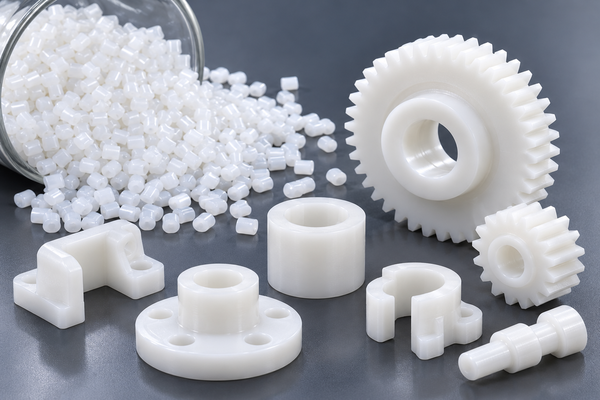
Choosing the right plastic for a precision part is not only about strength. You also need to consider wear, friction, moisture, creep, and dimensional stability. Delrin material properties make this engineering plastic a common choice for gears, bushings, clips, sliding parts, and other precision components.
Delrin is an acetal homopolymer, also called POM-H. It offers high stiffness, low friction, good wear resistance, and low moisture absorption. Because of these features, Delrin can often replace metal or other engineering plastics in mechanical parts.
However, Delrin is not suitable for every product. Temperature, chemicals, tolerances, wall thickness, and mold design still matter.
At Fentor Mold, we review both material performance and part design before tooling. This helps reduce warpage, wear, and dimensional problems during production.
What Are the Main Delrin Material Properties?
The most important Delrin material properties are linked to strength, wear, friction, and dimensional control.
| Property | Benefit for Precision Parts |
|---|---|
| High stiffness | Helps the part keep its shape |
| Good strength | Suitable for mechanical loads |
| Low moisture absorption | Improves dimensional stability |
| Low friction | Good for sliding and rotating parts |
| Good wear resistance | Helps extend service life |
| Good fatigue resistance | Suitable for repeated movement |
| Low creep | Helps maintain shape under load |
| Good machinability | Useful for prototypes |
| Good moldability | Suitable for injection molding |
These properties make Delrin useful for many mechanical plastic parts.
It can work well in gears, guides, bushings, fasteners, rollers, and moving components.
Delrin Material Properties for Dimensional Stability
Dimensional stability is one of the main reasons engineers choose Delrin.
Some plastics absorb moisture from the air. When this happens, their size can change.
Nylon is a common example. It can absorb more moisture than Delrin. As a result, dimensions may change after molding.
Delrin has much lower moisture absorption. Therefore, the part size is usually more stable when humidity changes.
This is useful for:
- Precision gears
- Bushings
- Sliding blocks
- Mechanical guides
- Valve parts
- Small housings
- Precision assemblies
For parts with tight fits, better dimensional stability can reduce assembly problems.
Delrin Material Properties for Strength and Stiffness
Another important feature is stiffness.
Delrin is relatively stiff even without glass fiber. Therefore, it can support many mechanical applications while keeping a smooth surface.
This can be useful when the part needs:
- Good shape retention
- Stable dimensions
- Good surface quality
- Low friction
- Controlled wear
However, the material alone cannot solve every design problem.
A very thin wall can still bend. A long unsupported section can also deform.
Therefore, good part design is still necessary.
Ribs, wall thickness, radii, and support points should all be reviewed before tooling.
Delrin Material Properties for Wear and Friction
Low friction is one of the best-known Delrin material properties.
This makes Delrin useful for parts that slide or rotate.
Common examples include:
- Gears
- Bearings
- Rollers
- Bushings
- Sliding rails
- Actuators
- Conveyor parts
- Adjustment mechanisms
Low friction can reduce resistance between moving parts. Good wear resistance can also help improve service life.
However, wear does not depend on material alone.
Load, speed, temperature, lubrication, and surface finish also matter.
For critical parts, actual working conditions should always be tested.
Delrin Material Properties for Repeated Movement
Many precision parts move again and again during use.
For example:
- Gear teeth rotate many times
- Clips open and close
- Latches move repeatedly
- Mechanical parts slide back and forth
These parts need more than basic tensile strength.
They also need good fatigue resistance.
Delrin performs well in many repeated-motion applications. This is one reason it is often used in gears, clips, and mechanical mechanisms.
Still, the part design is important.
Sharp corners should be avoided. Large radii can reduce stress at the root of a feature.
This helps improve part life.
Delrin Material Properties and Creep Resistance
Creep happens when plastic slowly changes shape under a constant load.
This can be a problem in precision parts.
For example, a loaded boss may deform over time. A support may slowly move. A clamping feature may also lose force.
Delrin has good creep resistance compared with many general-purpose plastics.
Therefore, it can be useful when a part must keep its shape under a long-term load.
However, temperature has a strong effect.
As temperature rises, creep can increase.
Because of this, engineers should review both load and working temperature before selecting the final Delrin grade.
Typical Delrin Material Properties
Exact values depend on the grade.
However, typical Delrin grades usually offer the following characteristics:
| Characteristic | General Performance |
|---|---|
| Density | About 1.4 g/cm³ |
| Stiffness | High |
| Tensile strength | High |
| Moisture absorption | Low |
| Friction | Low |
| Wear resistance | Good |
| Fatigue resistance | Good |
| Dimensional stability | Very good |
| Machining | Good |
| Injection molding | Suitable |
Different grades can also provide special features.
Some grades are designed for:
- Lower friction
- Higher wear resistance
- Food contact
- Medical use
- UV resistance
- Lower emissions
- Special mechanical performance
Therefore, the drawing should not only say “Delrin.”
The exact grade should be confirmed before mold manufacturing.
Delrin Material Properties vs POM-C
Delrin and POM are often treated as the same material, but that is not fully correct.
Delrin is a POM homopolymer, also called POM-H.
POM-C is an acetal copolymer.
Both materials are widely used in precision plastic parts.
| Requirement | Delrin / POM-H | POM-C |
|---|---|---|
| Stiffness | Very good | Good |
| Strength | Very good | Good |
| Fatigue resistance | Very good | Good |
| Creep resistance | Very good | Good |
| Dimensional stability | Very good | Very good |
| Chemical resistance | Good | Often better in some chemicals |
| Wear performance | Very good | Good |
| Precision parts | Very suitable | Very suitable |
In many cases, Delrin offers higher stiffness and fatigue strength.
However, POM-C may be better in some chemical environments.
Therefore, the final choice should depend on the actual application.
Delrin Material Properties vs Nylon
Delrin and nylon are both common engineering plastics.
However, their behavior is different.
One important difference is moisture absorption.
Nylon can absorb more moisture. This can change its dimensions and mechanical performance.
Delrin absorbs less moisture. Therefore, it is often easier to control dimensions.
Delrin may be a better choice for:
- Precision gears
- Sliding parts
- Mechanical guides
- Dimension-sensitive components
- Parts used in changing humidity
Nylon may still be better when other properties are more important.
For example, some nylon grades offer better heat resistance or impact performance.
So the final choice should always match the real working conditions.
Precision Parts That Benefit From Delrin Material Properties
Many precision parts can benefit from Delrin material properties.
Precision Gears
Gears need accurate teeth and stable dimensions.
They also need low friction and good wear resistance.
For these reasons, Delrin is commonly used for plastic gears.
Bushings and Bearings
Bushings and bearings often need low friction.
Delrin can work well in many sliding applications.
However, load, speed, heat, and lubrication still need to be checked.
Clips and Snap-Fit Parts
Some Delrin grades work well for clips and repeated assembly features.
The design still needs proper radii and controlled strain.
Sliding Parts
Mechanical guides and sliding blocks need smooth movement.
Delrin’s low friction can help reduce resistance.
Precision Industrial Components
Delrin can also be used for:
- Fasteners
- Valve parts
- Conveyor parts
- Rollers
- Guides
- Small mechanical housings
If your project needs custom precision components, our components manufacturing service can support machining, tooling, molding, and inspection.
Injection Molding and Delrin Material Properties
Good Delrin material properties do not automatically guarantee a good molded part.
The molding process is also important.
POM is a crystalline plastic. Therefore, shrinkage control is important.
Final dimensions can be affected by:
- Mold temperature
- Melt temperature
- Packing pressure
- Packing time
- Gate size
- Gate location
- Cooling balance
- Wall thickness
- Mold shrinkage allowance
For precision parts, process stability is very important.
If molding conditions change, shrinkage can also change.
This can cause dimensional variation.
For production projects, our injection molding production service includes mold trials, process adjustment, dimensional inspection, and production validation.
Gate Design for Delrin Precision Parts
Gate design affects both filling and final dimensions.
If the gate is too small, it may freeze too early.
Then the cavity may not receive enough packing pressure.
This can increase shrinkage variation.
A poor gate position can also create:
- Weld lines
- Uneven packing
- Warpage
- Flow marks
- Dimensional differences
Therefore, gate design should match the part geometry.
For multi-cavity molds, balanced filling is even more important.
Each cavity should fill and pack in a similar way.
Wall Thickness and Delrin Material Properties
Uniform wall thickness helps improve molding stability.
Large thickness changes can cause uneven cooling.
This can lead to:
- Warpage
- Sink marks
- Internal stress
- Different shrinkage
- Poor dimensional control
Instead of making a section very thick, ribs can often improve stiffness.
However, ribs also need proper dimensions.
If the ribs are too thick, sink marks may appear on the opposite surface.
Good DFM review can reduce these risks before mold manufacturing.
Our custom injection mold manufacturing service includes DFM review before steel cutting.
Machining Delrin vs Injection Molding
Delrin can also be CNC machined.
This is useful for prototypes and low-volume production.
CNC Machining Is Useful When:
- Quantity is low
- The design is still changing
- Tooling cost should be avoided
- Fast prototypes are needed
- The shape is easy to machine
Injection Molding Is Better When:
- Quantity is higher
- Lower unit cost is needed
- The part has complex molded features
- Repeatability is important
- Stable mass production is required
However, machined Delrin and molded Delrin may not behave exactly the same.
The stress, material orientation, and shrinkage can be different.
Therefore, final production dimensions should normally be checked with molded samples.
Limitations of Delrin Material Properties
Delrin has many advantages, but it also has limits.
Chemical Limits
Delrin is not suitable for every chemical.
Strong acids and strong bases can damage POM.
Chemical compatibility should be checked before production.
High Temperature
Delrin is not a high-temperature plastic like PEEK.
If the part works at high temperature for a long time, another material may be better.
Hot Water and Steam
Long exposure to hot water or steam can be a problem in some Delrin applications.
The exact grade and working conditions should be checked.
Flame Requirements
Standard Delrin grades may not meet strict flame-retardant requirements.
If the project requires a specific UL rating, the exact resin grade must be confirmed.
When Do Delrin Material Properties Make Sense?
Delrin is worth considering when a part needs several of these features:
- High dimensional stability
- Good stiffness
- Low moisture absorption
- Low friction
- Good wear resistance
- Good fatigue life
- Low creep
- Repeated movement
- Accurate molded dimensions
For example, a precision gear can benefit from many of these features at the same time.
A sliding part may also benefit from low friction and wear resistance.
However, the application should always come first.
Do not choose Delrin only because it is a well-known engineering plastic.
Questions to Ask Before Choosing Delrin
Before choosing Delrin, check the following:
- What is the working temperature?
- Is the load continuous?
- Does the part move repeatedly?
- What chemicals contact the part?
- What tolerances are required?
- Does the part slide against metal or plastic?
- Is lubrication used?
- Is food, medical, or automotive certification required?
- What is the production quantity?
- Will the part be machined or injection molded?
These questions help determine whether Delrin, POM-C, nylon, PBT, or another plastic is more suitable.
Final Thoughts on Delrin Material Properties
Delrin material properties make it a strong option for many precision plastic parts.
Its main advantages include good stiffness, low friction, wear resistance, low moisture absorption, fatigue resistance, and dimensional stability.
These features are useful for gears, bushings, clips, sliding parts, guides, and other mechanical components.
However, material selection is only one part of the project.
Wall thickness, ribs, gate design, shrinkage, cooling, and molding conditions also affect the final result.
Fentor Mold supports customers from DFM and material review through mold manufacturing, mold trials, dimensional inspection, and production.
By checking the material and tooling together, many dimensional and molding problems can be reduced before mass production.