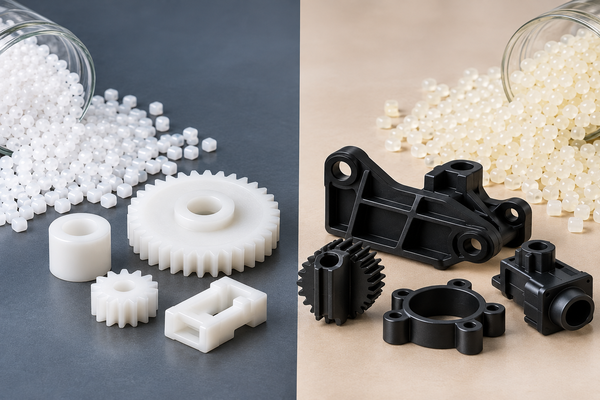
Choosing between Delrin vs Nylon is common when designing injection molded mechanical parts. Both materials offer good strength, wear resistance, and durability. However, they behave very differently when exposed to moisture, friction, heat, and mechanical loads.
Delrin is often selected when dimensional stability and low friction are important. Nylon, on the other hand, usually provides better toughness and resistance to repeated impact.
Therefore, the better material depends on how the molded part will work in the final application.
This guide compares Delrin and Nylon for injection molded parts and explains when each material may be the better choice.
What Is Delrin?
Delrin is a well-known acetal material based on POM, or polyoxymethylene. It is widely used for precision mechanical components because it combines stiffness, low friction, good wear resistance, and strong dimensional stability.
Common injection molded Delrin parts include:
- Gears
- Bearings
- Bushings
- Clips
- Sliding components
- Automotive mechanical parts
- Precision housings
- Small structural components
One major advantage of Delrin is its low moisture absorption. As a result, molded dimensions remain relatively stable even when humidity changes.
In addition, the material has a smooth surface and naturally low friction. Therefore, it works well in moving or sliding assemblies.
What Is Nylon?
Nylon belongs to the polyamide family. The most common grades used in injection molding include PA6 and PA66.
Nylon offers strong mechanical performance, especially when the molded part must withstand impact, repeated loading, vibration, or elevated temperatures.
Typical nylon injection molded parts include:
- Automotive brackets
- Clips and fasteners
- Electrical components
- Mechanical housings
- Gears
- Structural parts
- Under-hood automotive components
- Industrial machine parts
Nylon can also be reinforced with glass fiber. For example, PA66 GF30 contains about 30% glass fiber and offers much higher stiffness and strength than unfilled nylon.
However, nylon absorbs moisture more easily than Delrin. This can change dimensions and mechanical properties over time.
Delrin vs Nylon: Main Differences
Although both materials are engineering plastics, their properties are not identical.
| Property | Delrin | Nylon |
|---|---|---|
| Stiffness | High | Medium to high |
| Wear resistance | Excellent | Very good |
| Friction | Low | Low to moderate |
| Moisture absorption | Very low | Relatively high |
| Dimensional stability | Excellent | Moderate |
| Impact resistance | Good | Excellent |
| Heat resistance | Moderate | Good to high |
| Chemical resistance | Good | Good |
| Glass fiber reinforcement | Less common | Very common |
| Injection molding difficulty | Moderate | Moderate |
| Typical cost | Moderate | Moderate |
Therefore, the application environment should guide the material selection rather than strength alone.
Delrin vs Nylon for Wear Resistance
Wear resistance is one of the most important factors when comparing Delrin vs Nylon.
Delrin performs especially well in sliding applications. Its low coefficient of friction helps reduce wear between moving surfaces.
For this reason, manufacturers often use Delrin for:
- Sliding guides
- Gears
- Bushings
- Rollers
- Mechanical linkages
Delrin can sometimes operate without additional lubrication, depending on the load and operating conditions.
Nylon also provides good wear resistance. However, its performance can change after absorbing moisture.
Moisture may soften nylon slightly. In some applications, this can improve toughness. However, it may also change dimensions or friction characteristics.
Therefore, for precision sliding parts, Delrin often provides more predictable long-term performance.
Delrin vs Nylon for Strength
The answer depends on what type of strength the application requires.
Delrin provides high stiffness and good tensile strength. Therefore, it works well for parts that must maintain their shape under mechanical loads.
Nylon is generally tougher. It can absorb more impact energy before breaking.
As a result, nylon may perform better for:
- Snap-fit features
- Repeated impact
- Flexible clips
- Vibration-loaded components
- Structural automotive parts
Glass-fiber-reinforced nylon increases strength further.
For example, a glass-filled PA66 component can provide significantly higher stiffness than standard unfilled nylon. Therefore, reinforced nylon is commonly used to replace certain metal components.
However, glass fiber also makes the material more abrasive during injection molding. Mold steel, gates, runners, and screws may need additional wear protection.
For projects involving demanding engineering plastics, careful injection mold design and manufacturing can help reduce tooling wear and dimensional problems.
Moisture Absorption Is a Major Difference
Moisture is one of the biggest differences in the Delrin vs Nylon comparison.
Nylon is hygroscopic. In simple terms, it absorbs moisture from the surrounding environment.
After molding, nylon parts may gradually absorb water from the air. Consequently, several properties may change:
- Dimensions may increase slightly
- Stiffness may decrease
- Toughness may increase
- Electrical properties may change
- Mechanical tolerances may shift
This behavior must be considered during product design.
Delrin absorbs much less moisture. Therefore, it provides better dimensional stability in environments where humidity changes frequently.
For precision components with tight tolerances, this difference can be critical.
Delrin vs Nylon for Dimensional Stability
Delrin generally provides better dimensional stability.
Because it absorbs little moisture, part dimensions remain more consistent after molding.
This makes Delrin suitable for:
- Precision gears
- Moving mechanical assemblies
- Tight-fit components
- Measuring equipment parts
- Components requiring consistent clearances
Nylon requires more consideration.
For example, a nylon part may meet the drawing immediately after molding but change slightly after moisture conditioning.
Therefore, engineers should define whether dimensions should be inspected in the dry-as-molded condition or after moisture conditioning.
This is especially important for precision injection molded components.
At Fentor Mold, dimensional control starts with mold design, shrinkage evaluation, machining accuracy, and controlled injection molding production.
Which Material Has Better Friction Performance?
Delrin usually has an advantage in low-friction applications.
The surface of Delrin is naturally smooth, which reduces resistance between moving parts.
Therefore, it is commonly used for:
- Mechanical gears
- Sliding blocks
- Bearings
- Conveyor components
- Guide rails
- Moving assemblies
Nylon can also perform well, particularly when lubricated or modified with additives.
However, if stable friction and precise motion are the main requirements, Delrin is often easier to control.
Heat Resistance: Delrin vs Nylon
Nylon normally offers better performance at higher temperatures, especially reinforced PA66 grades.
This is one reason nylon is widely used in automotive engine compartments and other hot environments.
Glass-filled nylon can maintain useful mechanical strength at temperatures where many standard plastics become too soft.
Delrin also performs well across normal engineering temperatures. However, its long-term high-temperature capability is usually more limited.
Therefore, nylon may be the better option when the molded component is located near:
- Engines
- Motors
- Electrical systems
- Heating equipment
- Industrial machinery
Material datasheets should always be checked against the actual continuous operating temperature.
Chemical Resistance
Both Delrin and Nylon offer useful chemical resistance, but the exact performance depends on the chemical environment.
Delrin generally resists:
- Fuels
- Oils
- Many solvents
- Greases
- Weak chemicals
Nylon also resists many oils, fuels, and industrial chemicals.
However, water and humidity have a much stronger effect on nylon.
Therefore, when chemical exposure is combined with tight dimensional requirements, Delrin may offer an advantage.
For critical applications, actual chemical compatibility testing is recommended before final production.
Injection Molding Delrin
Delrin requires good control during injection molding.
Because POM is sensitive to excessive heat, processors must avoid overheating the resin.
Important molding factors include:
- Melt temperature
- Mold temperature
- Residence time
- Injection speed
- Holding pressure
- Venting
Poor processing can create burning, gas, or material degradation.
Good mold venting is especially important.
Gate design also needs attention because Delrin can shrink significantly during cooling. Proper holding pressure helps reduce voids and dimensional variation.
For complex molded components, a proper DFM review before tooling can prevent many production problems.
Injection Molding Nylon
Nylon requires different processing control.
The biggest concern is moisture.
Nylon pellets normally need proper drying before injection molding. If the material contains too much moisture, defects may appear.
Common problems include:
- Silver streaks
- Surface marks
- Bubbles
- Weak mechanical properties
- Poor dimensional consistency
Therefore, material drying should follow the resin supplier’s recommendations.
Mold temperature is also important. A higher mold temperature can improve crystallinity, surface quality, and mechanical performance.
However, cooling time may increase.
For companies requiring both tooling and production support, combining mold development with plastic injection molding production can make process adjustment easier.
Delrin vs Nylon Cost
Material price depends on the exact resin grade, supplier, reinforcement, additives, and purchasing volume.
Standard nylon grades can be economical for many mechanical applications.
However, specialty grades can become much more expensive.
Examples include:
- Glass-filled nylon
- Flame-retardant nylon
- Heat-stabilized nylon
- Impact-modified nylon
Delrin also sits in the engineering plastic category, so it normally costs more than commodity plastics such as PP or PE.
However, raw material price should not be the only comparison.
A slightly more expensive resin may reduce:
- Part failure
- Assembly problems
- Dimensional variation
- Lubrication requirements
- Maintenance costs
Therefore, the total product cost matters more than resin price alone.
When Should You Choose Delrin?
Delrin may be a better choice when the application requires:
- High dimensional stability
- Low moisture absorption
- Low friction
- Good wear resistance
- Precise tolerances
- Smooth mechanical movement
- High stiffness
Typical examples include gears, bushings, sliders, rollers, and precision mechanical components.
When Should You Choose Nylon?
Nylon may be more suitable when the application requires:
- High toughness
- Strong impact resistance
- Higher temperature resistance
- Flexible snap features
- Glass fiber reinforcement
- Strong structural performance
- Resistance to vibration
Typical examples include automotive brackets, clips, electrical components, structural housings, and machine parts.
Delrin vs Nylon for Precision Injection Molded Parts
For precision molding, material selection affects both the part and the mold.
Delrin provides strong dimensional stability. However, shrinkage and mold temperature still need careful control.
Nylon requires more attention to moisture conditioning and shrinkage.
Glass-filled nylon introduces another challenge because the fibers can increase tooling wear.
Therefore, the mold manufacturer should understand the material before mold steel, gate location, cooling, draft angles, and tolerances are finalized.
Fentor Mold provides custom injection mold manufacturing, plastic parts production, and components manufacturing for engineering plastic components.
You can also visit the Fentor Mold homepage to learn more about our tooling and manufacturing capabilities.
Final Thoughts
There is no single winner in the Delrin vs Nylon comparison.
Delrin usually performs better when low friction, wear resistance, precision, and dimensional stability are the main priorities.
Nylon is often stronger in applications that require impact resistance, toughness, heat resistance, or glass fiber reinforcement.
Therefore, the right choice depends on the working environment, load, temperature, humidity, tolerance, and expected service life.
Before making the final material decision, engineers should evaluate both material properties and injection molding requirements. Doing this early can reduce mold changes, part failures, and unnecessary production costs.