
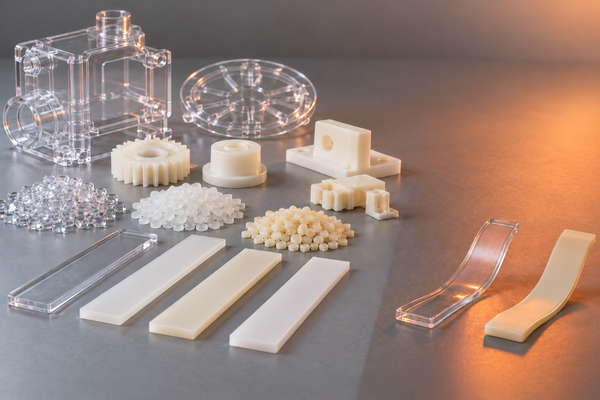
The glass transition temperature of polymers is an important material property in injection molding. It affects stiffness, heat resistance, dimensional stability, part performance, and material selection.
Glass transition temperature is usually written as Tg.
Below Tg, many plastics are harder and more rigid. As temperature rises above Tg, the polymer chains gain more movement. As a result, the material becomes softer and more flexible.
This does not mean the plastic has melted.
That difference is very important.
At Fentor Mold, we review material temperature limits together with part design and molding requirements before tooling. This helps avoid problems such as softening, warpage, poor dimensional stability, and material failure during use.
What Is the Glass Transition Temperature of Polymers?
The glass transition temperature of polymers is the temperature range where an amorphous region changes from a hard, glass-like state to a softer, rubber-like state.
It is not normally one exact temperature.
Instead, the change happens over a range.
Below Tg, molecular movement is limited. Therefore, the plastic is usually more rigid.
Above Tg, the molecular chains move more easily. As a result, stiffness can drop quickly.
This can affect:
- Strength
- Stiffness
- Creep
- Dimensional stability
- Impact behavior
- Heat resistance
That is why Tg matters in both product design and injection molding.
Glass Transition Temperature of Polymers vs Melting Point
The glass transition temperature of polymers is not the same as melting point.
This is one of the most common misunderstandings.
Glass Transition Temperature
Tg mainly describes changes in the amorphous regions of a polymer.
The material becomes softer, but it does not become a fully flowing melt.
Melting Temperature
Melting temperature, or Tm, relates to crystalline regions.
At Tm, these crystalline structures break down and the material becomes molten.
This difference is especially important when comparing amorphous and semi-crystalline plastics.
Why the Glass Transition Temperature of Polymers Matters in Injection Molding
The glass transition temperature of polymers affects both processing and final part performance.
Engineers need to understand Tg because it helps answer several questions:
- Will the part stay rigid at the working temperature?
- Will the plastic soften during use?
- Can the mold temperature affect surface quality?
- Will the part warp after molding?
- Is the material suitable for the final environment?
A material may mold well but still fail in service if its Tg is too close to the product’s working temperature.
Glass Transition Temperature of Polymers and Part Stiffness
One of the biggest effects of Tg is stiffness.
Below Tg, an amorphous plastic is usually much stiffer.
As temperature rises toward Tg, stiffness begins to drop.
Above Tg, the material can become much softer.
For example, a plastic housing may feel rigid at room temperature.
However, if it is used near a motor or heating element, the temperature may rise.
If the working temperature gets too close to Tg, the part may:
- Bend
- Deform
- Lose dimensional accuracy
- Creep under load
Therefore, room-temperature strength alone is not enough.
Glass Transition Temperature of Polymers and Heat Resistance
The glass transition temperature of polymers is closely related to heat performance.
However, Tg is not the same as the maximum service temperature.
Other factors also matter, such as:
- Load
- Exposure time
- Part thickness
- Material grade
- Reinforcement
- Heat aging
- Chemical exposure
Still, Tg gives engineers a useful reference.
A material with a higher Tg usually keeps stiffness better at higher temperatures.
This is one reason PC is often selected instead of ABS for higher-temperature parts.
Glass Transition Temperature of Polymers and Mold Temperature
Tg also helps explain why mold temperature matters.
During injection molding, hot plastic enters the cavity.
Then it cools against the mold surface.
For amorphous plastics, the material becomes rigid as it cools below its Tg region.
Therefore, mold temperature can affect:
- Surface appearance
- Residual stress
- Weld lines
- Shrinkage
- Warpage
- Cycle time
A very cold mold can freeze the surface too quickly.
This may create poor gloss or high internal stress.
A warmer mold can improve surface replication and reduce some stress.
However, cycle time may increase.
Glass Transition Temperature of Polymers and Service Temperature
The glass transition temperature of polymers is very important when selecting plastics for hot environments.
For example, a part may work well at 25°C.
But what happens at 80°C or 100°C?
If the working temperature approaches Tg, mechanical properties can change.
This can lead to:
- Higher creep
- Lower stiffness
- Greater deflection
- Dimensional change
- Assembly problems
Therefore, engineers should always compare service temperature with Tg.
A safety margin is normally needed.
Typical Glass Transition Temperature of Common Polymers
The values below are only general references.
Exact Tg depends on the material grade and test method.
| Polymer | Typical Tg |
|---|---|
| ABS | Around 100–110°C |
| Polycarbonate (PC) | Around 145–150°C |
| PMMA | Around 100–110°C |
| Polystyrene (PS) | Around 95–105°C |
| PVC | Around 80°C |
| PEEK | Around 140–145°C |
| PET | Around 70–80°C |
| Nylon 6 | Around 45–60°C |
| Nylon 66 | Around 45–60°C |
| POM | Around -60°C |
These values should not be used as final design data.
Always check the exact supplier datasheet.
Glass Transition Temperature of Polymers: ABS
ABS is an amorphous engineering plastic.
Its Tg is typically around 105°C.
This helps explain why ABS remains stiff at room temperature but loses stiffness as temperature rises.
ABS is commonly used for:
- Appliance housings
- Automotive interiors
- Electronic covers
- Consumer products
However, standard ABS may not be suitable for long-term high-temperature use.
Heat-resistant ABS grades are available when better thermal performance is needed.
Glass Transition Temperature of Polymers: Polycarbonate
Polycarbonate has a much higher Tg than ABS.
Typical PC Tg is around 145–150°C.
This gives PC better heat resistance.
PC is often used for:
- Electrical housings
- Transparent covers
- Automotive parts
- Safety guards
- Lighting components
Its higher Tg is one reason PC can maintain stiffness at temperatures where ABS may soften more.
However, PC also needs higher processing temperatures.
Glass Transition Temperature of Polymers: PMMA
PMMA, also called acrylic, usually has a Tg around 100–110°C.
It offers excellent transparency.
However, it is more brittle than PC.
PMMA is commonly used for:
- Lenses
- Light covers
- Display parts
- Transparent housings
Because its Tg is close to ABS, engineers should still check service temperature carefully.
Glass Transition Temperature of Polymers: Nylon
Nylon behaves differently from ABS or PC because it is semi-crystalline.
Its Tg is much lower.
For many nylon grades, Tg is around 45–60°C.
However, nylon still performs well above Tg because crystalline regions continue to provide structure.
Moisture also affects nylon strongly.
As nylon absorbs moisture:
- Tg can decrease
- Stiffness can decrease
- Toughness can increase
Therefore, conditioning has a major effect on nylon performance.
Glass Transition Temperature of Polymers: POM
POM has a very low Tg, often around -60°C.
However, POM is a semi-crystalline polymer.
Its crystalline structure gives it good stiffness and dimensional stability even above Tg.
This is why POM can still perform well at normal room temperature.
It is commonly used for:
- Gears
- Bushings
- Sliding parts
- Precision mechanical components
This example shows why Tg should not be used alone to judge a material.
Amorphous vs Semi-Crystalline Polymers
Understanding the glass transition temperature of polymers becomes easier when materials are divided into two groups.
Amorphous Plastics
Examples include:
- ABS
- PC
- PMMA
- PS
These materials do not have a true crystalline melting point.
They soften gradually as temperature increases.
Tg is especially important for their mechanical behavior.
Semi-Crystalline Plastics
Examples include:
- PP
- PE
- PA
- POM
- PBT
These materials have both amorphous and crystalline regions.
Therefore, they have both:
- Tg
- Tm
Their crystalline regions help maintain structure above Tg.
What Happens Above the Glass Transition Temperature of Polymers?
When a polymer moves above Tg, several changes may occur.
Stiffness Drops
The material becomes softer.
Creep Increases
The part deforms more easily under constant load.
Deflection Increases
Flat or unsupported areas may bend more.
Dimensional Stability Decreases
Critical dimensions may become less stable.
Vibration Behavior Changes
The material may absorb vibration differently.
This is important for automotive and industrial products.
Glass Transition Temperature of Polymers and Creep
Creep is strongly affected by temperature.
A plastic part under constant load may look stable at room temperature.
However, when the temperature rises closer to Tg, creep can increase quickly.
Examples include:
- Shelves
- Brackets
- Clips
- Structural housings
- Mounting supports
This is why high-temperature load testing is important.
A part that passes a room-temperature load test may still fail in real use.
Glass Transition Temperature of Polymers and Warpage
Tg can also affect warpage.
During molding, different areas of the part cool at different speeds.
As the material cools through its transition region, internal stress can develop.
If cooling is uneven, the part may warp.
Common causes include:
- Uneven wall thickness
- Poor cooling layout
- Different mold surface temperatures
- Unbalanced filling
- Uneven packing
Good mold design is therefore essential.
Our injection mold manufacturing service includes DFM review before steel cutting.
Glass Transition Temperature of Polymers and Residual Stress
Residual stress can remain inside a molded part after ejection.
This is common in amorphous plastics such as PC and PMMA.
High residual stress can cause:
- Cracking
- Warpage
- Stress whitening
- Chemical stress cracking
- Dimensional change
A suitable mold temperature can help reduce residual stress.
So can proper gate design and balanced filling.
Glass Transition Temperature of Polymers and Cooling Time
Cooling time also depends on material behavior.
The molded part must become rigid enough before ejection.
For amorphous materials, this means cooling sufficiently below the softening region.
If the part is ejected too hot, it may:
- Deform
- Stick
- Mark
- Warp
However, excessive cooling increases cycle time.
Therefore, the goal is not simply to cool as much as possible.
The goal is stable ejection with consistent dimensions.
Glass Transition Temperature of Polymers and Material Selection
The glass transition temperature of polymers should be checked early in a project.
This is especially important when the product is exposed to heat.
Before selecting a plastic, ask:
- What is the normal working temperature?
- What is the maximum short-term temperature?
- Is the part under load?
- Is the load continuous?
- Does the part need tight tolerances?
- Will the part be used outdoors?
- Is creep important?
- Does the part require high impact resistance?
These questions help narrow the material options.
Why Tg Alone Is Not Enough
Tg is important, but it cannot tell you everything.
A material with a high Tg is not automatically the best choice.
Engineers must also review:
- Tensile strength
- Flexural modulus
- Impact strength
- Creep
- Chemical resistance
- Moisture absorption
- UV resistance
- Cost
- Moldability
For example, PC has a higher Tg than ABS.
However, ABS may still be the better choice for a low-cost appearance housing.
The final decision should match the application.
Glass Transition Temperature of Polymers and Injection Molding Defects
Tg can help explain some molding problems.
| Defect | Possible Relationship |
|---|---|
| Warpage | Uneven cooling and stress |
| Stress cracking | High residual stress |
| Poor gloss | Mold surface freezes too quickly |
| Deformation | Part ejected too hot |
| Dimensional change | Insufficient cooling |
| Creep in use | Working temperature too close to Tg |
However, defects should never be blamed on Tg alone.
Gate design, cooling, packing, and wall thickness also matter.
How Mold Engineers Use Glass Transition Temperature
Mold engineers use Tg as one part of the overall material review.
It can help guide:
- Mold temperature
- Cooling time
- Material selection
- Ejection timing
- Part design
- Service-temperature evaluation
However, final settings still depend on the exact grade.
That is why resin datasheets are important.
For production projects, our injection molding production service includes mold trials, process optimization, and dimensional inspection before stable production.
When Should You Choose a Higher-Tg Polymer?
A higher-Tg material may be useful when the product has:
- Higher service temperature
- Continuous mechanical load
- Tight dimensional requirements
- High internal heat
- Hot environments
For example, a product working near 100°C may need a higher-Tg polymer than a part used only at room temperature.
However, higher-Tg materials can also be more expensive or harder to process.
So there is always a balance.
Final Thoughts on the Glass Transition Temperature of Polymers
The glass transition temperature of polymers is one of the most important thermal properties in plastic engineering.
It explains when a polymer begins to change from a rigid state to a softer state.
Tg affects:
- Stiffness
- Creep
- Heat resistance
- Dimensional stability
- Warpage
- Product performance
However, Tg is not the same as melting point.
This difference is especially important when comparing amorphous and semi-crystalline plastics.
For injection molding, Tg should be reviewed together with mold temperature, cooling, wall thickness, gate design, and final service conditions.
Fentor Mold supports customers from material selection and DFM through mold manufacturing, mold trials, and production.
By understanding the material before tooling starts, many heat-related and dimensional problems can be reduced before mass production.