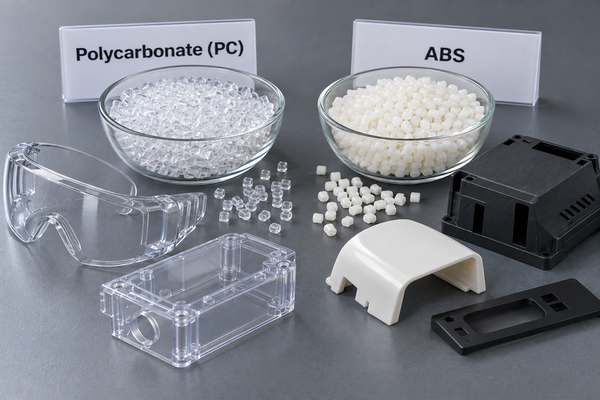
Choosing between polycarbonate vs ABS is common in injection molding projects. Both materials are widely used for housings, covers, mechanical parts, automotive components, and consumer products.
However, they perform differently.
Polycarbonate, also called PC, is known for high impact strength, heat resistance, and transparency. ABS is easier to process, offers good surface appearance, and usually has a lower material cost.
So, which one should you choose?
The answer depends on the part requirements. Strength, temperature, surface quality, molding difficulty, cost, and production volume all matter.
At Fentor Mold, we normally review the material together with the product design before tooling. This helps avoid using an expensive material where it is not needed or selecting a low-cost material that cannot meet the final application.
Polycarbonate vs ABS: What Is the Main Difference?
The main difference between polycarbonate vs ABS is their balance of strength, heat resistance, appearance, and cost.
PC is a high-performance engineering plastic. It offers excellent impact resistance and good heat resistance. Many PC grades also provide transparency. Covestro describes polycarbonate as highly impact resistant, dimensionally stable, and heat resistant, with some grades offering glass transition temperatures up to about 148°C.
ABS is also an engineering thermoplastic, but it is usually easier to mold and more cost-effective.
ABS is widely used when a product needs:
- Good appearance
- Good impact strength
- Easy molding
- Stable dimensions
- Painting or plating
- Lower material cost
Therefore, PC is often selected for more demanding mechanical or thermal applications, while ABS is commonly chosen for general housings and appearance parts.
Polycarbonate vs ABS Strength Comparison
Strength is one of the biggest differences between these materials.
Polycarbonate Strength
PC has very high impact resistance.
It can absorb significant impact without cracking. This makes it suitable for:
- Protective housings
- Safety components
- Electrical enclosures
- Automotive parts
- Transparent covers
- Mechanical guards
Some commercial PC injection molding grades have tensile modulus values around 2,200–2,400 MPa, although exact values vary by grade.
PC is also tough at lower temperatures.
Therefore, it is often chosen when impact performance is a major design requirement.
ABS Strength
ABS also has good impact resistance.
However, standard ABS normally cannot match the impact performance of PC.
For many housings and general plastic parts, ABS is still strong enough.
That is why the decision should not be based on which material is stronger.
The real question is:
How much strength does the product actually need?
If normal ABS already meets the requirement, using PC may add unnecessary material and molding cost.
Polycarbonate vs ABS Heat Resistance
Heat resistance is another important difference in polycarbonate vs ABS.
PC generally performs better at elevated temperatures.
This is useful for products near:
- Motors
- Electronics
- Lighting
- Batteries
- Heating components
- Vehicle interiors
- Electrical systems
Polycarbonate can maintain mechanical performance at higher temperatures than many standard ABS grades. Covestro lists good heat resistance as one of the core advantages of its Makrolon polycarbonate range.
ABS is suitable for many normal indoor applications.
However, if the product sees higher continuous temperatures, heat-resistant ABS or PC may be required.
Therefore, designers should always check the actual working temperature.
Do not choose a material based only on room-temperature data.
Polycarbonate vs ABS Injection Molding Temperature
PC normally requires a higher processing temperature than ABS.
Typical PC injection molding melt temperatures are often around:
- 280–320°C, depending on grade
ABS is normally processed at lower temperatures, often around:
- 220–260°C, depending on grade
The exact setting must always come from the resin supplier’s datasheet.
Higher PC processing temperatures create several challenges.
For example:
- More energy is required
- Material degradation risk increases
- Machine control becomes more important
- Mold temperature may need to be higher
- Drying becomes more critical
Therefore, ABS is generally easier to process.
Polycarbonate vs ABS Drying Requirements
Both materials should be properly stored and dried.
However, PC is especially sensitive to moisture.
If wet PC enters the barrel at high processing temperature, moisture can cause hydrolysis.
This may lead to:
- Reduced strength
- Silver streaks
- Surface defects
- Brittleness
- Poor appearance
For this reason, PC drying control is very important.
ABS can also develop splay and surface problems if moisture is present.
Still, PC normally requires stricter moisture control.
This is one reason why PC injection molding can be more demanding.
Polycarbonate vs ABS Cost Comparison
Cost is one of the strongest reasons manufacturers choose ABS.
In general, standard ABS is less expensive than PC.
However, raw material price is only one part of total cost.
You should also consider:
- Drying time
- Molding temperature
- Cycle time
- Machine size
- Mold temperature
- Scrap rate
- Production volume
- Required surface treatment
- Product failure risk
PC may cost more, but it can still be economical if its extra performance allows a thinner or more durable product.
ABS may be cheaper, but it is not a saving if the part fails because of heat or impact.
Therefore, compare the total project cost instead of only resin price.
Polycarbonate vs ABS Surface Quality
ABS is often preferred for appearance parts.
It can provide a clean molded surface and works well with many secondary finishing processes.
Common ABS surface options include:
- Painting
- Plating
- Printing
- Texture
- High gloss
- Laser marking
For automotive interiors, appliances, and consumer housings, this is a major advantage.
PC can also achieve good surfaces.
However, visible stress, flow marks, or internal stress can become more noticeable if the molding process is not well controlled.
Therefore, PC may require more careful gate design and process optimization.
Polycarbonate vs ABS Transparency
This is one area where the difference is very clear.
Standard ABS is opaque.
PC can be transparent.
Covestro notes that polycarbonate is widely used where glass-like transparency and impact resistance are required.
Transparent PC is commonly used for:
- Light covers
- Lenses
- Safety guards
- Transparent housings
- Display covers
- Lighting components
If transparency is required, standard ABS is normally not an option.
However, transparent PC molding also needs very good control of:
- Resin drying
- Mold polishing
- Flow marks
- Weld lines
- Gate position
- Internal stress
- Dust and contamination
Polycarbonate vs ABS Dimensional Stability
Both materials can produce dimensionally stable injection molded parts.
However, final dimensions still depend on:
- Mold temperature
- Packing pressure
- Wall thickness
- Gate position
- Cooling balance
- Part geometry
PC normally has relatively low molding shrinkage.
For example, some commercial PC grades list molding shrinkage around 0.5–0.8%, depending on grade and flow direction.
This can be useful for precision components.
However, low shrinkage does not mean zero warpage.
Uneven wall thickness or cooling can still distort the part.
ABS also offers good dimensional control for many general applications.
Therefore, mold design often matters more than a small difference in published shrinkage values.
Polycarbonate vs ABS for Impact-Resistant Parts
If impact resistance is the most important requirement, PC is usually the stronger candidate.
Examples include:
- Protective covers
- Machine guards
- Safety components
- Automotive impact areas
- Electronic housings
- Industrial equipment
PC can absorb high impact energy without breaking easily.
However, ABS still provides good toughness for many normal applications.
Therefore, do not automatically switch to PC.
First, define:
- Required impact level
- Working temperature
- Part thickness
- Drop height
- Product weight
- Impact direction
Testing the actual molded product is better than comparing only datasheets.
Polycarbonate vs ABS for Thin-Wall Parts
Thin-wall parts need good material flow.
ABS generally flows more easily than PC.
Therefore, ABS can be easier to use for:
- Thin housings
- Long flow paths
- Large cosmetic parts
- Complex rib structures
PC has higher melt viscosity in many grades.
This can require:
- Higher melt temperature
- Higher injection pressure
- Larger gates
- Better venting
- Careful wall thickness control
However, high-flow PC grades are also available.
The exact grade should match the part geometry.
Polycarbonate vs ABS for Large Plastic Parts
Large parts often create longer flow paths and higher warpage risk.
ABS can be a practical choice because it is easier to process.
It is commonly used for:
- Appliance housings
- Equipment covers
- Automotive interior parts
- Large electronic housings
PC may be selected when impact or heat resistance is more important.
However, molding a large PC part may require:
- Higher clamp force
- Higher injection pressure
- Better mold temperature control
- Larger gates
- Careful stress management
For large parts, DFM and Moldflow analysis can help identify filling and warpage risks before tooling.
Our injection mold manufacturing service includes DFM review before mold manufacturing.
Polycarbonate vs ABS Chemical Resistance
Neither material is resistant to every chemical.
PC can be sensitive to some solvents and chemicals.
Chemical attack may cause:
- Stress cracking
- Surface whitening
- Cracking
- Loss of strength
ABS can also be damaged by some solvents.
Therefore, chemical resistance should always be checked for the actual operating environment.
This is especially important for:
- Medical products
- Cleaning equipment
- Automotive parts
- Industrial equipment
- Consumer products exposed to alcohol or cleaners
A material that performs well mechanically may still fail chemically.
Polycarbonate vs ABS UV Resistance
Standard ABS is not normally the best choice for long-term outdoor use.
UV exposure can cause:
- Color fading
- Surface degradation
- Brittleness
Standard PC can also degrade under UV exposure.
However, UV-stabilized PC grades are widely available.
Covestro, for example, offers UV-stabilized polycarbonate grades for injection molding applications.
For outdoor products, designers should specify a UV-stabilized grade instead of assuming standard PC or ABS will be sufficient.
Polycarbonate vs ABS Flame Resistance
Electrical products often require flame-retardant materials.
Both PC and ABS families include flame-retardant grades.
However, PC-based materials are very common in electrical and electronic applications because they can combine:
- Heat resistance
- Impact strength
- Dimensional stability
- Flame performance
The exact UL rating