
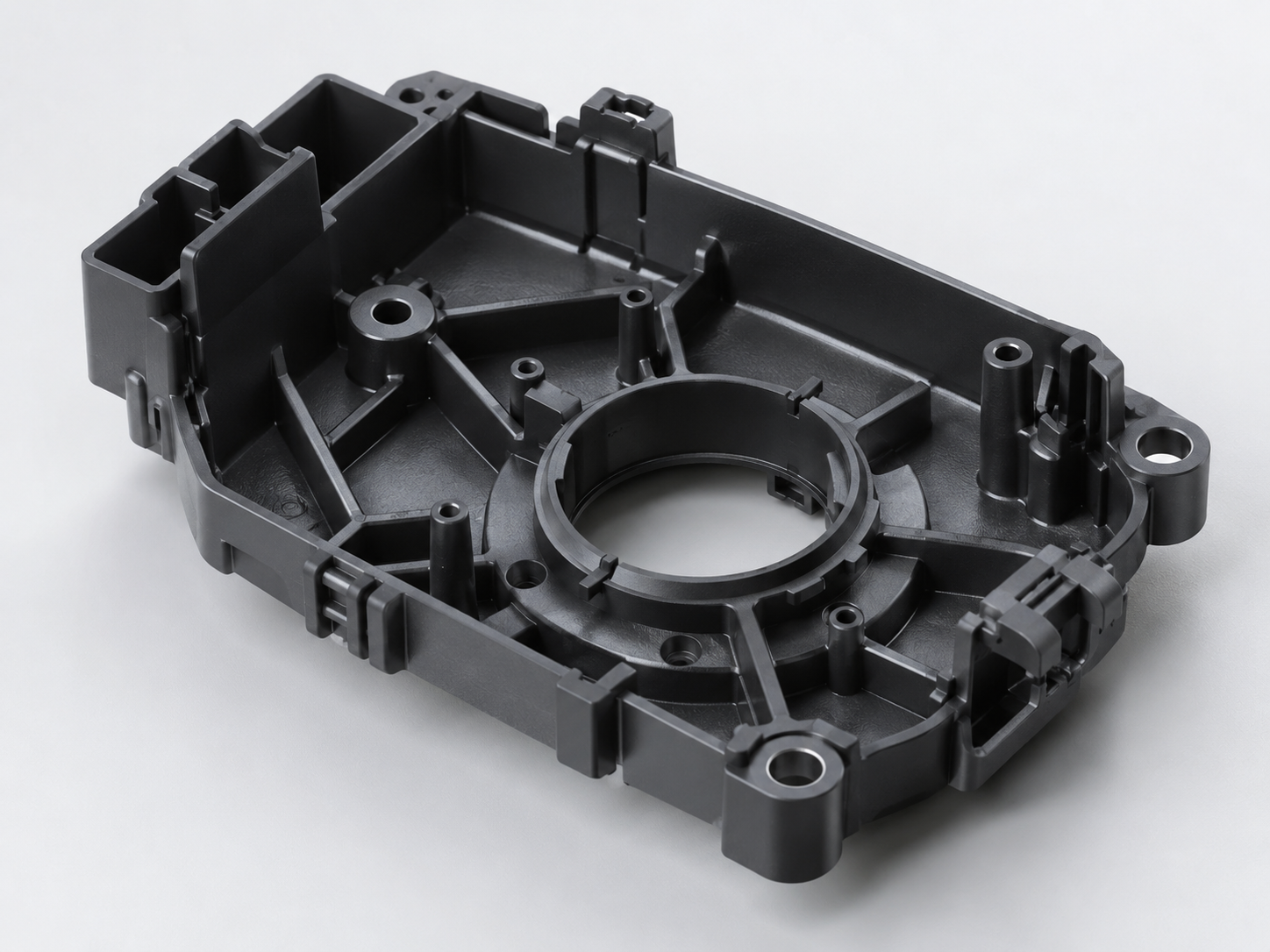
High precision injection molding is used when plastic parts need tighter dimensional control, stable assembly, and consistent performance across production batches. It is common in connectors, sensor housings, medical device parts, automotive components, gears, and other functional plastic products.
However, part accuracy does not depend on the injection molding machine alone. Mold accuracy, material shrinkage, gate location, cooling balance, process stability, and inspection methods all affect the final dimensions.
Therefore, improving precision requires control from mold design through mass production.
What Is High Precision Injection Molding?
High precision injection molding is the production of plastic parts with carefully controlled dimensions, geometry, and repeatability.
The required tolerance depends on the part size, material, structure, and function. For example, a small connector housing may require much tighter control than a large cosmetic cover.
Typical precision requirements may include:
| Requirement | Typical Concern |
|---|---|
| Hole position | Assembly with pins or screws |
| Flatness | Sealing or mating surfaces |
| Concentricity | Rotating or cylindrical parts |
| Wall thickness | Strength and filling balance |
| Snap-fit position | Assembly performance |
| Insert position | Electrical or mechanical function |
| Overall dimensions | Product assembly |
For this reason, tolerance requirements should be defined before mold manufacturing begins.
At Fentor Mold, we normally review critical dimensions during DFM before starting the injection mold manufacturing process.
How Mold Accuracy Affects High Precision Injection Molding
The mold creates the basic geometry of the plastic part. Therefore, inaccurate mold components will directly affect molded part dimensions.
Several areas require special attention:
- Core and cavity dimensions
- Insert position
- Slider and lifter positioning
- Parting line matching
- Ejector pin position
- Shut-off surfaces
- Guide pin and bushing alignment
Precision machining is especially important for small features.
For example, if a cavity insert moves only 0.03 mm from its designed position, the final plastic feature may also move. In some assemblies, that difference can already create fit problems.
Therefore, high precision molds require stable CNC machining, EDM, wire cutting, grinding, and proper mold assembly.
Our precision component manufacturing supports mold inserts and components that require accurate machining and inspection.
Material Shrinkage Must Be Controlled
Plastic does not remain the same size after molding.
After filling the cavity, the material cools and shrinks. Different materials behave differently.
For example:
| Material | Dimensional Behavior |
|---|---|
| ABS | Relatively stable |
| PC | Low shrinkage but sensitive to stress |
| POM | Higher shrinkage and crystallinity |
| PA | Sensitive to moisture and temperature |
| PP | Higher shrinkage |
| PA+GF | Lower shrinkage but fiber orientation affects dimensions |
| PBT+GF | Good stability but flow direction matters |
Therefore, simply applying one shrinkage value to the entire part can cause dimensional errors.
For high precision injection molding, the engineering team should consider:
- Material grade
- Glass fiber percentage
- Flow direction
- Wall thickness
- Gate position
- Cooling rate
- Mold temperature
Moldflow analysis can help predict shrinkage trends before steel is cut.
However, simulation is still a prediction. Final dimensions must be confirmed through mold trials and actual measurements.
Gate Location Can Change Part Dimensions
Gate position affects how plastic enters the cavity.
If the gate location is poor, the part may experience uneven pressure, orientation, shrinkage, or warpage.
For example, imagine a long housing with a gate at only one end.
The area near the gate receives higher pressure. Meanwhile, the far end receives lower packing pressure. As a result, shrinkage may differ from one side to another.
Therefore, engineers should evaluate:
- Filling distance
- Flow balance
- Weld lines
- Packing pressure
- Fiber orientation
- Gate freeze time
For multi-cavity molds, runner balance becomes even more important.
If cavity filling is not balanced, different cavities may produce slightly different dimensions even when the molding parameters remain the same.
Cooling Is Critical for High Precision Injection Molding
Cooling often has a greater effect on dimensional stability than buyers expect.
Uneven cooling can cause:
- Warpage
- Twisting
- Flatness problems
- Local shrinkage
- Dimensional differences between cavities
For example, one side of a housing may cool faster because the cooling channel is closer to the cavity surface. The opposite side may remain hotter for longer.
When the part ejects, both sides shrink differently.
As a result, the part may bend.
Therefore, good cooling design should consider:
- Cooling channel position
- Cooling channel diameter
- Water flow
- Mold temperature
- Hot spots
- Inserts
- Sliders and lifters
In some difficult areas, beryllium copper inserts or dedicated cooling circuits may improve heat transfer.
However, the cooling design should support both part quality and long-term mold reliability.
Keep Injection Molding Parameters Stable
Even a highly accurate mold cannot produce stable parts if the molding process changes continuously.
Key parameters include:
- Melt temperature
- Mold temperature
- Injection speed
- Holding pressure
- Holding time
- Cooling time
- Back pressure
- Screw position
Therefore, once acceptable dimensions are achieved, the process should be recorded and controlled.
A stable process window is especially important for high precision injection molding.
For example, increasing holding pressure may reduce shrinkage. However, excessive pressure may increase stress, flash, or part weight.
That is why engineers should not adjust one parameter without checking its effect on other dimensions.
Our injection molding production process focuses on maintaining stable molding parameters after sample approval.
Control Mold Temperature Carefully
Mold temperature affects flow, shrinkage, crystallization, surface appearance, and final dimensions.
If the mold temperature changes significantly during production, part dimensions may also change.
This is especially important for:
- POM
- PA
- PBT
- PPS
- Glass-filled materials
- Engineering plastics
For example, if one production batch runs with a mold temperature of 70°C and another runs at 90°C, dimensions may not remain exactly the same.
Therefore, high precision parts should use controlled mold temperature rather than relying only on cooling water entering the mold.
Water temperature, flow rate, and pressure should also remain stable.
Avoid Ejecting the Part Too Early
Shorter cycle time reduces production cost.
However, reducing cooling time too much can damage dimensional stability.
If a part is still too hot when it leaves the mold, it can continue changing shape outside the cavity.
This often causes:
- Warpage
- Flatness problems
- Hole movement
- Rib deformation
- Local shrinkage
Therefore, the shortest cycle is not always the best cycle.
For high precision injection molding, the correct goal is a stable cycle that produces repeatable dimensions.
High Precision Injection Molding Needs Good Part Design
Part design also determines how difficult it is to maintain accuracy.
Several design features can create dimensional problems:
| Design Issue | Possible Result |
|---|---|
| Uneven wall thickness | Uneven shrinkage |
| Very thick bosses | Sink marks and dimensional change |
| Long unsupported walls | Warpage |
| Poor rib design | Local deformation |
| Large flat surfaces | Flatness problems |
| Sharp thickness transitions | Stress and shrinkage variation |
| Poor gate access | Filling imbalance |
Therefore, DFM should happen before mold manufacturing.
Sometimes a small design change can improve dimensional stability more effectively than repeated mold modifications later.
Measure Critical Dimensions Correctly
Inspection is another important part of high precision production.
Not every dimension needs the same inspection method.
Common inspection equipment includes:
- CMM
- Vision measuring systems
- Digital calipers
- Micrometers
- Height gauges
- Pin gauges
- Go/no-go gauges
- Custom checking fixtures
However, measurement conditions also matter.
Plastic parts may change dimensions with temperature or moisture. Therefore, parts should sometimes rest for a defined period before final inspection.
For moisture-sensitive materials such as PA, conditioning requirements should also be considered.
Use Cpk for Critical Production Dimensions
A few good samples do not prove that the production process is stable.
For important dimensions, manufacturers can use Cpk to evaluate process capability.
For example, if 30 measured parts all fall within tolerance but many values are very close to one specification limit, the process may still be risky.
A better process keeps the dimensional distribution centered and controlled.
Therefore, for critical production parts, engineers should consider:
- Sampling frequency
- Cpk requirements
- Cavity identification
- Measurement records
- Golden samples
- First article inspection
These controls help prevent dimensional drift during long production runs.
Do Not Make Every Dimension Extremely Tight
One common mistake is applying very tight tolerances to the entire drawing.
This increases mold cost and production difficulty without improving product function.
Instead, divide dimensions into categories:
| Dimension Type | Recommended Approach |
|---|---|
| Critical assembly dimensions | Tight control |
| Sealing dimensions | Tight control |
| Cosmetic dimensions | Control appearance first |
| Non-functional dimensions | Use normal tolerance |
| Reference dimensions | Avoid unnecessary inspection |
The best high precision injection molding project does not chase the smallest possible tolerance.
Instead, it controls the dimensions that actually affect product function.
How Fentor Mold Improves Part Accuracy
For precision molding projects, Fentor Mold focuses on the complete process rather than relying on mold machining alone.
The main steps include:
- Review critical dimensions during DFM.
- Evaluate shrinkage and gate position.
- Machine mold components accurately.
- Check core, cavity, sliders, and inserts.
- Optimize cooling and molding parameters.
- Measure T0 and T1 samples.
- Adjust the mold based on actual data.
- Confirm approved dimensions before production.
- Maintain stable molding conditions during mass production.
If dimensional problems appear during trials, we first identify whether the cause comes from the mold, plastic material, cooling, or molding parameters.
This approach reduces unnecessary steel modification and makes troubleshooting more efficient.
You can also review our injection mold case studies to see how different tooling and production challenges are handled.
Final Thoughts
High precision injection molding depends on more than a precision mold.
Mold machining, material shrinkage, cooling balance, gate design, molding parameters, part design, and inspection must work together.
Therefore, buyers should define critical dimensions early and discuss them with the mold manufacturer before tooling begins.
A well-designed mold combined with a stable molding process makes it easier to achieve accurate parts repeatedly—not only during the first mold trial, but also throughout mass production.