Choosing between injection molding companies is not only about price, machine size, or factory scale. One of the most important questions is whether the supplier is suitable for your actual production volume.
A company that works well for millions of simple parts may not be the best choice for a project that needs 20,000 precision parts per year. Likewise, a small molding shop may handle prototypes well but struggle when monthly demand increases quickly.
Therefore, buyers should compare supplier capacity with expected order volume, mold complexity, quality requirements, and future demand.
The right match can reduce cost, shorten communication, and make production much more stable.
Why Production Volume Matters When Comparing Injection Molding Companies
Different injection molding companies are built around different business models.
Some factories focus on very high-volume production. Their machines run continuously, automation is extensive, and large orders receive priority.
Others specialize in medium-volume custom molding, where customers need more engineering support, frequent mold changes, smaller batches, or several different products.
For buyers, bigger does not automatically mean better.
A supplier should have enough capacity for your project, but your order should also be important enough to receive proper attention.
For example:
| Annual Volume | Typical Requirement | Supplier Focus |
|---|---|---|
| 1,000–10,000 parts | Prototype or low-volume production | Flexibility and tooling cost |
| 10,000–100,000 parts | Small to medium production | Cost, quality and flexibility |
| 100,000–1,000,000 parts | Medium to high volume | Capacity and process stability |
| 1,000,000+ parts | Mass production | Automation and cycle efficiency |
These numbers are only general references. Part size, cycle time, cavity number, material, and quality requirements can completely change the actual production load.
Compare Injection Molding Companies by Real Machine Capacity
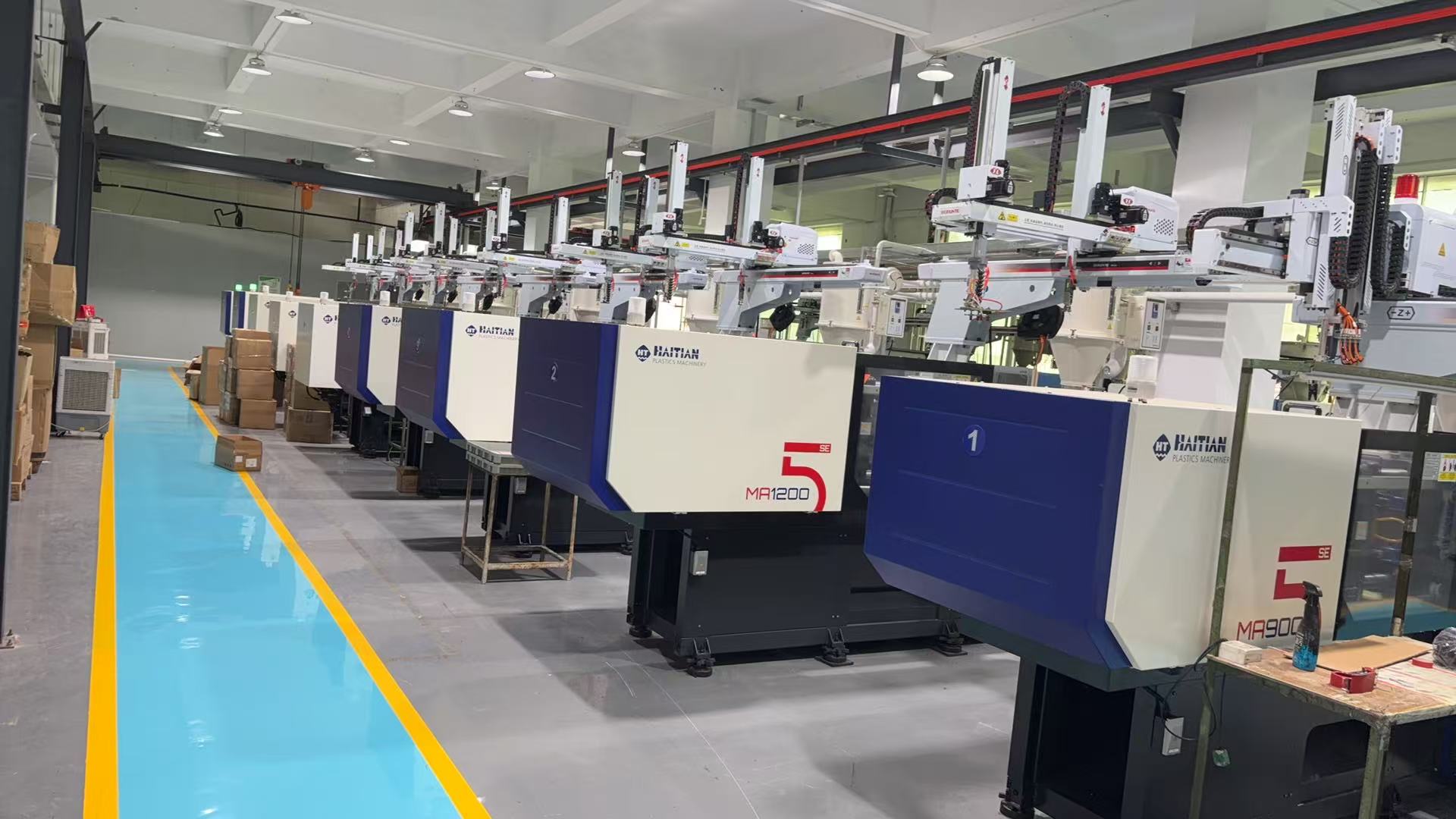
A factory may say it has 30 or 50 injection molding machines. However, the total machine count tells you very little about whether it can handle your project.
Instead, check the machine range.
A small connector may require a 100-ton machine, while a large housing may need 500 tons or more. Therefore, the supplier must have suitable machines available for your mold.
Buyers should check:
- Injection machine tonnage range
- Available machine capacity
- Maximum mold dimensions
- Shot size
- Machine age and condition
- Automatic production capability
- Number of machines suitable for your specific mold
For example, having twenty 120-ton machines does not help much if your mold requires a 500-ton machine.
This is why we recommend checking actual injection molding supplier capacity instead of simply asking how many machines the supplier owns.
Your Order Volume Should Fit the Supplier
Imagine a large injection molding company mainly producing millions of automotive components every month.
Your requirement is 30,000 parts per year.
Technically, the factory can manufacture them. However, your order may be very small compared with its normal projects. As a result, scheduling changes, engineering support, and small production adjustments may receive less attention.
The opposite situation can also create problems.
Suppose your annual requirement is two million parts, but the supplier has only a few molding machines. One machine breakdown or another urgent project could affect your delivery.
Therefore, the best supplier is usually not the largest one. It is the company whose normal project size matches your business.
At Fentor Mold, we look at expected production volume before planning the mold structure, cavity number, runner system, and production method. These decisions should match the real business requirement rather than simply making the mold more complicated.
How Injection Molding Companies Calculate Capacity
Production capacity depends on much more than machine quantity.
A simple way to estimate theoretical output is:
Parts per hour = 3600 ÷ cycle time × cavity number
For example, assume:
- Cycle time: 30 seconds
- Mold cavities: 4
- Production time: 20 hours per day
The theoretical daily output is:
3600 ÷ 30 × 4 × 20 = 9,600 parts
However, actual production will be lower.
Factories also need time for:
- Mold installation
- Material changes
- Color changes
- Machine maintenance
- Mold maintenance
- Quality inspection
- Production adjustments
- Unexpected downtime
Therefore, do not judge capacity only from theoretical numbers.
A good supplier should leave reasonable capacity for unexpected demand.
Compare Mold Capability, Not Only Molding Volume
When comparing injection molding companies, buyers sometimes focus too heavily on production.
However, the mold determines much of the future production stability.
If the supplier also builds molds, check whether it can properly handle:
- Mold design
- DFM analysis
- Moldflow analysis when needed
- CNC machining
- EDM
- Wire cutting
- Mold fitting
- Mold trials
- Engineering changes
- Mold maintenance
A supplier with strong tooling support can often react faster when a production mold develops a problem.
For projects that require both tooling and production, you can also compare whether mold making and injection molding should use one supplier.
This is especially useful for medium-volume projects because engineering changes are common during early production.
Check Whether Capacity Can Grow With Your Business
Today’s order may be 50,000 parts.
Next year’s order may be 300,000.
Therefore, buyers should not only ask:
“Can you produce my current quantity?”
Also ask:
“What happens if our volume increases three or five times?”
Reliable injection molding companies should have a reasonable plan for increasing output.
Possible solutions include:
- Adding production shifts
- Moving the mold to another suitable machine
- Increasing automation
- Improving cycle time
- Building a higher-cavity mold
- Adding another production mold
For example, a two-cavity mold may be enough during product launch. However, if demand becomes much higher, a second mold or higher-cavity tool may eventually provide better production security.
This planning is especially important for products with uncertain market demand.
Do Not Compare Injection Molding Companies by Price Alone
The lowest molding price can look attractive during supplier selection.
However, unit price is only one part of the real cost.
Suppose Supplier A quotes $0.42 per part while Supplier B quotes $0.46.
Supplier A appears cheaper.
But if Supplier A has overloaded machines, unstable quality, frequent delays, or poor mold maintenance, the additional cost can quickly exceed the four-cent difference.
Buyers should compare:
| Factor | What to Check |
|---|---|
| Tooling cost | Mold quality and expected life |
| Part price | Material, cycle and labor assumptions |
| Capacity | Available machines and production load |
| Quality | Inspection and process control |
| Lead time | Realistic production schedule |
| Engineering | Ability to solve molding problems |
| Communication | Response speed and project support |
| Backup plan | What happens if production stops |
The goal is not to find the cheapest supplier.
The goal is to find a supplier that can repeatedly deliver acceptable parts at a competitive total cost.
Quality Requirements Can Change the Right Supplier Volume
Two projects with the same annual quantity may require completely different manufacturing resources.
Consider two products.
Product A
- Simple PP cover
- Loose tolerances
- No cosmetic surface
- 500,000 parts per year
Product B
- Medical equipment housing
- Tight assembly requirements
- Strict appearance standard
- Lot traceability
- 100,000 parts per year
Product B has lower volume, but it may require more engineering, inspection, documentation, and process control.
Therefore, production quantity alone should never determine supplier selection.
This is also why buyers should provide drawings, material information, expected annual quantity, tolerance requirements, surface requirements, and application details when requesting quotations from injection molding companies.
Better information produces a more realistic quotation.
Ask About Current Production Load
There is a difference between maximum capacity and available capacity.
A factory may theoretically produce one million additional parts per month. However, if most machines are already booked for existing customers, your project may still face delays.
Ask practical questions:
- Which machine would run our mold?
- How many similar machines are available?
- What is the current machine loading?
- How many shifts do you normally operate?
- What happens if the assigned machine breaks down?
- Can another machine run the same mold?
- How quickly can you increase production?
These questions give a much clearer picture than asking only about annual factory capacity.
If supply security is especially important, it may also be useful to qualify a backup injection molding supplier before problems occur.
Engineering Support Is Important for Medium-Volume Buyers
Large-volume buyers often have strong internal engineering teams.
Smaller and medium-sized companies may depend more heavily on supplier support.
Therefore, when comparing injection molding companies, consider how much technical assistance you will actually receive.
Useful support can include:
- DFM review
- Gate position recommendations
- Mold structure review
- Material suggestions
- Moldflow analysis
- Trial feedback
- Dimensional problem analysis
- Molding defect troubleshooting
- Engineering changes
At Fentor Mold, mold making and production are supported by engineering, machining, quality, and molding teams. This allows problems found during mold trials or production to be discussed directly with the people responsible for the mold and process.
For many custom plastic projects, this communication is just as important as machine capacity.
A Practical Supplier Comparison
A simple supplier comparison can look like this:
| Supplier | Capacity Match | Tooling | Engineering | Price | Flexibility |
|---|---|---|---|---|---|
| Company A | Excellent | Good | Good | Medium | Good |
| Company B | Too large | Excellent | Limited attention | Low | Low |
| Company C | Too small | Good | Good | Medium | High |
| Company D | Good | Excellent | Excellent | Medium | Excellent |
Company B may have the largest factory.
Company C may offer the fastest initial response.
However, Company D may still be the better overall choice because its capacity, tooling ability, engineering support, and flexibility match the project.
That is the main idea buyers should remember.
Final Thoughts
There are thousands of injection molding companies, but not every capable factory is the right supplier for every project.
First, determine your expected annual volume. Then consider part size, cycle time, cavity number, quality requirements, mold complexity, and future growth.
After that, compare each supplier’s actual machine availability, tooling capability, engineering support, quality system, and production flexibility.
Most importantly, choose a supplier whose normal business fits your project.
A factory that is too small may struggle with capacity. A factory that is too large may not give a medium-sized project enough attention.
The best injection molding company is the one that has enough capacity to support your growth while still treating your project as an important part of its production schedule.
If you are evaluating tooling and plastic part production for a new project, Fentor Mold can review your drawings, expected volume, material, and production requirements before recommending a suitable tooling and molding solution.