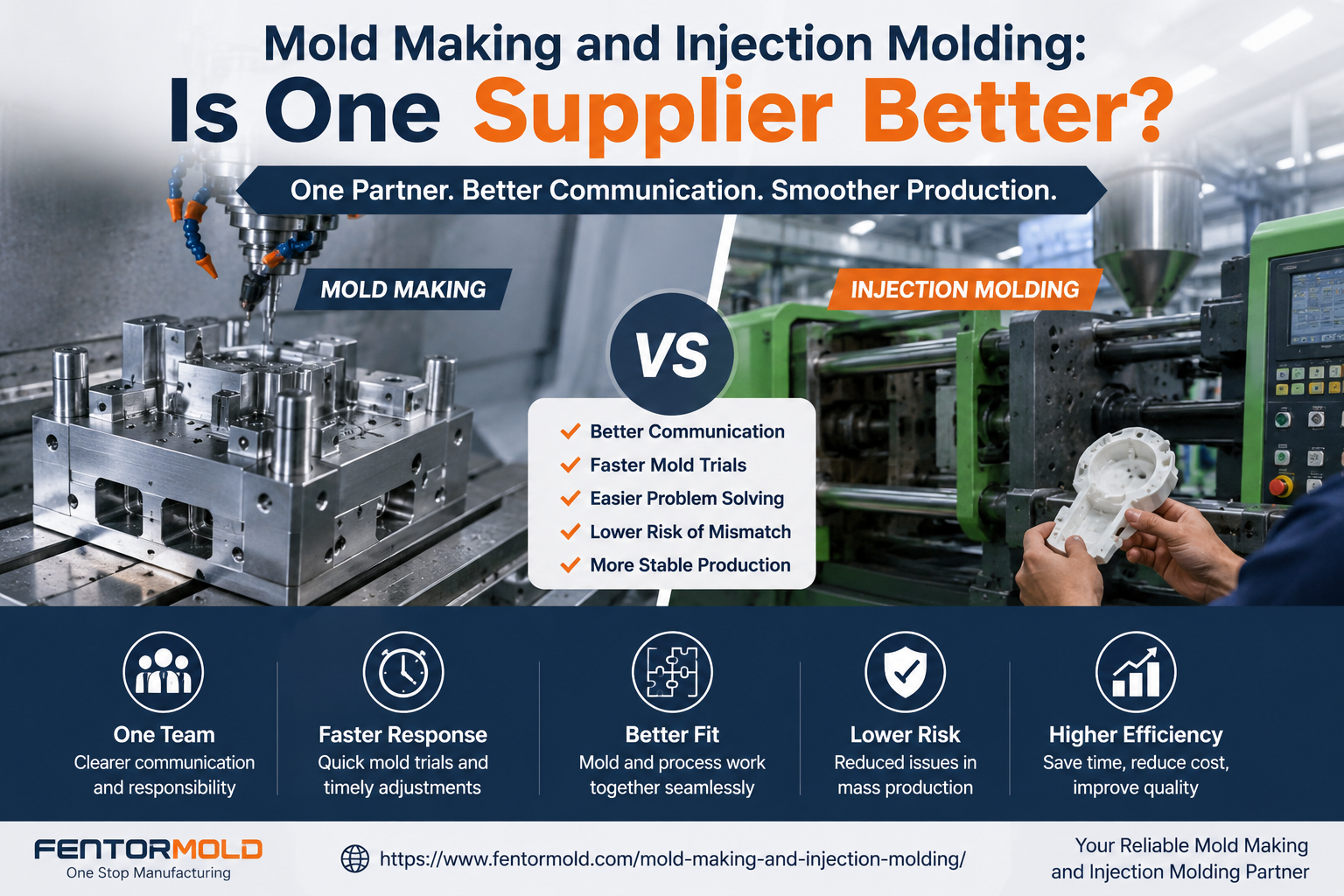
Mold making and injection molding are closely connected, but buyers still need to decide whether both stages should stay with one supplier or be handled by separate companies.
Using one supplier can simplify communication, mold trials, engineering changes, and production support. However, it is not automatically the best choice for every project. The right setup depends on the mold complexity, production volume, supplier capability, location, and how much control the buyer needs after the mold is completed.
The important question is not simply whether one supplier is more convenient. It is whether that supplier can handle both tooling and production well.
Why Mold Making and Injection Molding Are Closely Connected
A mold is not finished when machining ends.
Its real performance becomes clear during injection molding.
During mold trials, problems may appear in:
- Filling
- Venting
- Ejection
- Cooling
- Warpage
- Weld lines
- Flash
- Sink marks
- Gate appearance
- Cycle time
- Dimensional stability
Some problems come from the mold itself. Others come from molding parameters, material behavior, or a combination of both.
When mold making and injection molding are handled by the same supplier, the tooling team and molding team can review the problem together.
For example, if a part warps after molding, the cause may involve:
- Uneven cooling
- Gate position
- Part geometry
- Mold temperature
- Packing pressure
- Material shrinkage
A supplier that understands both sides can often identify the real cause faster.
How Mold Making and Injection Molding Reduce Communication Gaps
When mold making and injection molding are separated, communication usually becomes more complicated.
The mold maker may say:
The mold is correct. The molding parameters need adjustment.
The injection molding supplier may say:
The process is stable. The mold needs modification.
Meanwhile, the buyer has to coordinate between both companies.
This can slow down problem solving.
When one supplier manages both stages, there is usually one project team responsible for:
- Mold design
- Mold manufacturing
- T1 trial
- Measurement
- Mold modification
- Process adjustment
- Sample approval
- Production
This does not guarantee that every problem will be solved immediately, but responsibility is generally clearer.
At Fentormold, our injection mold manufacturing and injection molding production services can be connected within the same project, allowing tooling and production issues to be reviewed together.
Mold Making and Injection Molding Make Mold Trials Easier
Mold trials are one of the strongest reasons to keep mold making and injection molding with one supplier.
A new mold often needs several rounds of adjustment before reaching stable production.
T1 may reveal:
- Short shot
- Flash
- Poor venting
- Ejection marks
- Warpage
- Dimensional problems
- Cosmetic defects
After modification, T2 or T3 may be needed.
If the mold maker also operates injection molding machines, the mold can often be:
Modified → assembled → tested → measured → adjusted again
without being transported between different factories.
This shortens the feedback loop.
It also reduces the chance that process settings, machine conditions, or trial information are lost between suppliers.
For buyers who want a better understanding of this stage, our guide on injection mold trial process explains how tooling normally progresses from initial sampling toward stable production.
How Mold Making and Injection Molding Support Production Problems
A mold that runs well during T1 does not always remain problem-free during long-term production.
After thousands of cycles, small issues can become more obvious.
For example:
- Slider wear can increase flash
- Ejector wear can affect part release
- Venting may become blocked
- Cooling lines may lose efficiency
- Inserts may wear
- Part dimensions may slowly shift
When the production supplier also understands the mold structure, maintenance and repair can often be handled faster.
This is particularly useful for molds with:
- Sliders
- Lifters
- Inserts
- Hot runner systems
- Complex cooling
- Tight tolerance requirements
If a separate molding supplier has limited tooling capability, the mold may need to be sent back to the original mold maker whenever a significant issue appears.
That adds time and logistics.
One Supplier Can Simplify Project Responsibility
When one company handles both tooling and production, the buyer usually has one main point of contact.
That can simplify discussions about:
- Drawing changes
- Mold modification
- Sample problems
- Production scheduling
- Quality issues
- Mold maintenance
- Spare parts
This is especially useful for smaller project teams that do not want to coordinate several manufacturing suppliers.
However, buyers should still keep their own project records.
Even when mold making and injection molding stay with one supplier, you should retain:
- Mold drawings
- Product drawings
- Approved samples
- Material specifications
- Trial reports
- Mold modification records
- Process information
Good documentation protects the buyer if the production location changes later.
Our article on injection mold documentation explains the key files buyers should keep.
Does One Supplier Lower Mold Making and Injection Molding Costs?
Not necessarily.
Using one supplier may reduce:
- Mold transportation
- Repeated setup
- Communication time
- Trial coordination
- External repair costs
But buyers should still compare the full commercial package.
One supplier may offer an attractive mold price but a higher part price.
Another supplier may be strong in mold making but less competitive for large-volume production.
Therefore, compare:
- Tooling cost
- Part price
- Cycle time
- Scrap rate
- Mold maintenance
- Packaging
- Logistics
- Long-term production volume
The lowest mold price does not always create the lowest total project cost.
Likewise, the lowest piece price may not be attractive if mold support is slow or quality is unstable.
When Mold Making and Injection Molding Should Use Separate Suppliers
There are also situations where separating mold making and injection molding is reasonable.
Production Must Be Local
A buyer may build the mold in China but run production in the United States, Europe, Mexico, or another country.
In this case, the mold maker only needs to ensure the mold is fully tested and ready for transfer.
Very High Production Volume
A specialist mold maker may build the tooling, while a larger injection molding company handles continuous high-volume production.
The molding supplier may have better automation, capacity, assembly, or logistics for that specific program.
Existing Approved Molding Supplier
Some buyers already have a long-term production partner.
They only need another supplier to manufacture the mold.
In that situation, changing the molding supplier may create unnecessary risk.
Specialized Production Requirements
Some products require:
- Cleanroom molding
- Medical validation
- Special automation
- Two-shot molding
- Insert molding
- High-tonnage machines
- Special inspection systems
The mold maker may not have the required production environment.
In these cases, separate suppliers can be the better arrangement.
Risks of Separating Mold Making and Injection Molding
The biggest risk is not transportation.
It is unclear responsibility.
Suppose the transferred mold produces flash.
The new molding supplier believes the parting line needs correction.
The mold maker believes clamp force or process settings are wrong.
The buyer now needs enough technical knowledge to determine which side is correct.
This problem becomes more serious if:
- Trial reports are incomplete
- Final mold drawings are missing
- Approved process settings are unavailable
- The new machine is very different
- Mold maintenance history is unclear
Before moving a mold, documentation becomes extremely important.
If you are considering a supplier change, our article on injection mold transfer covers the main issues buyers should prepare for.
What Buyers Should Check for Mold Making and Injection Molding
Choosing one supplier only works if the company is genuinely capable in both areas.
Check the mold-making side:
- Mold design capability
- CNC
- EDM
- Wire EDM
- Grinding
- Mold fitting
- Trial capability
- Mold modification
Then check the injection molding side:
- Suitable machine tonnage
- Machine availability
- Process technicians
- Quality inspection
- Material handling
- Production scheduling
- Mold maintenance
- Backup machines
A strong mold maker with weak production control is not enough.
Likewise, a good injection molding factory that depends heavily on outside mold makers may struggle when tooling problems appear.
Mold Making and Injection Molding With One Supplier: Who Owns the Problem?
This is one of the most useful questions during supplier evaluation.
Ask:
If production parts fail because of a tooling or process issue, who will be responsible for finding the root cause?
The answer should be clear.
A reliable supplier should not immediately separate every problem into:
“mold problem” or “molding problem.”
The first step should be identifying the actual cause.
Sometimes the solution requires both:
- Mold correction
- Process adjustment
This is where integrated mold making and injection molding capability becomes valuable.
Consider Mold Transfer Before You Place the Order
Even if you plan to keep tooling and production with one supplier for many years, the mold should still be transferable.
Before ordering, confirm:
- Mold ownership
- Mold drawings
- Tooling standards
- Electrical connections
- Water connections
- Hot runner information
- Spare parts
- Approved samples
- Production parameters
A good supplier should not make the mold deliberately difficult to transfer.
Keeping mold information organized gives the buyer more flexibility if future production requirements change.
Which Setup Is Better for Small and Medium Projects?
For many small and medium-volume projects, using one capable supplier for mold making and injection molding can be practical.
There are fewer companies to coordinate, and tooling changes can move quickly into another mold trial.
Production problems can also return directly to the tooling team.
However, this only works when the supplier has genuine production capability.
Do not choose the same supplier only because it seems convenient.
Verify:
- Mold manufacturing capability
- Injection molding equipment
- Quality control
- Technical staffing
- Production capacity
- Mold maintenance
- Communication
The combined capability must be real.
Mold Making and Injection Molding: One Supplier or Separate Suppliers?
There is no single answer for every project.
Using one supplier is usually attractive when:
- The project needs several mold trials
- Tooling changes are expected
- Production volume is small or medium
- Fast technical communication matters
- Mold maintenance is important
- The buyer wants simpler project management
Separate suppliers may make more sense when:
- Production must happen locally
- An approved molding supplier already exists
- Very large production capacity is required
- Specialized molding equipment is needed
- Regulatory requirements limit production location
The decision should be based on the whole project, not just the mold quotation.
Final Thoughts
Keeping mold making and injection molding with one supplier can reduce communication gaps, simplify mold trials, improve tooling support, and make responsibility clearer.
But one supplier is only the better choice when that company is capable of both.
Buyers should verify the mold-making capability, molding equipment, production capacity, quality control, maintenance support, and documentation before making the decision.
For many projects, the best supplier is not simply the company that can build the mold or mold the parts.
It is the company that can support the product from tooling development through stable production.