
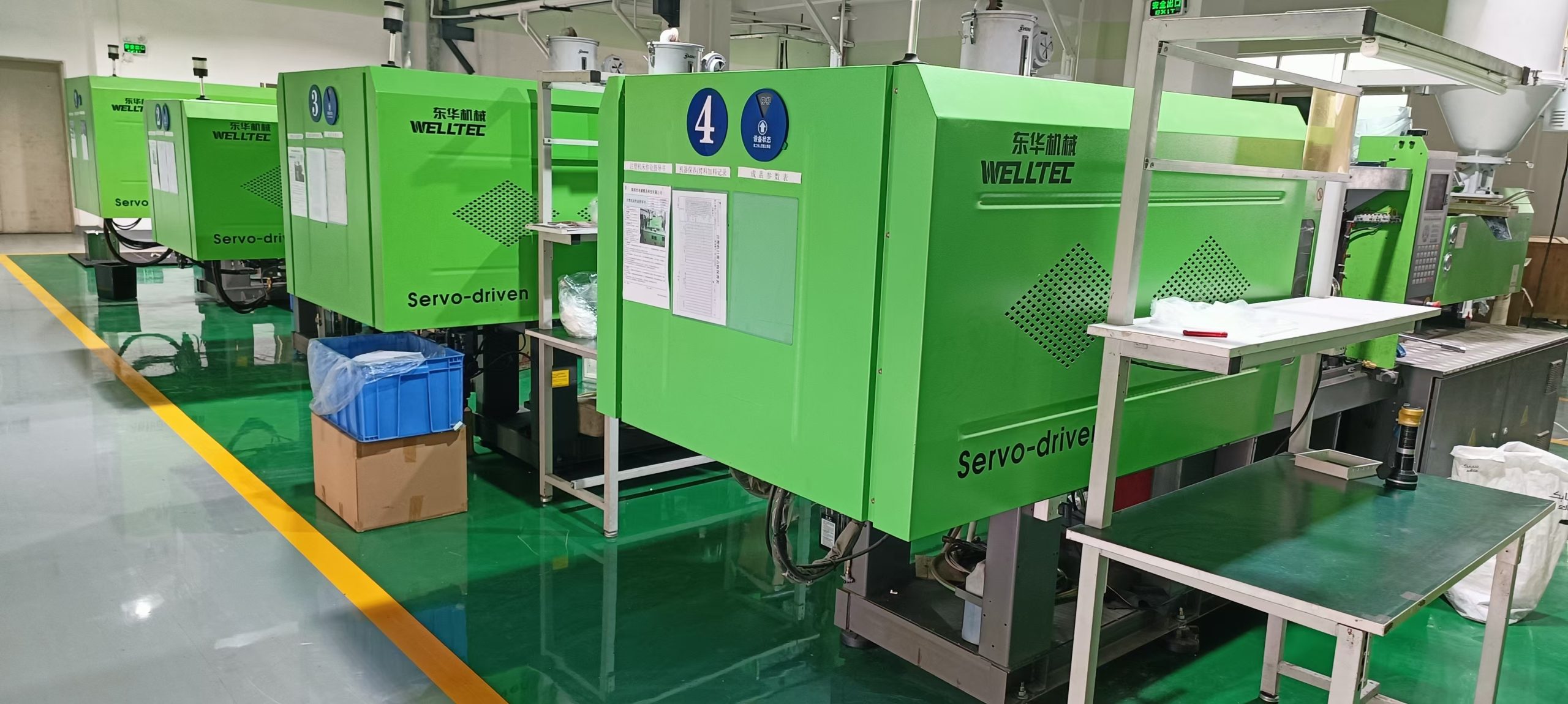
A supplier may have the right price, good samples, and a professional-looking factory, but injection molding supplier capacity determines whether they can keep up once production volume increases.
Machine quantity alone does not tell you much. A factory may own twenty injection molding machines, but only one may be suitable for your mold. That machine may already be heavily scheduled, and there may be no practical backup if it stops.
Before placing a production order, buyers should look beyond the equipment list and understand how much usable capacity the supplier can actually provide.
Injection Molding Supplier Capacity Starts With the Right Machines
The first check is simple: does the supplier have machines that actually match your project?
Injection molding machines vary significantly in:
- Clamp tonnage
- Shot size
- Tie-bar spacing
- Mold thickness
- Injection pressure
- Ejection stroke
- Platen dimensions
A factory with many 80–160 ton machines cannot automatically support a large plastic housing that requires a 500-ton machine.
The opposite can also happen. Running a small precision part on an oversized machine may not provide the best process control or production efficiency.
Before ordering, ask the supplier which machine they expect to use for your mold.
You should know:
- Machine tonnage
- Expected shot size
- Mold dimensions
- Required clamp force
- Estimated cycle time
- Whether another compatible machine is available
This gives you a much clearer picture of actual injection molding supplier capacity than simply asking how many machines the factory owns.
Do Not Confuse Machine Quantity With Available Capacity
This is one of the most common mistakes during supplier evaluation.
A supplier may tell you:
We have 30 injection molding machines.
The more useful question is:
How many suitable machines are actually available for my project?
Suppose your mold requires a 350-ton machine.
The supplier may have thirty machines in total but only two in the 350–400 ton range. If both machines are already heavily occupied, your real production flexibility is limited.
Ask about current machine utilization.
You do not necessarily need confidential information about other customers. However, the supplier should be able to explain whether your planned machine normally has enough available production time.
For recurring production, ask:
- How many days are normally needed to schedule a production run?
- Is machine time reserved for repeat orders?
- What happens when another customer’s demand suddenly increases?
- Can production move to another machine?
These questions expose capacity problems much faster than a general factory presentation.
Can Your Mold Run on a Backup Machine?
A suitable backup machine can make a major difference when production problems occur.
Machines require maintenance. Electrical components fail. Hydraulic systems develop problems. Unexpected repairs happen in every factory.
If your mold can only run on one machine, even a minor equipment failure can create a serious delivery problem.
For this reason, injection molding supplier capacity should include backup capacity.
Before production starts, confirm whether another machine has compatible:
- Clamp tonnage
- Shot capacity
- Tie-bar spacing
- Nozzle size and radius
- Locating ring
- Ejection arrangement
- Hydraulic connections
- Hot runner connections
Ideally, these considerations should begin during tooling development.
Good mold documentation also makes machine transfer and future production easier. Buyers should retain the latest mold drawings and technical records, as explained in our guide to injection mold documentation.
Tooling Support Is Part of Injection Molding Supplier Capacity
Injection molding capacity is not just about keeping machines running.
The mold itself also needs support.
During long-term production, problems may include:
- Ejector pin wear
- Slider wear
- Damaged inserts
- Flash
- Gate damage
- Cooling blockage
- Broken springs
- Water leakage
- Part sticking
If the supplier cannot repair these problems quickly, available machine capacity becomes meaningless.
For that reason, check whether the supplier has practical tooling support.
Useful capabilities include:
- CNC machining
- EDM
- Wire EDM
- Grinding
- Mold fitting
- Welding
- Mold maintenance
- Spare component manufacturing
At Fentormold, our injection mold manufacturing and injection molding production services are closely connected. When a tooling issue appears during production, the mold condition and molding process can be reviewed together instead of treating them as separate problems.
This becomes particularly important when production schedules are tight.
Check Staffing as Carefully as Equipment
Machines do not create stable production by themselves.
A supplier also needs enough experienced people to run them.
Ask about:
- Molding technicians
- Mold-setting technicians
- Process engineers
- Quality inspectors
- Material handlers
- Mold maintenance technicians
- Production shifts
For simple PP parts, staffing may be relatively straightforward.
However, projects involving PC, PA+GF, POM, PEEK, tight tolerances, appearance surfaces, multi-cavity molds, or complex assembly requirements need stronger technical support.
One experienced process technician may handle several machines under normal conditions. During a busy period, however, multiple molds may require troubleshooting at the same time.
This is where limited staffing begins to affect delivery and quality.
Therefore, when checking injection molding supplier capacity, do not only walk through the machine area. Look at how the production team is actually organized.
What Happens During Peak Production?
Capacity should be evaluated under realistic conditions, not only during a quiet week.
Many injection molding factories experience periods when machine utilization becomes much higher.
Your supplier may easily accommodate 20,000 parts this month but struggle when several customers increase orders simultaneously.
Discuss the real production pattern before placing the order.
For example:
Project A
20,000 parts every month.
Project B
120,000 parts every six months.
These projects may have the same annual volume but create completely different scheduling pressure.
Ask the supplier:
- How are recurring orders scheduled?
- How much notice is needed before production?
- Can additional shifts be added?
- Is weekend production possible?
- How are urgent orders handled?
- Is preventive machine maintenance planned around customer orders?
A supplier does not need unlimited free capacity. However, there should be enough margin to deal with normal production changes.
Inspection Capacity Can Become the Hidden Bottleneck
Sometimes the molding machines can produce enough parts, but the quality team cannot inspect them fast enough.
This is particularly important for precision or multi-cavity products.
Inspection requirements may include:
- First-piece inspection
- Cavity-by-cavity measurement
- CMM inspection
- Appearance inspection
- Functional testing
- Color checking
- Periodic dimensional inspection
- Final shipment inspection
For example, an eight-cavity mold may produce parts quickly, but if several critical dimensions must be checked on every cavity, inspection workload increases significantly.
Therefore, injection molding supplier capacity should include quality capacity as well as molding capacity.
Stable mass production also requires a clear approved standard. Once tooling trials are complete, dimensions, appearance, function, material, and acceptable defects should be clearly defined before regular production begins.
Ask What Happens When the Assigned Machine Breaks Down
Almost every supplier will tell you they can meet your delivery date.
A better question is:
What happens if the planned machine stops for three days?
This reveals much more.
Possible recovery options include:
- Move the mold to another compatible machine
- Add additional production shifts
- Run weekend production
- Prioritize machine repair
- Reschedule lower-priority work
A reliable answer does not need to promise that nothing will ever go wrong.
Production problems happen.
What matters is whether the supplier already has a realistic recovery plan.
The same principle applies to mold problems. If tooling becomes seriously damaged, production can stop even when several machines remain available.
Our article on injection mold repair by another supplier explains what buyers should consider when an existing mold needs to be inspected or recovered elsewhere.
Calculate Capacity Using Your Real Production Numbers
Avoid asking:
What is your monthly production capacity?
That number is too broad to be useful.
Instead, calculate capacity around your own project.
Provide:
- Part weight
- Number of cavities
- Estimated cycle time
- Monthly demand
- Annual demand
- Material
- Required delivery frequency
Consider a four-cavity mold running a 30-second cycle.
The theoretical output is:
- 2 cycles per minute
- 120 cycles per hour
- 480 parts per hour
However, 480 parts per hour is not the real production output.
Actual production includes:
- Mold setup
- Material preparation
- Machine adjustment
- Inspection
- Breaks
- Mold cleaning
- Scrap
- Machine downtime
- Maintenance
Therefore, production planning should always include reasonable downtime and capacity margin.
If a supplier calculates output using only theoretical cycle time, the delivery plan may already be too optimistic.
Can the Supplier Support Future Growth?
Your first order may be small.
That does not mean future demand will remain small.
Suppose initial production is 10,000 parts per month, but the project succeeds and demand grows to 40,000.
Can the supplier support that increase without disrupting delivery?
This is another reason to evaluate injection molding supplier capacity before ordering rather than after volume has already increased.
Ask whether:
- Additional compatible machines are available
- More shifts can be added
- The mold cycle can be optimized
- A higher-cavity mold may eventually be needed
- A second production mold could be introduced
You do not need to build extra tooling immediately.
However, understanding the next production step makes future expansion much easier.
A Bigger Factory Is Not Always the Better Choice
Large capacity is useful, but bigger is not automatically better.
The right supplier is the one whose equipment, technical resources, scheduling, and service level match your project.
For many small and medium-volume projects, a supplier with the right machines and reasonable spare capacity can provide better support than a much larger factory where the project represents only a small part of total production.
What matters is the balance between:
Required capacity + available capacity + backup capacity
If your project already consumes most of the supplier’s suitable machine time, future delivery risk will naturally be higher.
If it only uses a reasonable portion of available capacity, scheduling will usually be easier.
Injection Molding Supplier Capacity Checklist
Before placing a production order, buyers should confirm:
- Suitable molding machine tonnage
- Sufficient injection capacity
- Compatible mold dimensions
- Current machine workload
- Expected production schedule
- Backup machine availability
- Number of production shifts
- Experienced process technicians
- Mold maintenance capability
- Tooling repair capability
- Quality inspection capacity
- Material handling capability
- Peak-season availability
- Machine breakdown recovery plan
- Capacity for future volume growth
You do not need a complicated factory audit for every small project.
However, the important questions should be answered before you commit tooling and production to one supplier.
Final Thoughts
Reliable injection molding supplier capacity is not measured by how impressive a factory looks or how many machines appear in a company presentation.
Buyers should verify whether the supplier has the right machine, enough available production time, qualified technical staff, tooling support, inspection capability, and a practical backup plan.
Most importantly, capacity should be evaluated against your actual project requirements.
A supplier that can comfortably support today’s volume and still has room for changes, maintenance, and future growth will usually provide a much more stable production relationship.
Before ordering, buyers should confirm whether the supplier has the right machines, enough available capacity, reliable tooling support, inspection capability, and a realistic backup plan.