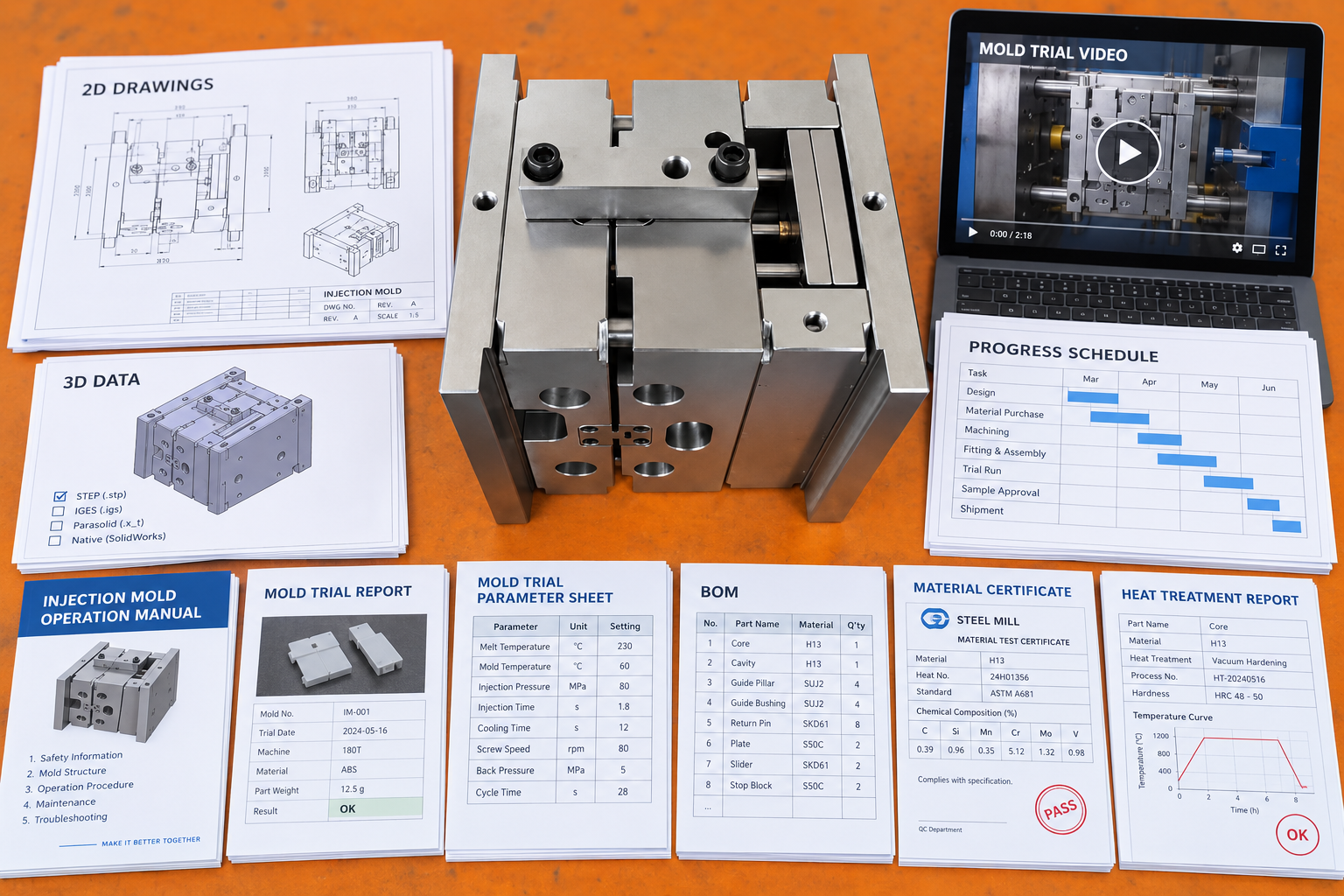
Injection mold documentation is an important part of the mold delivery package. It gives buyers the technical information needed to inspect, operate, maintain, repair, and manage the mold during its production life.
A mold may run well when it first arrives. However, problems can appear months or years later.
At that point, drawings, steel records, component lists, trial data, inspection reports, and maintenance information can become extremely valuable.
For buyers, the key question is simple:
What injection mold documentation should you receive before the mold is accepted and shipped?
This guide explains the most important documents and why they matter.
Why Injection Mold Documentation Matters
Injection mold documentation is more than paperwork.
It creates a technical record of what the supplier actually delivered.
For example, imagine that a guide component fails after two years of production.
Without drawings or a component list, the maintenance team may need to:
- Disassemble the mold
- Measure the damaged part
- Identify the component
- Find a replacement
- Confirm the correct specification
With proper documentation, this process can be much faster.
Good documentation is also useful when:
- The mold needs repair
- Components need replacement
- The mold is transferred
- Production moves to another factory
- Engineering changes are required
- A second mold needs to be built
- A new supplier needs to inspect the tool
Therefore, documentation should be treated as part of the mold value, not as an optional extra.
For complete tooling projects, Fentor Mold provides custom injection mold manufacturing from DFM through mold trial and delivery.
What Is Included in Injection Mold Documentation?
The exact package depends on the mold type, production volume, and customer requirements.
However, a typical production mold may include:
- Mold assembly drawing
- 2D drawings
- 3D CAD files
- Steel certificates
- Component list
- Mold inspection report
- T1 or mold trial report
- Plastic part inspection report
- Mold acceptance record
- Maintenance instructions
- Spare parts list
- Hot runner information
- Mold operating information
The most important point is to agree on the required injection mold documentation before the mold is finished.
1. Mold Assembly Drawing
A mold assembly drawing gives an overview of the complete tool.
It normally shows:
- Mold plates
- Core and cavity
- Sliders
- Lifters
- Ejection system
- Guide components
- Cooling circuits
- Major inserts
This drawing is especially useful during future maintenance.
For example, an engineer can quickly understand where a slider, lifter, or cooling line is located without fully disassembling the mold.
Therefore, an approved final assembly drawing should normally be included in the documentation package.
2. 2D Mold Drawings
2D drawings provide detailed dimensions for important mold parts.
They may include:
- Core inserts
- Cavity inserts
- Sliders
- Lifters
- Mold plates
- Ejector components
- Special inserts
- Custom mechanisms
Not every mold needs drawings for every standard component.
However, custom components should normally have enough dimensional information to support future repair or replacement.
3. Final 3D CAD Files
For long-life production tooling, final 3D mold data can be very useful.
It can support:
- Mold modification
- Troubleshooting
- Engineering changes
- New mold construction
- Supplier transfer
- Design review
However, buyers should confirm the required file format before delivery.
More importantly, the 3D data should match the final approved mold, not an early design version.
4. Mold Steel Certificates
Steel selection affects mold life, wear, corrosion resistance, and durability.
Therefore, steel records can be important for production tooling.
A steel certificate may include:
- Material grade
- Heat number
- Material identification
- Manufacturer information
- Test information
If a specific steel grade was agreed in the quotation, the buyer should be able to verify it.
A verbal statement is much weaker than documented material records.
5. Mold Component List
A component list is one of the most useful documents for maintenance.
It may identify:
- Guide pins
- Guide bushings
- Ejector pins
- Springs
- Wear plates
- Sliders
- Lifters
- Inserts
- Hydraulic parts
- Hot runner components
Ideally, the list should include:
- Part name
- Quantity
- Specification
- Supplier
- Part number
This makes spare-part purchasing much easier.
For custom and precision tooling components, buyers can also review Fentor Mold’s components manufacturing service.
6. Mold Inspection Report
A mold inspection report shows that the finished tool was checked before delivery.
Inspection may cover:
- Mold dimensions
- Critical component dimensions
- Mold opening and closing
- Ejection
- Slider movement
- Lifter movement
- Cooling circuits
- Hydraulic systems
- Cavity and core condition
- Surface finish
Instead of asking:
“Was the mold inspected?”
Buyers should ask:
“Can you provide the inspection report?”
A written record is much easier to review later.
For more detail, see our Injection Mold Acceptance Checklist.
7. T1 and Mold Trial Report
The T1 report records how the mold performed during trial.
It may include:
- Injection molding machine
- Plastic material
- Mold temperature
- Injection settings
- Cycle time
- Part weight
- Defects
- Required mold changes
This information becomes very useful if the mold is later moved to another factory.
The new molding team can use the original trial data as a starting point.
Therefore, the T1 report is an important part of injection mold documentation.
8. Plastic Part Inspection Report
The mold itself is not the final product.
The real goal is to produce acceptable plastic parts.
Therefore, molded part inspection should also be included when required.
A report may cover:
- Critical dimensions
- Overall dimensions
- Hole locations
- Wall thickness
- Flatness
- Assembly features
- Appearance
- Part weight
For critical parts, the buyer should clearly define which dimensions must be measured.
9. Mold Acceptance Record
The acceptance record confirms that the mold has passed the agreed approval process.
This may include:
- Sample approval
- Dimensional approval
- Visual inspection
- Mold function checks
- Cycle-time confirmation
- Documentation review
- Final mold inspection
For procurement teams, this stage is important because it connects technical approval with final payment and shipment.
Therefore, all agreed acceptance items should be closed before the mold leaves the supplier.
10. Mold Maintenance Instructions
A production mold needs regular maintenance.
Basic maintenance information may include:
- Lubrication points
- Cleaning requirements
- Maintenance intervals
- Wear-part inspection
- Cooling system cleaning
- Ejector maintenance
- Rust prevention
- Storage requirements
This does not need to become a large manual.
However, the production team should have enough information to maintain the mold correctly.
11. Spare Parts List
Not every component needs to be stocked.
Instead, buyers should focus on parts that can stop production if they fail.
Typical spare parts may include:
- Ejector pins
- Springs
- Wear plates
- Guide components
- Seals
- Inserts
- Special screws
- Hot runner components
The key question is:
Which components would cause long downtime if they failed?
Custom components with long lead times are usually more important to stock than common standard parts.
12. Hot Runner Documentation
If the mold uses a hot runner, additional records may be required.
These may include:
- Hot runner layout
- Nozzle specifications
- Heater information
- Thermocouple information
- Wiring diagram
- Temperature controller settings
- Spare parts
- Supplier information
This documentation becomes important when the system needs troubleshooting or replacement parts.
Injection Mold Documentation Checklist
Before mold shipment, buyers can use the following checklist:
| Document | Why It Matters |
|---|---|
| Mold assembly drawing | Understand the complete mold structure |
| 2D drawings | Support repair and dimensional reference |
| Final 3D CAD | Support future modification |
| Steel certificate | Verify mold material |
| Component list | Simplify replacement purchasing |
| Mold inspection report | Confirm mold quality checks |
| T1 report | Record molding conditions |
| Part inspection report | Verify molded part quality |
| Acceptance record | Confirm project approval |
| Maintenance instructions | Support long-term mold use |
| Spare parts list | Reduce downtime |
| Hot runner documents | Support hot runner service |
This table can also be added directly to the RFQ or purchase order.
What Buyers Should Check Before Mold Delivery
Before accepting the mold, buyers should review both the physical tool and the documentation package.
Are All Documents Included?
Compare the final package with the original RFQ or purchase-order requirements.
Do the Files Match the Final Mold?
Drawings and CAD data should match the actual delivered tool.
Are Critical Dimensions Recorded?
If the mold contains tight tolerances, make sure the required inspection data is included.
Are Steel Records Available?
Verify that the material documentation matches the agreed mold steel.
Is Trial Information Complete?
The T1 report should provide enough information for future production setup.
Can the Mold Be Maintained Without the Original Supplier?
This is an important buyer question.
Good injection mold documentation gives the owner more control over the tool.
When Should Injection Mold Documentation Be Requested?
Do not wait until the mold is ready to ship.
The best time to define the documentation package is during the RFQ or purchase-order stage.
A practical process is:
RFQ → Mold Design → Manufacturing → Trial → Inspection → Documentation → Acceptance → Shipment
This avoids last-minute disputes.
It also allows suppliers to prepare the correct files and reports during the project instead of trying to recreate them later.
Why Documentation Matters During Mold Transfer
Injection mold documentation becomes even more important when a mold moves to another supplier or factory.
The new team may need to understand:
- Mold structure
- Cooling layout
- Ejection
- Slider and lifter mechanisms
- Hot runner system
- Spare parts
- Original trial settings
Without this information, the new supplier may need to reverse-engineer parts of the mold.
As a result, transfer time and repair cost can increase.
Good documentation makes the mold easier to manage throughout its life.
What Happens If Documentation Is Missing?
Missing documentation may not cause an immediate problem.
However, the risk increases as the mold gets older.
For example:
- A broken ejector pin may be difficult to identify
- A custom insert may need to be remade from measurements
- Missing CAD data may slow down modifications
- Unknown steel grades can complicate repair
- Missing hot runner information can delay maintenance
Therefore, injection mold documentation is a form of long-term technical protection for the buyer.
Frequently Asked Questions
What injection mold documentation should a supplier provide?
A typical production mold package may include assembly drawings, 2D drawings, 3D CAD files, steel certificates, component lists, inspection reports, T1 reports, maintenance information, and spare-parts information.
Should buyers receive final 3D mold data?
For many custom production molds, yes.
Final 3D data can help with future repair, modification, troubleshooting, and mold transfer.
Are steel certificates necessary?
If a specific mold steel grade was agreed, material documentation is useful for verification.
Is a T1 report important?
Yes.
It provides a record of the machine, material, process conditions, cycle time, and mold performance during trial.
Should maintenance instructions be included?
For production molds, basic maintenance instructions are highly useful.
They can help reduce unexpected downtime and extend mold life.
Final Takeaway
Injection mold documentation should be treated as part of the mold delivery package.
For buyers, the most important documents usually include:
- Assembly drawings
- 2D and 3D data
- Steel records
- Component lists
- Inspection reports
- T1 trial records
- Part inspection results
- Acceptance records
- Maintenance information
- Spare parts information
Most importantly, these requirements should be agreed before mold manufacturing begins.
Do not wait until shipment to ask for them.
A complete documentation package gives the buyer better control over mold acceptance, maintenance, repair, modification, and future transfer.
Fentor Mold can support the project from mold design and manufacturing through inspection, trial, documentation, and production preparation.