
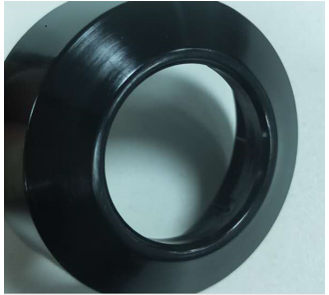
Weld lines appear when two or more flow fronts meet during injection molding.
They are common in PC parts with holes, inserts, ribs, or multiple gates.
On normal opaque parts, a weld line may be difficult to notice. But on transparent, black, glossy, or appearance-critical PC parts, it can become very obvious.
The problem is not only cosmetic. A weak weld line can also reduce the strength of the part.
1. Multiple Flow Fronts Create Weld Lines
When plastic flows around a hole or splits from multiple gates, the flow fronts eventually meet.
At this point, the material has already started to cool.
If the two flow fronts do not fuse well, a visible line remains on the surface.
This is one reason why gate location is so important for PC molds.
2. Low Mold Temperature Makes Weld Lines Worse
PC needs enough heat to fuse properly when two flow fronts meet.
If the mold temperature is too low, the material cools too quickly.
The two flow fronts may then meet without sufficient heat and pressure.
This can make the weld line more visible and weaker.
For appearance-critical PC parts, mold temperature should be considered during the mold design stage, not only during molding trials.
3. Gate Location Can Move the Weld Line
You cannot always eliminate a weld line.
Sometimes the best solution is to move it to a less visible area.
For example, a gate can be positioned so that the weld line forms on the back side rather than on the cosmetic surface.
For complex products, mold flow analysis can predict where the flow fronts will meet.
Our injection mold manufacturing service includes gate and runner design based on the product structure.
4. Flow Speed and Pressure Matter
If the flow front becomes too cold before the two fronts meet, the weld line becomes more obvious.
Filling speed, injection pressure, and mold temperature work together.
Simply increasing injection speed is not always the best solution.
The goal is to maintain a stable and sufficiently hot flow front until the cavity is filled.
5. Poor Venting Can Make Weld Lines Worse
Air can become trapped where two flow fronts meet.
If the air cannot escape, it can interfere with proper fusion.
This may result in a visible weld line, burn mark, or even a short shot.
Good venting near the end of fill helps the material meet and fuse more effectively.
6. Product Design Also Matters
Some weld lines are created by the product itself.
Holes, ribs, bosses, and inserts can split the material flow.
If a cosmetic surface is critical, these features should be considered before mold construction.
Sometimes a small change to the product structure can move the weld line away from the visible area.
How to Reduce Visible Weld Lines
A practical approach is:
- Review the gate location.
- Use mold flow analysis for complex parts.
- Maintain a suitable mold temperature.
- Optimize filling speed and pressure.
- Improve venting near weld-line areas.
- Avoid unnecessary flow splits.
- Move weld lines away from cosmetic surfaces when possible.
Can Weld Lines Be Completely Eliminated?
Not always.
For many PC parts, the better goal is to control the weld line rather than completely eliminate it.
If the product has holes, ribs, or multiple gates, some weld lines may be unavoidable.
The important question is whether the weld line is in an acceptable location and whether it affects part strength or appearance.
Final Thoughts
Visible weld lines on PC parts are mainly related to flow-front temperature, gate location, filling conditions, and venting.
For appearance-critical PC products, the best time to solve the problem is before the mold is built.
A good gate layout and mold flow analysis can help predict weld-line locations and move them away from important cosmetic areas.
For more information about our injection molding production service, visit Fentormold.
You can also find more practical mold design topics on our injection molding blog.