
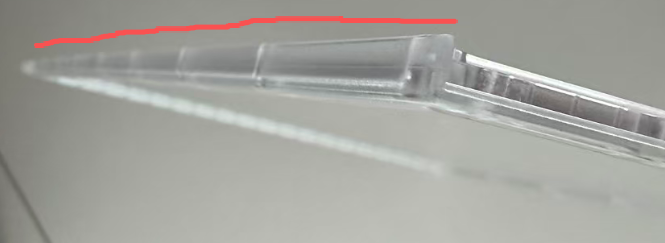
What Causes Warpage in PC Injection Molded Parts?
PC has good strength and dimensional stability, but PC injection molded parts can still warp after molding.
Warpage usually comes from uneven shrinkage and internal stress.
The problem often becomes more serious with large, thin, or asymmetric parts.
Good mold design is the first step. Our injection mold manufacturing service focuses on mold structure, cooling, gating, and ejection from the early design stage.
1. Uneven Wall Thickness
Large changes in wall thickness can cause different cooling and shrinkage rates.
Thick areas stay hot longer. Thin areas cool faster.
This difference can pull the part out of shape.
Try to keep the wall thickness as uniform as possible.
If a thick section is necessary, use ribs or other structures instead of simply increasing the wall thickness.
2. Poor Cooling Design
Cooling is one of the most important factors for PC parts.
If one side of the mold cools faster than the other, the part can develop uneven shrinkage.
For large PC parts, we should pay special attention to:
- Cooling channel layout
- Distance from the cavity surface
- Cooling balance between both sides
- Hot spots around thick sections
A good cooling system helps the part cool more evenly.
3. Gate Location Affects Warpage
Gate location can strongly affect internal stress and shrinkage.
A poor gate position may create an unbalanced filling pattern.
For large parts, multiple gates may be necessary to reduce flow length and injection pressure.
Before building the mold, we recommend checking the filling pattern with mold flow analysis.
Our prototype injection molding service can also help verify difficult product designs before mass production.
4. Too Much Injection Pressure
High injection pressure does not always mean better parts.
Excessive pressure can increase molecular orientation and residual stress in PC.
After the part leaves the mold, this stress can gradually release and cause deformation.
Instead of simply increasing pressure, first check the gate, runner, venting, and flow length.
5. Ejection Can Distort the Part
A PC part may already be slightly deformed during ejection.
If the ejector pins are poorly positioned, they can push against weak areas.
Large flat parts need a well-balanced ejection system.
Use enough ejector pins and place them near areas that can safely carry the ejection force.
How to Reduce PC Part Warpage
A practical approach is:
- Keep wall thickness as uniform as possible.
- Design balanced cooling channels.
- Choose the gate position carefully.
- Use multiple gates when necessary.
- Avoid excessive injection pressure.
- Balance the ejection system.
- Use mold flow analysis for difficult parts.
Warpage is often a mold design problem rather than simply a molding parameter problem.
Final Thoughts
PC injection molded parts can warp when cooling, filling, or ejection is not balanced.
For difficult PC products, do not wait until the first molding trial to solve the problem.
Analyze the part design, gate layout, cooling system, and ejection system before mold manufacturing.
Good preparation can reduce trial-and-error, shorten mold development time, and improve final part quality.
For more practical injection molding topics, visit the Fentormold injection molding blog.
You can also learn about our injection molding production service for PC and other engineering plastics.