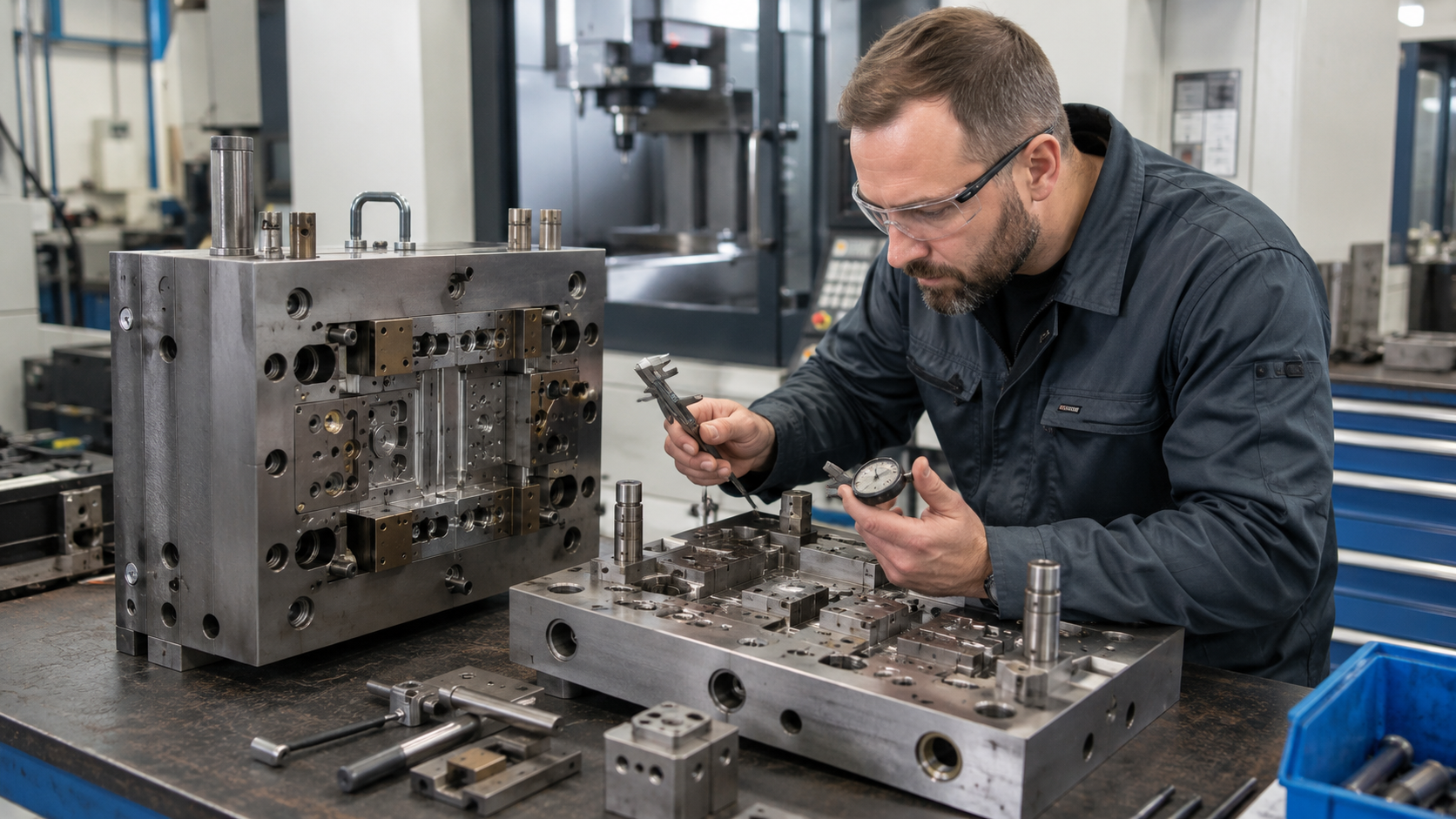
Injection mold repair does not always have to be handled by the company that originally built your mold. In many cases, an experienced mold manufacturer can inspect an existing tool, identify the root cause of the problem, manufacture replacement components, complete the necessary repairs, and run a new mold trial before putting the tool back into production.
This situation is common when the original mold maker is no longer available, repair lead times have become too long, communication has become difficult, or production needs to move to another factory.
Changing suppliers does not automatically mean you need a completely new mold. The first step is to understand the actual condition of the tool and determine whether repair is technically and economically reasonable.
When Do You Need Injection Mold Repair From Another Supplier?
There are several reasons why a buyer may need injection mold repair from a new supplier.
The original mold maker may no longer support the project. In other cases, the supplier is still available, but recurring failures, slow response, or unstable part quality make continued cooperation difficult.
Common situations include:
- Repeated mold breakdowns
- Flash returning after previous repairs
- Broken ejector pins
- Worn sliders or lifters
- Damaged core or cavity areas
- Cooling leakage
- Poor venting
- Hot runner problems
- Long maintenance lead times
- Difficulty obtaining replacement components
- Production transfer to another molding factory
Before any machining begins, the new supplier should understand both the mold condition and the production problem.
If the tool needs more than a simple local repair, our injection mold manufacturing service can help evaluate whether repair, modification, component replacement, or rebuilding is the more practical option.
What Should Be Checked Before Injection Mold Repair?
A reliable injection mold repair process should always start with inspection.
The mold should not be welded, polished, or machined immediately after arriving at the new supplier. Repairing only the visible damage without finding the root cause may lead to the same problem returning after production restarts.
The following areas should be checked first.
Core and Cavity Condition
The core and cavity should be inspected for:
- Wear
- Corrosion
- Scratches
- Cracks
- Chipped edges
- Previous welding
- Deformation
- Damaged shut-off surfaces
- Polishing problems
- Texture damage
Small local defects can often be repaired through welding, CNC machining, EDM, grinding, or polishing.
If the damaged area is severe, replacing a mold insert may be safer than repeatedly welding the same location.
When replacement cores, cavity inserts, sliders, or other precision parts are required, our mold components manufacturing service can support CNC machining, EDM, and precision fitting.
Parting Line Condition
Parting-line wear is a common reason for flash.
However, flash should not automatically be blamed on high injection pressure.
The supplier should also inspect:
- Shut-off surfaces
- Mold alignment
- Plate deformation
- Insert fit
- Guide pins and bushings
- Clamping condition
If the real cause is mechanical wear or poor alignment, reducing injection pressure may only hide the problem temporarily.
Ejection System
The ejection system should move smoothly and return correctly.
Important parts include:
- Ejector pins
- Ejector sleeves
- Return pins
- Ejector plates
- Springs
- Guide components
Replacing a broken ejector pin is normally straightforward.
The more important question is why the pin failed.
If the molded part is sticking too tightly to the core, replacing the pin without correcting the release problem may lead to another failure.
What Problems Can Injection Mold Repair Solve?
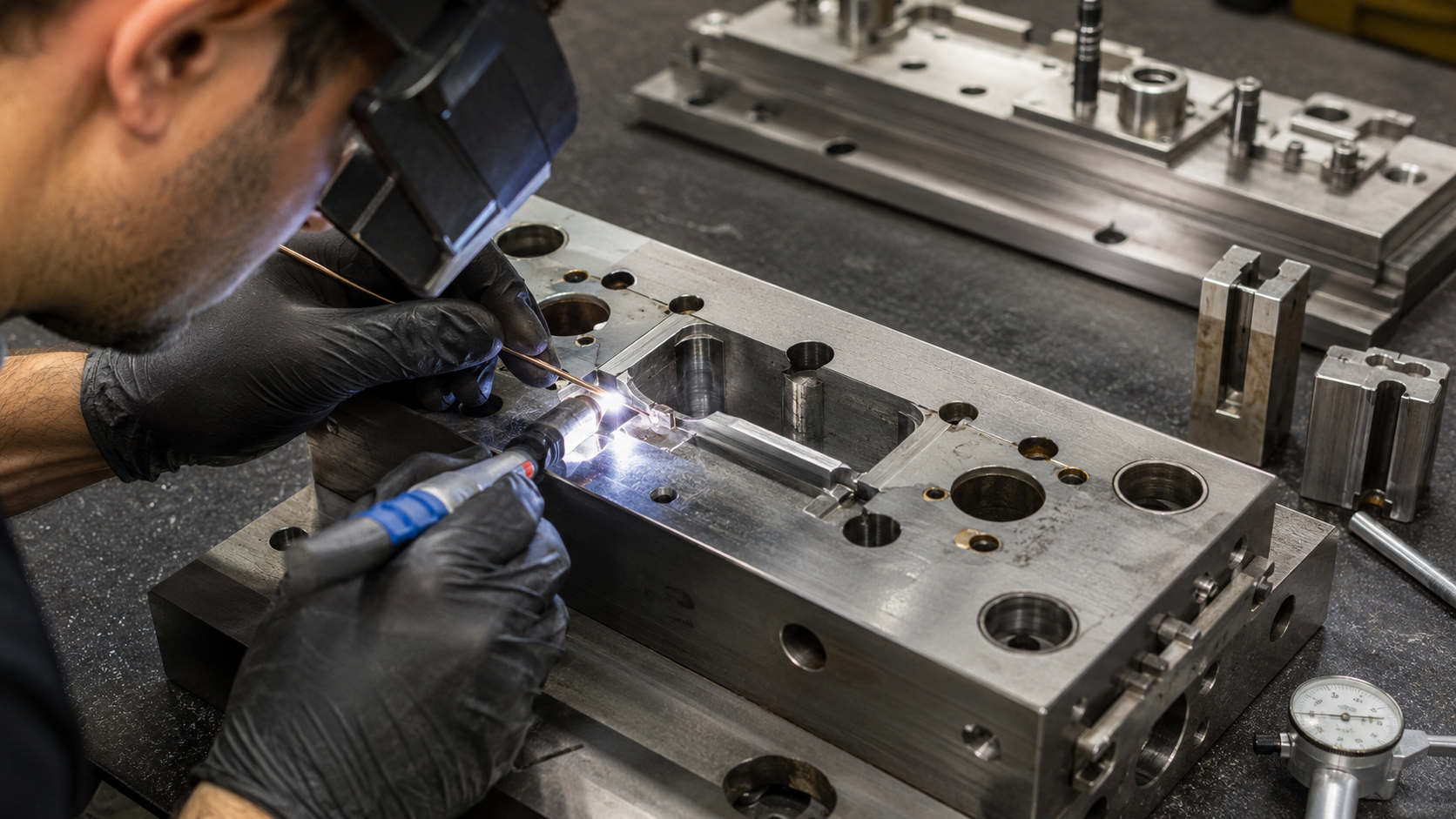
The scope of injection mold repair depends on mold steel, mold condition, part requirements, and remaining tool life.
Many common mold problems can be corrected without manufacturing a completely new tool.
Repairing Damaged Cores and Cavities
Local core or cavity damage may sometimes be corrected by:
- Laser welding
- Conventional welding
- CNC machining
- EDM
- Grinding
- Polishing
- Insert replacement
The correct method depends on the mold steel, tolerance, surface finish, and location of the damage.
A hidden internal surface may tolerate a repair method that would not be acceptable on a high-gloss cosmetic surface.
For more information about these critical areas, see our guide to injection mold core and cavity machining.
Fixing Flash Caused by Mold Wear
When flash is caused by local parting-line wear, the repair may involve:
- Rebuilding damaged surfaces
- Re-machining shut-offs
- Re-fitting inserts
- Correcting alignment
- Restoring worn parting surfaces
The root cause should be confirmed before repair work begins.
If mold deformation or poor support is creating the gap, polishing the flash area alone will not provide a stable solution.
Repairing Worn Sliders and Lifters
Sliders and lifters experience repeated movement during every molding cycle.
Common problems include:
- Jamming
- Excessive clearance
- Worn guide surfaces
- Loose inserts
- Damaged angle pins
- Poor lubrication
- Incorrect movement timing
Sometimes replacing the slider or lifter alone is not enough.
The matching guide surface may also need repair or machining to restore the correct fit.
Correcting Cooling System Problems
Cooling system problems can affect both cycle time and part quality.
Typical symptoms include:
- Warpage
- Uneven shrinkage
- Long cooling time
- Dimensional instability
- Production inconsistency
Cooling circuits should be checked for:
- Leakage
- Corrosion
- Blockage
- Poor flow
- Damaged fittings
When a mold moves to another factory, cooling performance should also be verified under the new production conditions.
Fixing Mold Venting Problems
Poor venting can cause:
- Burn marks
- Short shots
- Trapped gas
- Poor filling
- Unstable appearance
In some cases, cleaning the vents is enough.
In others, the vent depth, width, or position may need to be corrected.
For more information about preventing long-term tooling problems, see our injection mold maintenance guide.
Can a Mold Be Repaired Without Original Drawings?
Yes, in many cases.
Original mold drawings make the work easier, but their absence does not automatically prevent repair.
An experienced mold shop can inspect the existing tool and reverse engineer damaged components when necessary.
This may involve:
- Measuring mold plates and inserts
- Checking mating surfaces
- Measuring molded samples
- Rebuilding a 3D model
- Manufacturing replacement inserts
- Fitting new components into the existing mold
Original drawings are especially useful for more complex tooling, including:
- Hot runner molds
- Unscrewing molds
- Two-shot molds
- Multi-action tooling
- Precision molds
- Molds with complicated cooling circuits
If drawings are unavailable, send as much other information as possible.
Useful information includes:
- Part 3D CAD files
- 2D drawings
- Mold photos
- Defective part photos
- Good and bad samples
- Plastic material
- Mold steel information
- Hot runner information
- Existing molding parameters
- Previous repair records
- Dimensional inspection reports
What Information Is Needed for an Injection Mold Repair Quote?
A useful injection mold repair quotation requires more than a short message saying that the mold is damaged.
The supplier needs enough information to understand both the mold condition and the production problem.
For an initial evaluation, provide:
- Overall mold photos
- Close-up photos of damaged areas
- Photos of defective molded parts
- Mold dimensions
- Mold weight
- Part drawings
- Mold drawings, if available
- Plastic material
- Current production volume
- Description of the problem
- Previous repair history
A short video can also be very useful if the problem involves slider movement, ejection, mold opening, or abnormal mechanical movement.
In many cases, these materials allow the supplier to make a preliminary assessment before the physical mold is shipped.
Repair, Modify, or Build a New Mold?
Not every mold problem should automatically be handled with repair.
The right decision depends on mold condition, remaining tool life, future production volume, downtime risk, and total cost.
Repair Usually Makes Sense When:
- Damage is localized
- The mold structure remains sound
- Core and cavity condition is generally good
- The product design has not changed significantly
- The mold still has useful life remaining
- Repair cost is reasonable compared with replacement
Modification May Be Better When:
- The product design has changed
- A feature must be added or removed
- Gate position needs to change
- Cooling needs improvement
- The mold must run in another machine
- Production requirements have changed
A New Mold May Be Better When:
- Core and cavity wear is extensive
- Mold steel is severely corroded
- Major cracks are present
- Several mold systems are failing
- Repair frequency keeps increasing
- The mold has exceeded its expected service life
- Future production volume is high
Repeated injection mold repair can eventually become more expensive than replacing the tool.
The lowest repair quotation is therefore not always the lowest-cost production decision.
What Happens After Injection Mold Repair?
After injection mold repair is completed, the mold should be assembled and tested under actual molding conditions whenever possible.
A practical process is:
Inspection → Repair → Assembly → Mold Trial → Sample Inspection → Adjustment → Approval
During the mold trial, the supplier should check:
- Mold opening and closing
- Slider movement
- Lifter movement
- Ejection
- Cooling performance
- Leakage
- Part filling
- Flash
- Part release
- Critical dimensions
- Surface appearance
If the mold is being transferred to another injection molding factory, processing parameters may also need adjustment.
Machine characteristics, cooling-water conditions, resin handling, and peripheral equipment can differ between factories even when the same mold and plastic material are used.
How to Choose the Right Mold Repair Supplier
The right supplier should offer more than basic polishing or manual fitting.
Ask whether the supplier can:
- Inspect molds manufactured by other companies
- Manufacture new cores and inserts
- Perform CNC machining
- Perform EDM
- Handle welding and polishing
- Repair sliders and lifters
- Check cooling circuits
- Test hot runner systems
- Run mold trials
- Measure molded samples
- Provide repair documentation
A supplier with both mold-making and injection molding capability can also make the transfer easier if the mold will remain at the new factory for production.
Can Fentor Mold Repair Tooling Made by Another Supplier?
Yes. The first step is to evaluate the actual mold condition.
Fentor Mold can review mold photos, molded samples, part drawings, existing tooling information, and known production problems before recommending the next step.
Depending on the condition of the tool, the practical solution may include:
- Injection mold repair
- Replacement cores or inserts
- Slider or lifter replacement
- Mold modification
- Partial rebuilding
- New tooling
Not every damaged mold needs to be replaced.
At the same time, repeatedly repairing a heavily worn tool can increase production downtime and long-term cost.
If your existing mold was made by another supplier and is causing production problems, send the available mold photos, part drawings, defective samples, and repair history for an initial engineering review.
Injection Mold Repair FAQ
Can Another Supplier Repair My Mold?
Yes. An experienced mold manufacturer can usually inspect and repair tooling made by another supplier, depending on the mold condition and the type of damage.
Can a Mold Be Repaired Without Drawings?
In many cases, yes. Existing components can be measured and reverse engineered. Original drawings are still helpful for complicated mold structures.
How Long Does Mold Repair Take?
The lead time depends on the damage, mold structure, replacement components, machining requirements, surface treatment, and whether another mold trial is required.
Can a Damaged Core or Cavity Be Repaired?
Local damage can often be corrected through welding, machining, EDM, polishing, or replacement inserts. Severe damage may require a new core, cavity insert, or complete mold.
Is Repair Always Cheaper Than a New Mold?
No. Repair is usually economical when damage is limited and the tool still has useful production life. If several major systems are worn or failures keep returning, new tooling may provide a better long-term result.