
Why Do PC Injection Molded Parts Crack?
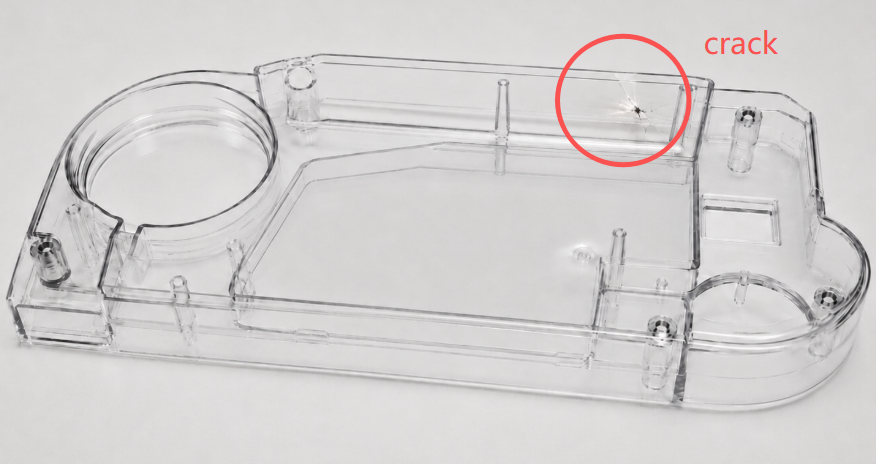
PC is strong and impact-resistant, but PC injection molded parts can still crack when the material carries too much internal stress.
Cracks often appear after molding, during assembly, or after the part has been used for some time.
The root cause is not always the injection molding machine. Mold design, part design, material, and processing conditions can all affect the result.
For reliable PC parts, mold design should start with a proper review of the product structure. You can learn more about our injection mold manufacturing service.
1. Sharp Corners Create Stress
Sharp internal corners are one of the most common causes of cracking.
PC does not flow and cool evenly around a sharp corner. This can create a high-stress area.
A simple solution is to add a suitable R angle to the corner.
A larger radius usually reduces stress and improves material flow.
2. Injection Pressure Is Too High
PC normally needs higher injection pressure than materials such as PP or ABS.
However, excessive pressure can increase internal stress.
If the filling pressure is too high, the part may look perfect after molding but crack later.
We should not simply increase pressure to solve a filling problem. First check:
- Gate position
- Runner size
- Wall thickness
- Flow length
- Venting
- Mold temperature
A good mold design can often reduce the required injection pressure.
3. Poor Gate Location
The gate has a major effect on stress.
If the gate is placed in a thin or highly stressed area, the material may enter the cavity under high shear.
This can leave high residual stress around the gate.
For difficult PC parts, we normally review the gate position and filling balance before mold construction.
Our prototype injection molding service can also help verify the design before making a production mold.
4. Poor Venting
Air trapped in the cavity can create filling problems.
The machine may need more pressure to fill the cavity. This can increase stress in the molded part.
Good venting helps PC fill more smoothly and reduces unnecessary injection pressure.
Vents should be placed where air is likely to become trapped, especially at the end of the filling flow.
5. Ejection Stress
A PC part can also crack during ejection.
This often happens when:
- The part sticks to the core
- There are too few ejector pins
- Ejector pins are too small
- The draft angle is insufficient
- The part has deep ribs or undercuts
The ejection system should push the part evenly.
Do not concentrate too much force on a small area.
6. Assembly Can Cause Delayed Cracking
Sometimes the mold is not the only problem.
A PC part may look good after molding but crack during assembly.
For example, excessive screw torque can create stress around a screw boss.
The problem may become worse when the part is exposed to chemicals, heat, or long-term loading.
For this reason, the molding process and assembly conditions should be considered together.
7. Material and Drying Matter
PC is sensitive to moisture.
If the material is not dried correctly, molding quality can suffer. Poor material handling can also reduce the mechanical performance of the part.
Always follow the material supplier’s recommended drying conditions.
Recycled material should also be controlled carefully, especially for high-performance or transparent PC parts.
How to Prevent Cracking in PC Parts
A practical approach is:
- Check the product design.
- Add proper corner radii.
- Review gate location.
- Check the runner and gate size.
- Improve mold venting.
- Control injection pressure.
- Balance the ejection system.
- Dry PC material correctly.
- Check assembly stress.
- Use mold flow analysis for difficult parts.
Cracking is usually easier to prevent than to fix after the mold is finished.
At Fentormold, we review the product structure, gate location, cooling, venting, and ejection system before mold manufacturing. See our injection molding production service for more information.
Final Thoughts
PC injection molded parts crack mainly because of excessive stress.
Sharp corners, poor gate locations, high injection pressure, poor venting, difficult ejection, and assembly loads can all increase stress.
The best solution is not simply to change the injection parameters.
Start with the part and mold design. A well-designed mold can reduce filling pressure, improve part quality, and greatly reduce the risk of cracking.
For more practical injection molding topics, visit the Fentormold injection molding blog.