
A tolerance of 0.02 mm is acceptable for many plastic parts. For optical components, it is not.
Even a tiny offset can affect assembly, optical performance, and product reliability. That is why precision mold design matters just as much as the injection molding process.
In this article, we share how we developed a 16-cavity mold for a miniature PET ring and solved the challenges behind stable mass production.
If you are looking for a reliable precision mold manufacturer, We provides complete solutions from DFM analysis to mold making and production support. Learn more at Fentormold.
Product Overview
This PET ring looks simple, but its requirements are extremely demanding.
Part specifications
- Material: PET
- Size: 8 mm × 6 mm
- Thickness: 1 mm
- Mold: 16 cavities
- Steel: S136
- Flatness: ≤0.01 mm
- Concentricity: ≤0.05 mm
- Center offset: ≤0.02 mm
- Submarine gate with automatic gate separation
The part is used in an optical application. Small defects that are acceptable for normal plastic parts are not acceptable here.
The mold must prevent:
- Flash on the inner ring
- Part sticking to the front cavity
- Runner sticking
- Gate breaking
- Stringing
- Weld lines
- Edge marks
- Ejector damage
- Poor flatness
- Concentricity deviation
Every detail matters.
1. Keep the Part on the Moving Side
Small parts often stick to the wrong mold half.
We solved this by placing the outer surface in the front cavity and the inner surface in the rear core.
The front core releases the part first. The part stays on the rear core, and the rear ejector block pushes it out smoothly.
This design prevents sticking, scratches, and unstable ejection.
2. Control Flatness from the Beginning
The flatness requirement is only 0.01 mm.
CNC machining alone cannot achieve this consistently.
We grind every molding surface with a precision surface grinder. This creates a perfectly flat molding surface and keeps the part within tolerance.
3. Concentricity Depends on Mold Accuracy
The biggest challenge is concentricity.
The inner and outer diameters come from different mold halves. Any small alignment error becomes part eccentricity.
To control the center offset within 0.02 mm, we follow several steps.
First, we align and lock both mold plates.
Next, we grind all four reference faces and keep the squareness within 0.005 mm.
Finally, we use internal grinding for all 32 precision holes in both mold halves. The position tolerance stays within 0.005 mm.
This process keeps the total accumulated tolerance below 0.01 mm and ensures excellent concentricity.
Read more about our precision mold manufacturing capabilities at Fentormold
4. Eliminate Flash
Even tiny flash can affect an optical product.
We prevent flash by combining several methods:
- Precision-ground parting surfaces
- Proper parting line relief
- Balanced cavity pressure
- Balanced runner design
- Effective venting
Good machining alone is not enough. Mold fitting and vent design are equally important.
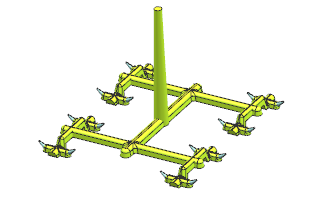
5. Design a Stable Submarine Gate
The gate size is only 0.4 × 0.2 mm.
All 16 cavities must have exactly the same gate dimensions.
We also optimize the gate break point. This allows automatic gate separation without gate breakage or stringing.
The result is stable production and a clean part appearance.
6. Reduce Weld Lines
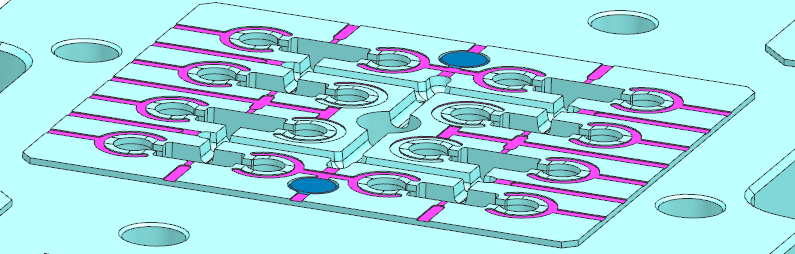
Weld lines usually appear where two melt fronts meet.
Poor venting makes them much more visible.
We add vents at the end of the filling path and around the inner ring. Air escapes quickly, and the melt flows together more smoothly.
This greatly reduces visible weld lines.
7. Remove Every Burr Before Production
Tiny burrs can create visible marks on small plastic parts.
Sharp edges on mold components may collide during mold movement. Over time, they leave scratches on the part.
Broken gate particles can also stay on the mold surface and damage the next shot.
We inspect every component under magnification after machining.
We remove all sharp edges and polish every contact surface.
During production, we eliminate static electricity and clean the mold surface regularly to remove plastic dust.
These small steps make a big difference in optical applications.
8. Choose the Right Mold Steel
Good steel helps maintain precision over a long production run.
We use S136 stainless mold steel because it offers:
- High wear resistance
- Excellent corrosion resistance
- Good toughness
- Stable dimensions
- High-quality mirror finish
These properties make it an excellent choice for PET and optical plastic parts.
Conclusion
Precision injection molding is much more than making a part fit the drawing.
It requires precise mold design, accurate machining, stable molding, and strict quality control.
For this tiny PET ring, every 0.005 mm, every vent, and every polished surface affects the final result.
That is how Fentormold delivers reliable precision molds for optical, medical, and high-performance plastic components.
Visit Fentormold to learn more about our precision mold solutions: