
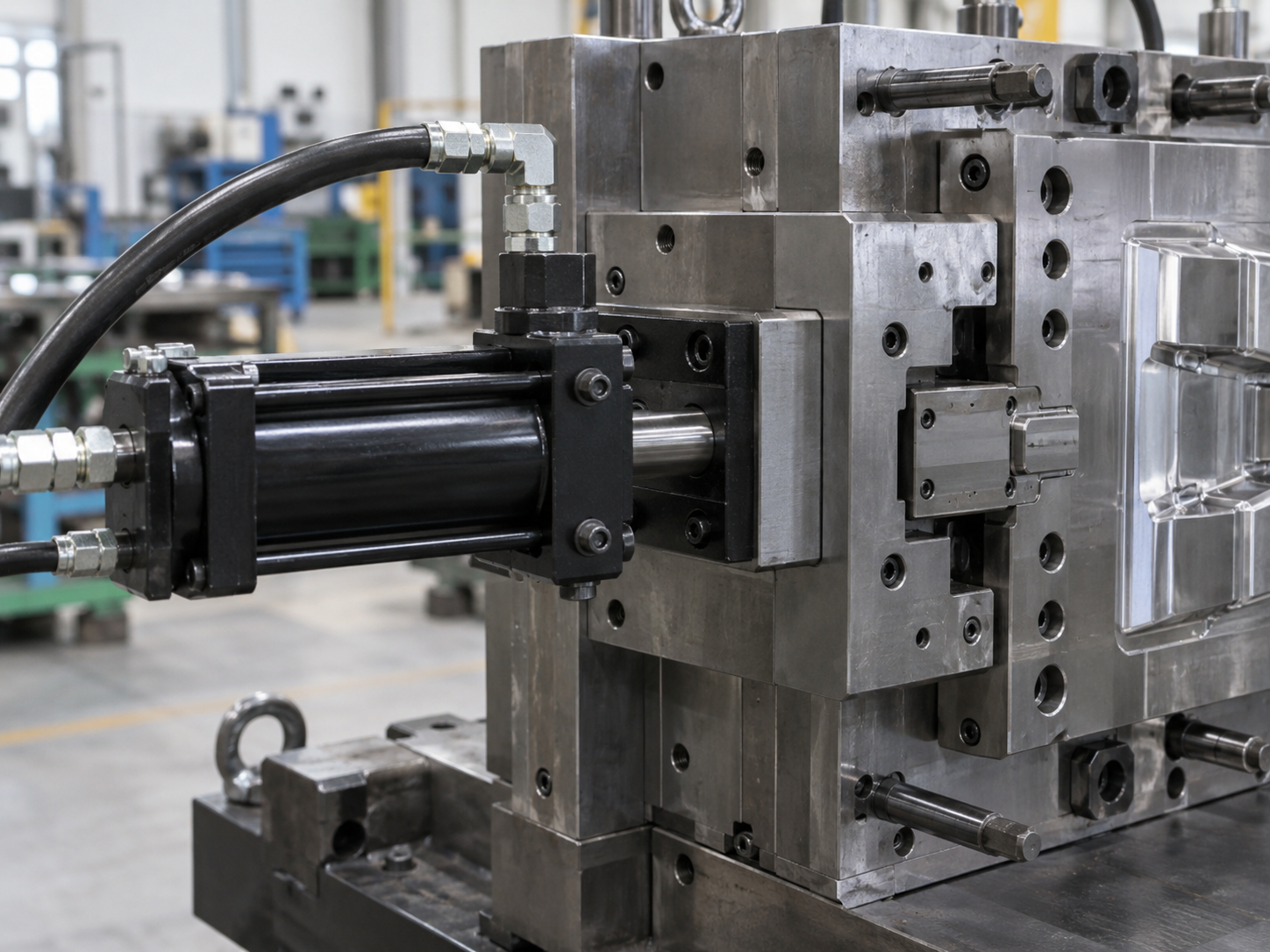
An injection mold hydraulic cylinder is often used to drive sliders, cores, and other side-action mechanisms when a mechanical angle pin is not suitable.
For large undercuts, long travel, heavy sliders, or controlled movement, hydraulic cylinders can provide strong and flexible motion.
However, reliability depends on much more than the cylinder itself.
If the cylinder, guide system, stroke control, locking structure, and sensors are not designed correctly, the mold may suffer from unstable movement, oil leakage, misalignment, incomplete core pulling, or even mold damage.
Therefore, the goal is not simply to install a hydraulic cylinder.
The goal is to create a reliable hydraulic action system that can run repeatedly during production.
What Is an Injection Mold Hydraulic Cylinder?
An injection mold hydraulic cylinder uses hydraulic pressure to move a mold component.
It is commonly used for:
- Slider movement
- Side core pulling
- Long-stroke actions
- Heavy moving components
- Special undercut release
- Sequential mold movement
Compared with a mechanical angle pin, a hydraulic cylinder gives more control over movement distance and timing.
However, it also adds hydraulic lines, sensors, seals, mounting components, and control requirements.
For complex side-action molds, Fentor Mold can review the complete structure during custom injection mold manufacturing.
When Should an Injection Mold Hydraulic Cylinder Be Used?
A hydraulic cylinder is useful when the mold requires movement that is difficult to achieve with a simple mechanical system.
Typical situations include:
Long Core-Pulling Stroke
Some side cores need more travel than an angle pin can easily provide.
In this case, a hydraulic cylinder can provide a longer and more controlled stroke.
Heavy Sliders
Large sliders can create high friction and require strong pulling force.
Therefore, hydraulic movement may provide better control.
Limited Mold Space
In some molds, the available space does not allow a practical angle-pin layout.
A hydraulic cylinder can sometimes provide more flexibility.
Controlled Movement Sequence
Some mold actions must happen before or after another movement.
Hydraulic cylinders can be controlled in sequence.
This makes them useful in molds with multiple moving actions.
Main Reliability Risks of an Injection Mold Hydraulic Cylinder
The cylinder itself is only one part of the system.
The most common reliability risks come from:
- Poor alignment
- Insufficient guide support
- Incorrect stroke setting
- Weak mounting
- Oil leakage
- Poor sensor position
- Incomplete locking
- Hydraulic pressure variation
- Contamination
- Poor maintenance access
Therefore, engineers should evaluate the complete movement system.
1. Keep the Cylinder and Slider Properly Aligned
Alignment is one of the most important factors.
The cylinder rod should push or pull in the same direction as the slider movement.
If the cylinder is installed at an angle, side load can increase.
As a result, the system may suffer from:
- Uneven movement
- Rod wear
- Seal wear
- Slider binding
- Guide surface damage
- Shorter cylinder life
Therefore, the cylinder should not be used to correct a poorly guided slider.
The slider should have its own reliable guide system.
The cylinder should mainly provide the driving force.
2. Provide Enough Guide Support
A heavy slider should not depend only on the cylinder rod for support.
Instead, the moving component should be guided by:
- Guide rails
- Wear plates
- Guide blocks
- Hardened guide surfaces
Good guide support helps keep the slider straight.
In addition, it reduces side load on the hydraulic cylinder.
This is especially important for large or long sliders.
3. Control the Stroke Accurately
The injection mold hydraulic cylinder must stop at the correct position.
If the stroke is too short, the slider may not fully reach the molding position.
If the stroke is too long, the mechanism may hit a hard stop with excessive force.
Both conditions can cause problems.
Therefore, engineers should define:
- Full forward position
- Full backward position
- Mechanical stop
- Sensor position
- Safety allowance
The cylinder stroke should not be controlled only by hydraulic pressure.
A reliable mechanical stop is often safer.
4. Use Reliable Position Sensors
Position confirmation is critical in hydraulic mold actions.
Before the mold closes, the machine should know whether the slider or core is in the correct position.
Likewise, before ejection or mold opening, the system may need confirmation that the core has fully retracted.
Common systems include:
- Limit switches
- Proximity sensors
- Magnetic sensors
- Mechanical switches
Poor sensor location can cause false signals.
As a result, the machine may continue the cycle before the mechanism reaches the correct position.
Therefore, the sensor should be easy to adjust, inspect, and protect from damage.
5. Prevent Oil Leakage
Oil leakage is one of the most common concerns with hydraulic mold systems.
Possible leakage points include:
- Cylinder seals
- Hose fittings
- Threaded connections
- Manifolds
- Quick connectors
- Hydraulic hoses
Small leaks may seem minor at first.
However, oil can contaminate the mold, machine, and finished parts.
In addition, pressure loss can make the cylinder movement unstable.
Therefore, fittings and hoses should be selected for the actual pressure and temperature.
Regular inspection is also important.
6. Make Sure the Hydraulic Pressure Is Stable
Hydraulic force depends on pressure.
If pressure is unstable, movement can also become unstable.
Possible symptoms include:
- Slow movement
- Incomplete core pulling
- Jerky motion
- Inconsistent positioning
- Failure to reach the stop
Therefore, the system should have enough pressure and flow for the cylinder size and load.
However, using excessive pressure is not a good solution.
Too much pressure can increase wear and impact.
The objective is stable, sufficient pressure.
7. Use a Proper Locking Structure
A hydraulic cylinder should not always be expected to resist injection pressure by itself.
For sliders exposed to cavity pressure, a separate locking structure may be needed.
Typical locking methods include:
- Heel blocks
- Wedge locks
- Tapered locking surfaces
- Mechanical support blocks
The locking structure should hold the slider firmly during injection.
Then the hydraulic cylinder only moves the slider before and after molding.
This reduces load on the cylinder and improves reliability.
8. Protect the Cylinder From Side Load
Side load is one of the biggest reasons a hydraulic cylinder becomes unstable over time.
It can come from:
- Poor slider alignment
- Uneven guide wear
- Incorrect mounting
- Deformed support plates
- Heavy off-center loads
Therefore, the cylinder rod should not be forced sideways during movement.
A straight motion path helps protect:
- Rod seals
- Bearings
- Cylinder rod
- Slider guides
9. Keep Hydraulic Oil Clean
Contaminated hydraulic oil can damage seals and valves.
Dirt can also cause unstable movement.
Therefore, the hydraulic system should remain clean.
Important points include:
- Clean hoses
- Clean fittings
- Proper filtration
- Sealed connections
- Regular oil inspection
For production molds, cleanliness helps maintain stable long-term operation.
10. Avoid Excessive Impact at the End of Stroke
If a heavy slider stops suddenly, the impact can be large.
Over time, repeated impact can damage:
- Cylinder mounts
- Slider stops
- Guide surfaces
- Sensors
- Screws
- Support blocks
Therefore, movement speed should be controlled.
In some designs, cushioning or flow control can reduce the impact near the end of the stroke.
This can improve the life of the complete mechanism.
Injection Mold Hydraulic Cylinder and Slider Design
The hydraulic cylinder and slider should be designed as one system.
Important factors include:
- Slider weight
- Stroke
- Friction
- Required pulling force
- Guide length
- Locking force
- Injection pressure
- Available mold space
- Cylinder mounting position
A larger cylinder is not always better.
Instead, the correct cylinder should provide enough force without creating unnecessary size, pressure, or cost.
For more detail about slider reliability, see our Injection Mold Slide Jamming guide.
Injection Mold Hydraulic Cylinder Troubleshooting Table
| Symptom | Possible Cause | Recommended Check |
|---|---|---|
| Cylinder moves slowly | Low pressure or restricted flow | Check pressure and hydraulic line |
| Slider movement is uneven | Poor alignment or guide wear | Check guide surfaces and mounting |
| Oil leakage | Seal or fitting problem | Inspect cylinder and connections |
| Slider does not reach position | Incorrect stroke or low pressure | Check stop, sensor, and pressure |
| Strong impact at stroke end | Movement too fast | Adjust flow control |
| Sensor signal unstable | Poor sensor position | Check mounting and adjustment |
| Rod wear | Excessive side load | Check slider alignment |
| Repeated movement problems | System design issue | Review cylinder, guides, and locking together |
A repeated problem should not be treated only as a cylinder issue.
Often, the real cause is in the surrounding mold structure.
How to Improve Injection Mold Hydraulic Cylinder Reliability
A reliable system usually follows several basic rules:
- Keep the cylinder aligned with the movement direction.
- Guide the slider independently.
- Use accurate mechanical stops.
- Confirm position with reliable sensors.
- Use a strong locking structure where needed.
- Prevent side load on the cylinder rod.
- Keep hydraulic oil and connections clean.
- Control movement speed.
- Make maintenance access easy.
- Inspect the complete system during mold trials.
These points can greatly improve long-term reliability.
Maintenance for Hydraulic Cylinder Mold Systems
Routine maintenance should include:
- Check for oil leakage
- Inspect hose condition
- Check fittings
- Inspect cylinder rod
- Check guide wear
- Check sensor position
- Check mounting screws
- Confirm full stroke
- Check locking surfaces
- Clean hydraulic connections
In addition, maintenance records can help identify gradual wear before it causes production downtime.
For molds that remain with the supplier for production, Fentor Mold can also manage mold maintenance through its injection molding production service.
When Should the Hydraulic Cylinder Be Replaced?
The cylinder does not need replacement every time movement becomes unstable.
First, check:
- Hydraulic pressure
- Hose restriction
- Sensor setting
- Slider alignment
- Guide wear
- Mounting
- Oil leakage
However, replacement may be necessary when there is:
- Severe seal damage
- Rod damage
- Internal leakage
- Unstable pressure holding
- Excessive cylinder wear
- Repeated leakage after repair
The correct decision should be based on the real cause.
How DFM Helps Improve Hydraulic Cylinder Reliability
Hydraulic movement should be reviewed before the mold is manufactured.
During DFM and mold design, engineers should check:
- Stroke
- Cylinder size
- Slider weight
- Guide structure
- Locking
- Sensor location
- Hose routing
- Maintenance space
- Mechanical stops
- Movement sequence
This is especially important when multiple hydraulic actions are used in one mold.
A poor movement sequence can cause interference or mold damage.
Therefore, all hydraulic actions should be clearly defined before steel machining begins.
Final Takeaway
An injection mold hydraulic cylinder can provide strong and flexible movement for sliders and side cores.
However, long-term reliability depends on the complete system.
The most important factors are:
- Correct alignment
- Strong guide support
- Accurate stroke control
- Reliable sensors
- Stable hydraulic pressure
- Proper locking
- Low side load
- Clean hydraulic oil
- Controlled movement speed
- Regular maintenance
Therefore, improving reliability is not simply about choosing a good cylinder.
It is about designing the cylinder, slider, guide system, locking structure, sensors, and hydraulic control to work together.
Fentor Mold can review hydraulic side-action mechanisms during mold design to reduce movement problems and improve long-term production stability.