Injection mold quality control is one of the first things buyers should consider when choosing a tooling supplier. A mold can look perfectly fine when it leaves the factory and still cause problems later if the machining, assembly, cooling, ejection, or trial process was not handled properly.
For overseas buyers, this can be difficult to judge. You may not be at the mold factory every day, and you may only see the finished samples, inspection reports, and a few photos or videos.
So what should you actually check?
The answer is not just the final mold. Good injection mold quality control starts with the RFQ and continues through DFM, mold design, machining, assembly, T1 trials, part inspection, and final acceptance.
This guide walks through those stages and explains what buyers should look for before accepting a new injection mold.
Why Is Injection Mold Quality Control Important?
An injection mold is not just a piece of steel with a cavity in it. It is a production tool that may run hundreds of thousands or even millions of cycles.
A problem that looks small during mold manufacturing can become a much bigger problem during production.
For example, poor cooling can lead to longer cycle times or inconsistent part dimensions. A badly fitted slider can wear quickly. An inaccurate cavity can cause dimensional problems that are difficult to correct after the mold has been completed.
That is why quality needs to be checked throughout the project rather than waiting until the final inspection.
Good mold quality can affect:
- Part dimensions
- Surface appearance
- Cycle time
- Production stability
- Mold maintenance
- Mold life
- Scrap rate
- Overall production cost
The lowest mold quotation is not necessarily the lowest-cost option in the long run.
Injection Mold Quality Control Starts with the RFQ
A good quality process starts before the mold is even designed.
When a customer sends an RFQ, the mold manufacturer needs enough information to understand what the tooling actually needs to achieve.
A typical RFQ may include:
- 3D part model
- 2D drawing
- Plastic material and grade
- Expected production volume
- Required mold life
- Number of cavities
- Surface finish
- Critical dimensions
- Tolerance requirements
- Mold standard
- Injection molding machine information
Not every part needs the same level of tooling.
A small PP component for a relatively simple product is very different from a large automotive component with tight tolerances and cosmetic requirements.
The manufacturer should identify these differences before quoting the mold.
For customers looking for a complete tooling solution, Fentormold provides custom injection mold manufacturing for different part sizes, materials, and production requirements.
How Is Mold Design Quality Checked?
Once the project moves forward, mold design becomes one of the most important quality checkpoints.
A good mold design should do more than simply fit the product geometry. It should make sense for actual production.
Engineers normally review areas such as:
- Parting line
- Draft angles
- Gate location
- Runner layout
- Cooling channels
- Ejection
- Venting
- Sliders
- Lifters
- Inserts
- Mold strength
- Maintenance access
The parting line is a good example.
A poorly selected parting line can create unnecessary flash, visible witness marks, or difficult ejection. Moving it to a more suitable location during the design stage may solve the problem before any steel is machined.
The same applies to cooling and ejection. A design that works on a CAD screen may still be difficult to maintain or manufacture.
This is why DFM review and mold design review should happen before machining starts.
For more information about tooling design, see our Injection Mold Design Guide.
Injection Mold Quality Control During CNC Machining
Once the mold design is approved, the project moves into manufacturing.
CNC machining is responsible for many of the critical features in an injection mold, particularly the core, cavity, inserts, and other precision components.
Quality control during CNC machining should cover:
- Machine accuracy
- Workpiece positioning
- Cutting tools
- Machining parameters
- Critical dimensions
- Surface finish
Not every dimension needs to be inspected in exactly the same way.
Critical dimensions should receive more attention because they directly affect the molded part.
For example, an inaccurate cavity feature can change the size of the plastic part. A problem with an insert may affect assembly or create an unwanted step on the parting surface.
This is where practical mold manufacturing quality control matters. The goal is to catch problems while the component is still being machined, rather than discovering them after the entire mold has been assembled.
Injection Mold Quality Control During EDM Machining
EDM is often used for features that are difficult to machine with conventional cutting tools.
Typical examples include:
- Deep narrow areas
- Small internal features
- Sharp corners
- Complex cavity details
- Difficult-to-reach geometry
EDM quality depends heavily on electrode accuracy and positioning.
The manufacturer needs to control the electrode, machining depth, location, and resulting surface condition.
If an EDM feature is too deep, too shallow, or slightly out of position, the error may show up on the molded part later.
For this reason, EDM should be treated as a precision manufacturing operation, not simply as a secondary machining step.
Mold Assembly Inspection
After the individual components are machined, the mold has to be fitted and assembled.
This stage is easy to underestimate.
Even when individual components have been machined correctly, poor fitting or incorrect assembly can cause problems.
During assembly, engineers should check:
- Core and cavity alignment
- Guide pins and bushings
- Ejector system
- Sliders
- Lifters
- Inserts
- Parting surfaces
- Runner system
- Cooling connections
- Fasteners
Moving components should operate smoothly.
A slider that feels tight during assembly may become a serious production problem after thousands of cycles. Ejector pins should also move freely and return properly.
The parting surfaces deserve particular attention because poor fitting can contribute to flash.
T1 Trial and Mold Quality Verification
The first mold trial, commonly called T1, is where the tooling gets its first real production test.
The purpose is not simply to produce a few plastic parts.
Engineers are looking at how the mold fills, cools, opens, and ejects.
Typical T1 checks include:
- Filling
- Injection pressure
- Gate performance
- Cooling
- Ejection
- Part dimensions
- Surface appearance
- Flash
- Short shots
- Sink marks
- Weld lines
- Warpage
Some issues may be caused by the molding process rather than the mold itself.
For example, injection speed, holding pressure, mold temperature, and cooling conditions can all affect the result.
This is why an experienced tooling team needs to look at the mold and the molding process together.
T1 is a checkpoint, not necessarily the finish line.
If the first samples show problems, the team needs to identify the cause and decide whether the solution is a mold modification, a process adjustment, or both.
Injection Mold Quality Control for Molded Parts
At the end of the day, the mold is judged by the parts it produces.
This is why injection mold quality inspection should include actual molded samples rather than focusing only on the steel components.
Depending on the product, dimensional inspection may cover:
- Overall dimensions
- Critical dimensions
- Hole positions
- Wall thickness
- Assembly features
- Functional dimensions
- Geometric tolerances
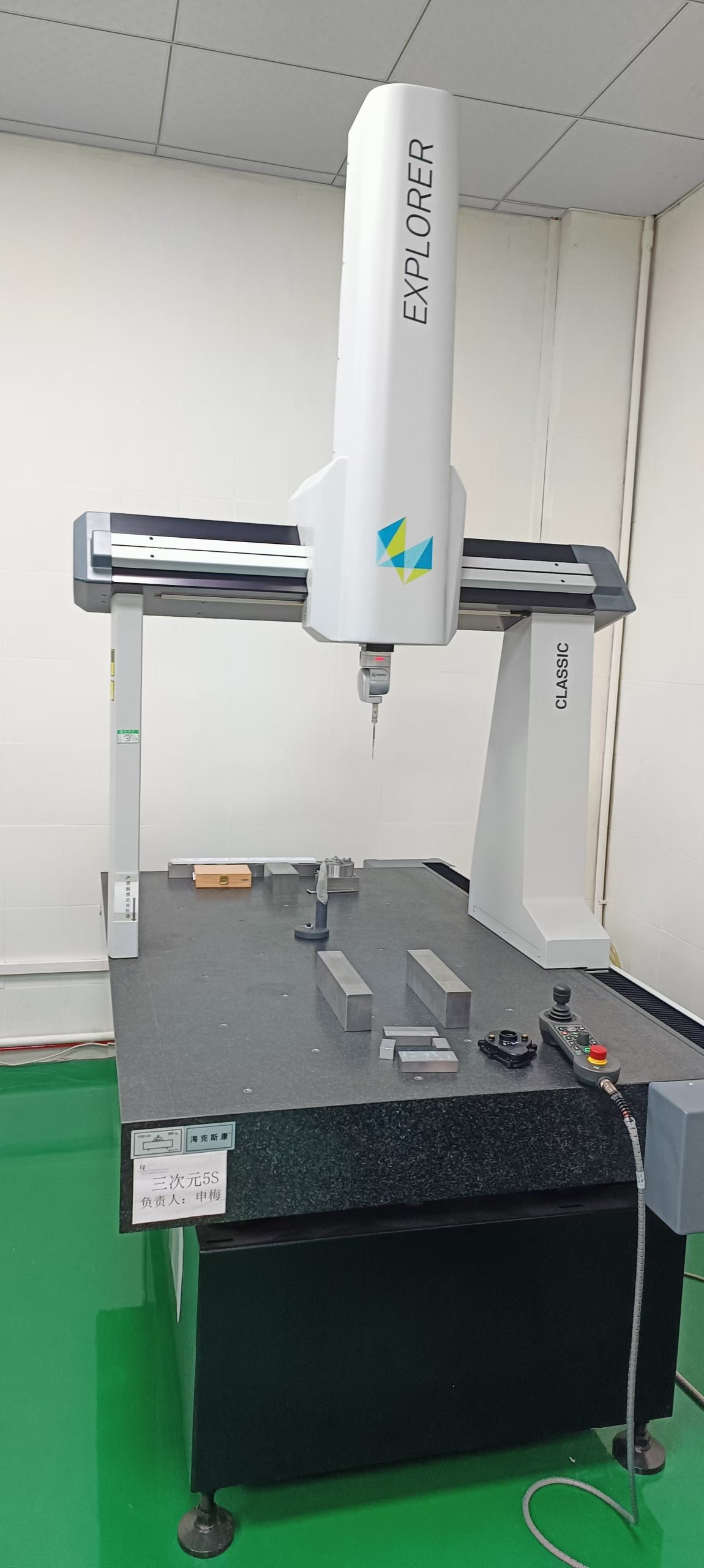
Inspection equipment can include calipers, micrometers, height gauges, CMM equipment, optical measurement systems, or dedicated inspection fixtures.
The inspection method should match the tolerance requirements.
Why Part Inspection Matters
A mold can meet its internal machining requirements and still fail to produce a part that fits the customer’s assembly.
Injection molding involves more than mold geometry.
Material shrinkage, filling balance, cooling, injection pressure, and processing conditions can all influence the final part.
For that reason, mold inspection and part inspection should be considered together.
Mold Surface Finish Inspection
For cosmetic parts, surface finish can be just as important as dimensional accuracy.
Depending on the product, the mold may require:
- Polishing
- Texture
- Matte finish
- EDM finish
- Mirror finish
These requirements should be discussed before manufacturing starts.
A customer asking for a “high-gloss” surface, for example, may need to provide a specific finish requirement rather than relying on a general description.
During inspection, buyers should look for problems such as:
- Scratches
- Uneven polishing
- EDM marks
- Burn marks
- Uneven texture
- Visible machining marks
For cosmetic tooling, a clear reference sample or agreed surface specification can make acceptance much easier.
Injection Mold Quality Control for Mold Function
A mold should not only make a good sample. It should also operate properly.
Several basic functions should be checked before delivery.
Mold Opening and Closing
The mold should open and close smoothly without abnormal resistance or interference.
Ejection System
Ejector pins should move correctly and return completely.
Slider Operation
Sliders should move smoothly and reach the correct positions.
Lifter Operation
Lifters should operate without interference.
Cooling System
Cooling circuits should be checked for leakage, blockage, and correct connections.
Hot Runner System
If a hot runner is used, the system should be checked according to the agreed technical requirements.
These checks are important because a mold that produces good parts but is difficult to operate or maintain can still create problems during production.
Final Injection Mold Quality Inspection
Before the mold is shipped, the manufacturer should perform a final inspection.
The exact inspection requirements depend on the project, but common checks include:
- Mold dimensions
- Core and cavity condition
- Parting surfaces
- Ejection
- Cooling
- Runner system
- Sliders and lifters
- Mold identification
- Spare parts
- Documentation
The molded parts should also be checked against the agreed product requirements.
For a more detailed delivery-stage checklist, see our Injection Mold Acceptance Checklist.
The final inspection is important, but it should not be the only quality checkpoint. Most serious tooling problems are easier to solve earlier in the project.
What Quality Documents Should Buyers Request?
Depending on the project, customers may request different types of quality documentation.
Common examples include:
- Steel certificates
- Material certificates
- Heat treatment records
- Dimensional inspection reports
- T1 trial reports
- Part inspection reports
- Mold drawings
- Spare parts lists
- Maintenance instructions
- Mold photographs
The exact documents should be agreed upon before production.
For a simple project, a full documentation package may not be necessary. For automotive, medical, industrial, or other demanding applications, more detailed records may be required.
The important point is that both sides understand what will be supplied before the mold is completed.
How Should Buyers Evaluate a Mold Manufacturer’s Quality Control?
When comparing mold suppliers, don’t look only at the quotation.
Ask how the supplier controls quality during the project.
1. Engineering Capability
Can the engineering team identify problems during DFM and mold design?
2. Machining Capability
Does the factory have suitable CNC and EDM equipment for the required tolerances?
3. Inspection Capability
Can the supplier measure both mold components and molded parts accurately?
4. T1 Trial Capability
Can the supplier investigate molding problems and make appropriate tooling corrections?
5. Documentation
Can the supplier provide the inspection and material documents required for your project?
6. Communication
Does the supplier tell you about potential problems before they become expensive?
For overseas buyers, this last point matters more than it may seem. A supplier that communicates clearly during the project can save considerable time when design changes or trial problems arise.
Injection Mold Quality Control Checklist
A practical quality control process can be divided into the following stages:
| Stage | What Buyers Should Check |
|---|---|
| RFQ | Product requirements and technical specifications |
| DFM | Manufacturability and potential risks |
| Mold Design | Structure, gates, cooling, ejection and venting |
| Steel Preparation | Steel grade and certification |
| CNC | Dimensions and machining accuracy |
| EDM | Geometry, depth and surface condition |
| Assembly | Alignment and component movement |
| T1 | Filling, dimensions and appearance |
| Modification | Corrective actions |
| Final Inspection | Mold function and part quality |
| Delivery | Packaging, documents and protection |
Looking at quality this way gives buyers a much better picture of how a mold was actually manufactured.
How Does Quality Control Affect Injection Mold Cost?
Quality control does add work to a tooling project, but cutting quality checks to save money can be expensive later.
Poor quality may lead to:
- Additional mold modifications
- Repeated T1 trials
- Production delays
- Higher scrap rates
- Premature component wear
- Unexpected maintenance
- Mold repair costs
This is why buyers should compare the overall tooling solution rather than simply choosing the lowest quotation.
A supplier that spends more time on engineering and inspection may ultimately provide a lower total project cost.
Injection Mold Quality Control from RFQ to Delivery
Quality control should continue throughout the complete tooling project:
RFQ → DFM → Mold Design → Design Approval → Material Preparation → CNC/EDM → Assembly → T1 → Modification → Final Inspection → Delivery
Each stage affects the next one.
For example, a problem missed during DFM may become a design problem. A design problem may become a machining problem. A machining problem may only become obvious during T1.
That is why controlling quality early is usually more efficient than trying to fix everything at the end.
You can learn more about the complete injection mold manufacturing process in our guide from RFQ through final mold delivery.
How Fentormold Approaches Injection Mold Quality Control
At Fentormold, quality control is built into the tooling process rather than treated as a final inspection step.
The project can be reviewed through:
- RFQ and engineering review
- DFM analysis
- Mold design
- Material and component preparation
- CNC machining
- EDM machining
- Mold assembly
- T1 trial
- Part inspection
- Final mold inspection
- Export preparation
Fentormold also provides mold components manufacturing for precision tooling components.
For customers who need both tooling and production support, Fentormold provides injection molding production after the mold is completed.
If you are planning a new tooling project, contact Fentormold with your 3D model, 2D drawing, material specification, production volume, and quality requirements.
Frequently Asked Questions
What is injection mold quality control?
Injection mold quality control is the process of checking the mold’s design, materials, machining, assembly, function, trial parts, and final condition throughout the tooling project.
When should injection mold quality be checked?
Quality should be checked throughout the project, starting with the RFQ and DFM stage and continuing through design, machining, assembly, T1 trials, final inspection, and delivery.
How do I know if an injection mold is high quality?
A high-quality mold should meet the agreed design and dimensional requirements, operate smoothly, produce consistent parts, and be supported by appropriate inspection and material documentation.
Should I request a mold inspection report?
If your project has strict dimensional or quality requirements, an inspection report can provide useful evidence that the mold and molded parts meet the agreed specifications.
What is checked during a T1 trial?
T1 normally evaluates mold operation, filling, ejection, dimensions, appearance, and common molding defects. The results help determine whether mold modifications are required.
Is mold steel certification important?
For production tooling, steel certification can help confirm that the agreed mold steel was used. It can be particularly useful when mold life and durability are important.
How can I reduce the risk of receiving a poor-quality mold?
Define your technical requirements clearly, review DFM and mold design carefully, agree on acceptance criteria before manufacturing, and choose a supplier with suitable engineering, machining, inspection, and trial capabilities.
Conclusion
Injection mold quality control is not something that should happen only when the mold is ready to ship.
It starts with the RFQ and continues through DFM, mold design, steel preparation, CNC machining, EDM, assembly, T1 trials, part inspection, and final acceptance.
For buyers, the most useful question is not simply:
“How much does the mold cost?”
It is:
“How does the supplier control quality throughout the project?”
A reliable mold manufacturer should be able to explain its engineering process, machining capabilities, inspection methods, T1 trial procedure, and final acceptance process.
If you are preparing a new injection mold project, send Fentormold your product drawings, material requirements, production volume, and quality specifications. The team can review your requirements and help develop a tooling solution focused on reliable production and consistent part quality.