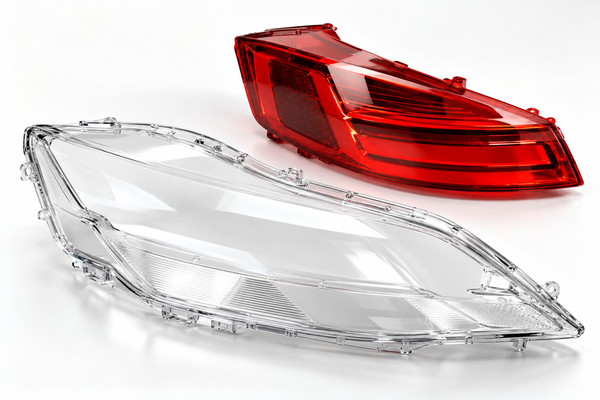
PC vs PMMA is a common material comparison when designing transparent injection molded parts. Both plastics offer good clarity. However, they differ in impact strength, heat resistance, scratch resistance, and molding performance. Choosing the right material can improve product quality and reduce production costs.
Polycarbonate (PC) is known for its high impact strength and heat resistance. Meanwhile, polymethyl methacrylate (PMMA), also called acrylic, offers excellent optical clarity, surface hardness, and weather resistance.
So, which material is better for your project?
The answer depends on how you plan to use the part. For example, automotive lighting components, protective covers, display windows, and electronic housings may need different properties.
In addition, material selection affects mold design, production cost, and final part quality.
This guide compares PC vs PMMA for transparent plastic parts. It also explains how to choose the right material and avoid common injection molding problems.
PC vs PMMA: Key Differences
PC and PMMA are both transparent thermoplastics. Yet, they perform differently under impact, heat, sunlight, and daily use.
The following PC vs PMMA comparison shows their main differences.
| Property | PC (Polycarbonate) | PMMA (Acrylic) |
|---|---|---|
| Light transmission | Around 88–90% | Up to 92% |
| Impact resistance | Excellent | Lower than PC |
| Scratch resistance | Moderate | Better than standard PC |
| Heat resistance | Higher | Lower |
| UV resistance | Depends on grade | Excellent |
| Surface hardness | Lower | Higher |
| Chemical resistance | Sensitive to some chemicals | Sensitive to some solvents |
| Processing temperature | Higher | Lower |
| Molding difficulty | More demanding | Moderate |
| Typical applications | Protective covers, automotive lenses, housings | Light guides, display windows, decorative lenses |
These values represent common transparent grades. Actual performance depends on the material grade, additives, wall thickness, and test conditions.
Therefore, neither material is always better.
Choose PC when impact resistance and heat performance matter most. Choose PMMA when optical clarity, surface appearance, and weather resistance are the main goals.
What Is PC Plastic?
Polycarbonate is a transparent engineering thermoplastic. Manufacturers use it when plastic parts need high strength and good dimensional stability.
Unlike many clear plastics, PC can withstand strong impacts without breaking easily.
As a result, it works well for protective and functional components.
Main Advantages of PC
- Excellent impact resistance
- Good heat resistance
- High transparency
- Good dimensional stability
- Suitable for complex engineering parts
- Available in optical and UV-stabilized grades
However, PC also has some limits.
Its surface can scratch more easily than PMMA. In addition, it needs careful drying and temperature control before injection molding.
PC may also develop stress cracking when exposed to certain chemicals.
For this reason, engineers should consider both mechanical strength and chemical exposure during material selection.
What Is PMMA Plastic?
PMMA is a transparent thermoplastic widely known as acrylic.
It offers excellent light transmission and a smooth, glossy appearance. Therefore, manufacturers often use it for products where visual quality is important.
PMMA also has good outdoor weather resistance.
Compared with standard PC, its surface usually resists scratching better.
Main Advantages of PMMA
- Excellent optical clarity
- Light transmission up to about 92%
- Good surface hardness
- High-gloss finish
- Strong UV and weather resistance
- Good color stability outdoors
However, PMMA is more brittle than PC.
Sharp impacts, thin sections, and high-stress areas may cause cracks.
Moreover, poor part design can increase the risk of stress cracking.
As a result, PMMA works best when transparency and appearance are more important than high impact strength.
PC vs PMMA: Which Has Better Transparency?
Transparency is often the first factor when comparing PC vs PMMA.
Both materials can produce clear injection molded parts. However, their optical properties differ.
PMMA Transparency
PMMA can reach approximately 92% visible light transmission in suitable clear grades.
It also offers excellent surface gloss and low haze.
These properties make it a strong choice for:
- Decorative lighting covers
- Display windows
- Optical lenses
- Transparent consumer products
- Light guides
In addition, PMMA provides good long-term clarity in outdoor applications.
PC Transparency
Standard transparent PC often provides around 88–90% light transmission, depending on the grade and thickness.
Although this is slightly lower than PMMA, the difference may be small in many practical applications.
PC also offers much better impact resistance.
Therefore, it is often a better choice for transparent parts that need both clarity and protection.
For optical products, engineers should also check haze, birefringence, surface quality, and light distribution.
Verdict: In the PC vs PMMA transparency comparison, PMMA usually provides better optical clarity. However, PC offers a better balance between transparency and mechanical strength.
PC vs PMMA: Impact Resistance
Impact resistance is one of the biggest differences between PC and PMMA.
PC is a tough engineering plastic. It can absorb strong impacts without breaking easily.
This makes PC suitable for protective covers, machine guards, and durable transparent housings.
In contrast, PMMA is harder but more brittle.
Although it performs well under normal use, sudden impact can cause cracks or fractures.
When Should You Choose PC?
PC is usually the better option for parts exposed to:
- Accidental drops
- Repeated mechanical loads
- High vibration
- Impact from moving objects
- Rough handling during assembly
For example, a transparent protective cover for industrial equipment needs more than good appearance.
It must also withstand accidental impact.
In this case, PC is usually the safer material choice.
However, engineers should still confirm the impact rating of the selected PC grade.
Verdict: PC is the clear winner in PC vs PMMA impact resistance.
PC vs PMMA: Heat Resistance
Temperature is another important factor in material selection.
PC generally offers better heat resistance than standard PMMA.
Many PC grades provide heat deflection temperatures around 120–135°C, depending on the applied load and test method.
Meanwhile, common PMMA grades often have heat deflection temperatures around 75–100°C.
However, these values do not represent continuous-use temperature ratings.
When Is PC Better?
PC is often suitable for transparent parts used near heat sources.
Examples include automotive lighting components, electrical covers, and electronic housings.
However, special high-temperature applications may require a specific PC grade.
When Is PMMA Better?
PMMA works well when operating temperatures remain within the material’s limits.
For example, indoor display covers and decorative panels may not need the higher heat resistance of PC.
Therefore, using PC in these applications may add unnecessary material and processing costs.
Verdict: When comparing PC vs PMMA for heat resistance, PC is generally the better choice.
PC vs PMMA: Scratch Resistance
Transparent parts must often maintain a clean and smooth surface.
Therefore, scratch resistance can strongly affect material selection.
Standard PMMA has better surface hardness than standard PC.
As a result, PMMA can maintain its visual appearance better under light surface contact.
PC, however, has a softer surface.
Frequent cleaning, rubbing, and handling may leave visible scratches.
Can PC Scratch Resistance Be Improved?
Yes. Manufacturers can apply a hard coating to PC parts.
This coating can improve scratch resistance while keeping the material’s high impact strength.
However, coating adds another production step.
It may also increase total part cost.
For high-volume projects, engineers should evaluate coating cost, quality requirements, and expected service life.
Verdict: PMMA generally offers better scratch resistance without additional coating.
PC vs PMMA: UV and Weather Resistance
Outdoor exposure can affect the appearance and performance of transparent plastics.
Sunlight, rain, temperature changes, and humidity all create challenges.
PMMA has excellent natural UV and weather resistance.
Therefore, it is widely used for outdoor transparent parts.
It can maintain good clarity and color stability over long periods.
Standard PC, however, may gradually yellow when exposed to strong sunlight without suitable UV protection.
Fortunately, manufacturers can use UV-stabilized PC grades or protective coatings.
These options improve outdoor durability.
Which Is Better for Outdoor Parts?
PMMA is often better for outdoor parts where appearance and long-term clarity are the main requirements.
However, PC may be more suitable when outdoor parts also need strong impact resistance.
For example, an exposed protective lens may need both UV resistance and toughness.
In this case, UV-stabilized PC may offer a better solution.
Verdict: In the PC vs PMMA weather resistance comparison, PMMA generally performs better without special UV protection.
PC vs PMMA: Injection Molding Differences
PC and PMMA both work with injection molding. However, each material requires different processing conditions.
Proper temperature control, material drying, and mold design are essential for transparent parts.
PC vs PMMA Processing Parameters
| Processing Parameter | PC | PMMA |
|---|---|---|
| Melt temperature | 280–320°C | 240–280°C |
| Mold temperature | 80–120°C | 35–80°C |
| Material drying | Required | Required |
| Typical drying temperature | Around 120°C | Around 90°C |
| Drying time | Depends on grade and dryer | Often 2–4 hours |
| Injection speed | Controlled to suit the part | Controlled to suit the part |
These values are general starting ranges. Always follow the selected material supplier’s processing recommendations.
PC Injection Molding Challenges
PC needs higher processing temperatures.
In addition, the material absorbs moisture from the air.
If manufacturers do not dry PC correctly, molded parts may develop silver streaks, bubbles, or reduced mechanical strength.
High internal stress can also affect transparent part quality.
Therefore, manufacturers should control:
- Material moisture
- Melt temperature
- Mold temperature
- Injection speed
- Packing pressure
- Cooling balance
PMMA Injection Molding Challenges
PMMA generally requires lower processing temperatures than PC.
However, it also needs careful drying and process control.
Poor processing can cause flow marks, bubbles, or visible weld lines.
In addition, excessive stress can increase the risk of cracking.
For this reason, manufacturers should avoid sharp corners, sudden wall thickness changes, and excessive packing pressure.
Verdict: PC vs PMMA injection molding requires different processing settings. PC generally needs higher temperatures, while both materials need careful drying and stress control.
PC vs PMMA: Mold Design for Transparent Parts
Good mold design is essential for transparent injection molded parts.
Even a suitable material cannot produce high-quality parts if the mold has poor cooling, venting, or gate placement.
Transparent surfaces make many molding defects easier to see.
Therefore, engineers should consider optical appearance during the early design stage.
1. Gate Location
Gate placement affects melt flow and surface quality.
An unsuitable gate may create visible flow lines, weld lines, or stress marks.
For transparent parts, engineers should place gates away from important viewing areas whenever possible.
In addition, the gate should provide enough flow without creating excessive shear.
2. Mold Surface Finish
Transparent parts often require highly polished mold surfaces.
A rough cavity surface can reduce gloss and increase visible defects.
Therefore, optical surfaces may need fine polishing or mirror finishing.
However, the required finish depends on the product.
For example, a decorative transparent cover may need a different finish from an optical lens.
3. Cooling System
Uneven cooling can cause warpage, sink marks, and internal stress.
These problems are especially important for PC and PMMA parts with large transparent surfaces.
As a result, mold designers should aim for balanced cooling.
They should also avoid large temperature differences across the cavity.
For complex products, injection mold design should address cooling and optical requirements together.
4. Venting Design
Poor venting may trap air inside the mold.
This can lead to burn marks, incomplete filling, or visible surface defects.
Therefore, engineers should design suitable vents near the final filling areas.
Vent depth must match the material and part geometry to avoid flash.
5. Part Ejection
Ejection marks can damage the appearance of transparent parts.
For this reason, ejector pins should stay away from important optical surfaces.
In addition, proper draft angles help reduce friction during demolding.
Balanced ejection also reduces part deformation.
At Fentor Mold, we review part geometry, gate location, cooling layout, and surface finish before mold manufacturing. This helps reduce quality problems during sampling and production.
PC vs PMMA: Common Injection Molding Defects
Both materials can develop visible defects during production.
However, most problems can be reduced through better material preparation, mold design, and process control.
| Defect | Possible Cause | Recommended Solution |
|---|---|---|
| Silver streaks | Moisture or trapped gas | Improve drying and venting |
| Flow marks | Poor flow conditions | Adjust temperature and injection speed |
| Weld lines | Multiple flow fronts | Optimize gate position and melt flow |
| Bubbles | Trapped air or moisture | Improve drying and filling conditions |
| Warpage | Uneven cooling or shrinkage | Balance cooling and packing |
| Stress cracking | High residual stress or chemical exposure | Reduce stress and review material compatibility |
| Sink marks | Uneven wall thickness | Improve part design and packing |
For PC, moisture control and residual stress are major concerns.
Meanwhile, PMMA parts need careful handling to reduce cracking and visible damage.
In both cases, consistent process settings help improve product quality.
PC vs PMMA: Automotive Applications
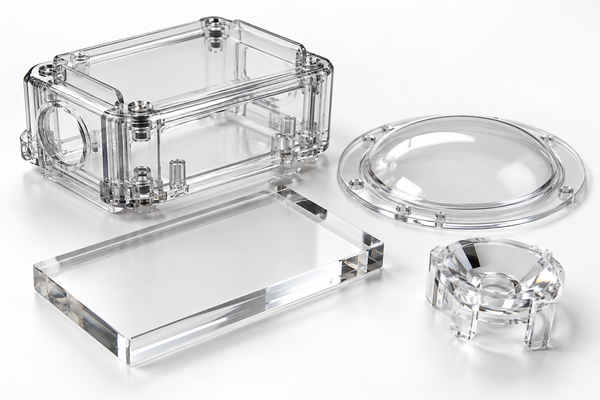
Automotive manufacturers use both PC and PMMA for transparent components.
However, the choice depends on each part’s operating environment.
PC Automotive Applications
PC is commonly used for:
- Automotive headlight lenses
- Instrument cluster covers
- Interior lighting components
- Transparent protective housings
- High-impact automotive covers
For example, automotive headlight outer lenses often use coated PC because they need impact resistance, heat performance, and outdoor durability.
However, coatings and suitable material grades are important for long-term service.
PMMA Automotive Applications
PMMA is often used for:
- Rear lighting lenses
- Decorative lighting components
- Light guides
- Interior display windows
- Transparent trim parts
PMMA provides excellent clarity and surface appearance.
In addition, its natural weather resistance makes it useful for suitable exterior lighting applications.
However, engineers must review impact, temperature, and mounting requirements before final material selection.
For automotive projects, the PC vs PMMA decision should also consider assembly design, mold cost, and production volume.
PC vs PMMA: Which Material Costs More?
Material cost is important, especially for high-volume production.
However, comparing only the price per kilogram may lead to the wrong decision.
PC and PMMA prices vary by grade, supplier, region, and purchase quantity.
Standard PMMA may offer a cost advantage in some optical applications. Yet, optical-grade or specialty PMMA can cost more than certain PC grades.
Therefore, engineers should compare the total production cost.
Factors That Affect Total Cost
Material grade: Optical, UV-stabilized, flame-retardant, and specialty grades may cost more.
Processing temperature: PC usually requires higher melt and mold temperatures, which can increase energy use.
Cycle time: Cooling requirements, wall thickness, and part geometry affect production efficiency.
Surface coating: PC may need hard coating or UV protection in certain applications.
Rejected parts: Optical defects, flow marks, and cracking can increase scrap costs.
Mold design: Complex optical surfaces and strict appearance requirements may increase tooling costs.
For example, PMMA may reduce cost for a decorative transparent cover.
However, PC may provide better overall value when the product requires high impact resistance.
Verdict: In a PC vs PMMA cost comparison, the best choice depends on total production cost rather than material price alone.
PC vs PMMA: How to Choose the Right Material
Before choosing PC or PMMA, engineers should define the part’s main requirements.
The following guide provides a practical starting point.
| Product Requirement | Recommended Material |
|---|---|
| Highest optical clarity | PMMA |
| Strong impact resistance | PC |
| Higher heat resistance | PC |
| Better natural scratch resistance | PMMA |
| Outdoor decorative lens | PMMA |
| Transparent protective cover | PC |
| Automotive headlight outer lens | Coated PC |
| Automotive rear light lens | Often PMMA |
| Transparent display window | PMMA or PC |
| High-strength clear housing | PC |
However, these recommendations are not final material specifications.
A suitable material must also meet the product’s temperature, chemical, impact, and regulatory requirements.
For complex parts, engineers should review the design before starting tooling.
An early engineering review can also identify issues with wall thickness, gate position, mold cooling, and part ejection.
How Fentor Mold Supports Transparent Plastic Parts
Transparent plastic parts require careful control throughout mold development and production.
Small defects can affect both appearance and product performance.
Therefore, material selection and mold design should work together.
Fentor Mold provides custom injection molding production and mold manufacturing services for engineering plastic components.
Our support includes:
- DFM analysis before mold manufacturing
- Material selection and processing review
- Gate and runner design
- Mold cooling and venting optimization
- Mold surface finish control
- Trial molding and sample inspection
- Injection molding production support
For customers developing PC or PMMA parts, early technical discussions can help reduce tooling changes and improve part quality.
PC vs PMMA: Frequently Asked Questions
Is PC Clearer Than PMMA?
No. PMMA generally offers slightly higher visible light transmission than standard PC. However, both materials can produce clear injection molded parts.
Is PMMA Stronger Than PC?
PMMA has better surface hardness than standard PC. However, PC offers much higher impact resistance and is less likely to break under sudden impact.
Can PC Replace PMMA?
Yes, in some applications. However, replacing PMMA with PC may affect optical appearance, scratch resistance, mold processing, and cost.
Therefore, engineers should verify the design requirements before changing materials.
Which Material Is Better for Automotive Lighting?
Both materials work well in automotive lighting. Coated PC is common for headlight outer lenses, while PMMA is often used for rear lighting lenses and light guides.
The final choice depends on the specific automotive requirements.
Which Material Is Easier to Injection Mold?
PMMA generally requires lower processing temperatures than PC. However, both materials need proper drying, mold design, and process control.
Optical-quality parts can be challenging with either material.
Conclusion: PC vs PMMA
When comparing PC vs PMMA, the best material depends on the part’s purpose.
PC provides excellent impact resistance, higher heat resistance, and good transparency. Therefore, it is a strong choice for protective and functional components.
PMMA offers excellent clarity, better natural surface hardness, and strong outdoor weather resistance. As a result, it is often suitable for decorative lenses, display windows, and lighting products.
However, material performance is only one part of the decision.
Good mold design, accurate processing, and quality control also affect the final result.
If you are developing transparent plastic parts, contact Fentor Mold to discuss your drawings, material requirements, and injection molding project.