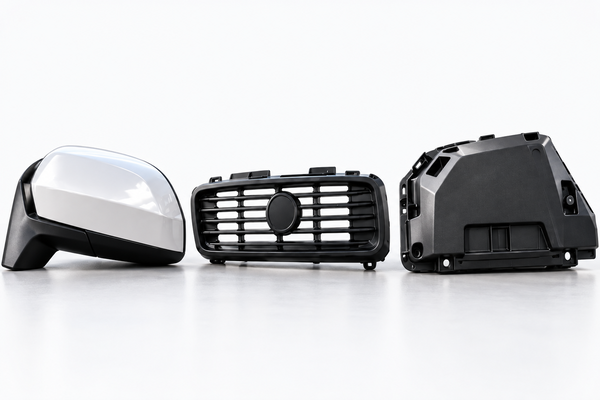
ASA injection molding is widely used to produce plastic parts that need good weather resistance, color stability, and an attractive surface finish. It is especially useful for automotive exterior parts, outdoor housings, and industrial products.
However, ASA injection molding can also cause defects such as warpage, sink marks, silver streaks, weld lines, and burn marks. Poor drying, unstable temperatures, and incorrect mold design often make these problems worse.
Fortunately, manufacturers can prevent many defects by selecting the right processing conditions and improving mold design.
This guide explains the most common ASA molding defects, their causes, and practical solutions to improve part quality.
What Is ASA Injection Molding?
ASA stands for acrylonitrile styrene acrylate. It is a thermoplastic material with good outdoor weather resistance.
Like ABS, ASA offers impact resistance, good surface quality, and practical processing properties. However, ASA uses an acrylic rubber phase, which provides better resistance to UV exposure and outdoor aging than conventional ABS.
As a result, manufacturers often choose ASA for parts exposed to sunlight, rain, and changing temperatures.
Common applications include:
- Automotive mirror housings and exterior trim
- Automotive grilles and decorative covers
- Outdoor electrical enclosures
- Garden equipment housings
- Appliance exterior panels
- Industrial control housings
- Outdoor lighting components
In addition, ASA supports different colors and surface textures. Therefore, manufacturers can often produce attractive outdoor components without painting, depending on the product requirements.
For automotive projects, good mold design is essential to achieve consistent appearance and dimensional accuracy.
ASA Injection Molding Processing Conditions
Correct processing conditions help prevent surface defects, dimensional changes, and unstable production.
However, not all ASA grades use the same settings. Manufacturers should always check the material supplier’s technical data sheet before starting production.
The following values are reference conditions for certain standard ASA grades rather than universal settings for every ASA resin.
| Processing Parameter | Reference Value |
|---|---|
| Material drying temperature | 80°C |
| Material drying time | 2–4 hours |
| Melt temperature | 240–280°C |
| Mold temperature | 40–80°C |
| Typical mold shrinkage | 0.4–0.7% |
| Target moisture content | Below 0.1% |
These conditions are useful starting points. However, the final settings depend on material grade, part thickness, gate design, and machine performance.
ASA Injection Molding Material Drying
Moisture is a common cause of ASA injection molding defects.
When ASA pellets contain excess moisture, molded parts may develop silver streaks, bubbles, or poor surface quality.
Therefore, proper drying is one of the first steps toward stable production.
For many standard ASA grades, drying at around 80°C for 2–4 hours is recommended. However, some modified grades need different conditions.
To improve drying:
- Use a suitable dehumidifying dryer.
- Keep material containers closed.
- Avoid leaving dried pellets exposed to humid air.
- Check material moisture when necessary.
- Follow the resin manufacturer’s drying instructions.
Proper drying helps reduce appearance defects and improves processing stability.
ASA Injection Molding Melt Temperature
Melt temperature affects how easily ASA flows through the cavity.
If the temperature is too low, the resin may not fill thin sections properly. As a result, the part may show short shots, flow marks, or weak weld lines.
On the other hand, excessive melt temperature or long residence time may cause discoloration and material degradation.
Therefore, operators should adjust barrel temperatures gradually and monitor the actual melt temperature.
The goal is to achieve stable filling without overheating the resin.
ASA Injection Molding Mold Temperature
Mold temperature affects surface appearance, shrinkage, and part dimensions.
If the mold is too cold, the material may freeze before the cavity fills completely.
However, an excessively high mold temperature can increase cooling time and may delay ejection.
Uneven mold temperature can also increase warpage.
For this reason, manufacturers should design balanced cooling channels and monitor the temperature across critical areas.
Common ASA Injection Molding Defects
Even when the material is suitable, processing problems can still affect finished parts.
The following defects are among the most common problems found during ASA injection molding.
1. Silver Streaks in ASA Injection Molding
Silver streaks appear as light-colored lines or cloudy marks on the part surface.
They often follow the melt flow direction and may become more visible on dark or glossy components.
Main Causes of Silver Streaks
- Moisture in ASA pellets
- Trapped air inside the cavity
- Excessive melt temperature
- High shear near the gate
- Contaminated material
How to Prevent Silver Streaks
First, check whether the material has been dried correctly.
Next, inspect the gate and runner system for excessive shear.
If moisture is not the cause, check cavity venting and melt temperature.
Also, avoid mixing contaminated regrind with clean material.
For automotive exterior parts, preventing silver streaks is especially important because customers often require a uniform appearance.
2. Warpage in ASA Injection Molding
Warpage occurs when a molded part bends or twists after cooling.
This problem is common in large, thin, or uneven plastic components.
For example, automotive exterior trim and appliance panels may distort when different areas cool at different rates.
Main Causes of Warpage
- Uneven wall thickness
- Unbalanced cooling
- Poor gate position
- Uneven packing pressure
- Early part ejection
- Residual stress
How to Prevent Warpage
Start by improving wall thickness consistency.
Next, review the cooling channel layout to reduce temperature differences across the cavity.
Gate location also matters because it affects melt flow and packing.
In addition, avoid excessive packing pressure and ensure the part has cooled enough before ejection.
For complex parts, Moldflow analysis can help identify potential filling, packing, and cooling problems before tooling begins.
3. Sink Marks in ASA Injection Molding
Sink marks are small depressions that appear on the molded surface.
They often occur near ribs, bosses, or thick wall sections.
Although they may not affect the basic function of a part, sink marks can reduce appearance quality.
Main Causes of Sink Marks
- Excessive wall thickness
- Thick rib intersections
- Insufficient packing pressure
- Early gate freeze
- Poor cooling near thick sections
How to Prevent Sink Marks
First, keep wall thickness as uniform as possible.
For ribs, a common starting guideline is to use a rib thickness of around 40–60% of the adjoining nominal wall. However, the correct ratio depends on the material, surface requirements, and part geometry.
Next, optimize packing pressure and holding time.
Also, make sure the gate remains open long enough to provide effective packing.
If sink marks continue, consider changing the rib design or improving cooling around the affected area.
Good part design often prevents sink marks more effectively than process changes alone.
4. Weld Lines in ASA Injection Molding
Weld lines appear where two or more melt fronts meet inside the cavity.
They are common around holes, ribs, inserts, and complex flow paths.
In some cases, weld lines only affect appearance. However, they can also reduce local strength.
Main Causes of Weld Lines
- Low melt temperature
- Low mold temperature
- Poor gate location
- Slow or unstable filling
- Trapped air at the meeting point
How to Prevent Weld Lines
First, review the gate position and the expected flow pattern.
A better gate location may move the weld line away from visible or highly stressed areas.
Next, optimize melt temperature and injection speed within the material supplier’s limits.
Improved venting may also help the melt fronts join more effectively.
For structural automotive parts, engineers should evaluate weld line location during mold design rather than waiting until the first trial.
5. Burn Marks in ASA Injection Molding
Burn marks usually appear as dark brown or black areas on the molded surface.
They often occur near the end of the flow path or in narrow cavity sections.
In many cases, the cause is trapped air that becomes highly compressed during filling.
Main Causes of Burn Marks
- Poor mold venting
- Excessive injection speed
- Trapped gas
- Excessive melt temperature
- Material degradation
How to Prevent Burn Marks
Start by checking the venting system.
Add or improve vents in areas where gas is likely to become trapped.
Then, review injection speed and the filling pattern.
Reducing injection speed near the end of filling may help in some cases.
However, avoid reducing speed too much because this may cause short shots or visible flow marks.
Proper venting is often the key to preventing burn marks without sacrificing productivity.
6. Flow Marks in ASA Injection Molding
Flow marks appear as waves, lines, or changes in gloss on the surface of a plastic part.
They are especially noticeable on smooth automotive covers and decorative components.
Main Causes of Flow Marks
- Low melt temperature
- Unstable injection speed
- Poor gate design
- Sudden wall thickness changes
- Low mold temperature
How to Prevent Flow Marks
First, check whether the melt temperature is suitable for the selected ASA grade.
Next, adjust injection speed to maintain a more stable flow front.
Gate size and position should also support smooth filling.
In addition, avoid sharp changes in wall thickness. Gradual transitions help the molten plastic flow more evenly.
For visible automotive parts, test the final surface texture during mold trials.
7. Short Shots in ASA Injection Molding
A short shot occurs when the molten material cannot fill the entire mold cavity.
Thin ribs, long flow paths, and complex shapes are especially vulnerable.
Main Causes of Short Shots
- Insufficient injection pressure
- Low melt temperature
- Restricted gates or runners
- Poor venting
- Premature freezing
How to Prevent Short Shots
First, confirm that the injection machine has sufficient capacity and pressure.
Then, check gate and runner dimensions.
If the material freezes too early, adjust the processing temperature within the recommended range.
Also, inspect the last filling areas for trapped air.
For long or thin ASA parts, flow simulation can help identify filling risks before mold production.
How Mold Design Improves ASA Injection Molding
Processing adjustments cannot solve every molding problem.
In many cases, mold design has a greater influence on product quality.
Therefore, engineers should review gate position, cooling, venting, and ejection during the early design stage.
Optimize Gate Design
Gate location determines how the molten ASA enters the cavity.
Poor gate placement can increase weld lines, warpage, and surface defects.
For visible products, the gate should also avoid important cosmetic surfaces whenever possible.
Improve Cooling Balance
Uneven cooling causes different areas of a part to shrink at different rates.
As a result, the finished component may warp or lose dimensional accuracy.
Balanced cooling channels help maintain more uniform temperatures.
For large automotive plastic parts, cooling design should be evaluated before mold manufacturing.
Provide Effective Mold Venting
Poor venting can lead to burn marks, short shots, and weak weld lines.
Therefore, vents should be placed near the expected last filling locations.
The correct vent dimensions depend on the material and mold structure. Engineers must also avoid excessive vent depth, which can cause flash.
Design a Reliable Ejection System
ASA parts can deform if they are ejected too early or unevenly.
Therefore, ejector pins should provide balanced support.
Large or thin components may need additional support to reduce local stress.
For complex projects, Fentor Mold provides engineering reviews through its injection mold manufacturing service to help identify potential design and tooling risks.
ASA Injection Molding for Automotive Parts
ASA is useful for automotive exterior applications because it offers good UV resistance and color stability.
However, automotive parts often have strict appearance and dimensional requirements.
Common applications include:
- Side mirror housings
- Exterior decorative trim
- Front grille components
- Exterior pillar covers
- Sensor covers
- Protective plastic housings
For these products, manufacturers must pay attention to surface appearance, fit, and dimensional stability.
Also, the selected ASA grade must meet the project’s specific heat, impact, weathering, and OEM material requirements.
Before mass production, engineers should validate dimensions and appearance using trial samples.
For automotive trim, repeated measurements after cooling and conditioning can also reveal delayed dimensional changes.
How to Improve ASA Injection Molding Quality
Consistent quality requires more than selecting the correct temperature.
Manufacturers should follow a clear process from material selection to final inspection.
Step 1: Select the Right ASA Grade
Choose the material according to impact strength, UV resistance, color, heat requirements, and product application.
Different ASA grades have different flow and processing properties.
Step 2: Perform DFM Analysis
Review wall thickness, ribs, bosses, draft angles, and undercuts before mold manufacturing.
Early design changes can help avoid costly modifications later.
Step 3: Validate Moldflow Results
For complex parts, use filling and packing simulation to evaluate gate positions, weld lines, and possible warpage.
However, simulation results should be verified through actual mold trials.
Step 4: Conduct Mold Trials
During mold trials, inspect surface defects, part dimensions, filling balance, and ejection performance.
Adjust one key processing parameter at a time to understand its effect.
Step 5: Maintain Stable Production
Once the process is validated, record the approved processing conditions.
Monitor drying, temperatures, pressures, cycle time, and product quality during production.
For projects that require ongoing supply, Fentor Mold also supports customers through its injection molding production services.
ASA Injection Molding FAQs
Is ASA Better Than ABS for Outdoor Parts?
ASA is often a better choice for outdoor applications because it generally offers superior UV and weather resistance.
However, ABS may be more cost-effective for indoor products.
The final choice depends on the required material properties and operating conditions.
What Temperature Is Used for ASA Injection Molding?
For certain standard ASA grades, a melt temperature of 240–280°C and a mold temperature of 40–80°C may serve as starting points.
However, some ASA grades have substantially different processing ranges. Always follow the specific resin manufacturer’s data sheet.
Why Do ASA Parts Warp?
Warpage usually results from uneven cooling, wall thickness differences, or residual stress.
Better cooling balance, gate placement, and process control can help reduce this problem.
Does ASA Need Drying Before Injection Molding?
Yes. Drying is normally recommended because absorbed moisture can cause silver streaks and other defects.
The correct drying conditions depend on the selected ASA grade.
Can ASA Be Used for Automotive Exterior Parts?
Yes. ASA is commonly considered for automotive exterior components that require weather resistance and stable appearance.
However, the chosen grade must meet the application’s specific performance and approval requirements.
Conclusion
ASA injection molding is a practical process for producing weather-resistant plastic parts with a good surface finish.
However, defects such as silver streaks, warpage, sink marks, and weld lines can affect product quality.
To prevent these problems, manufacturers should control material drying, processing temperatures, gate design, cooling, and mold venting.
Most importantly, early DFM analysis and mold trials help identify problems before mass production.
If you are developing automotive exterior components, outdoor housings, or other ASA plastic products, contact Fentor Mold to discuss your mold design and injection molding requirements.