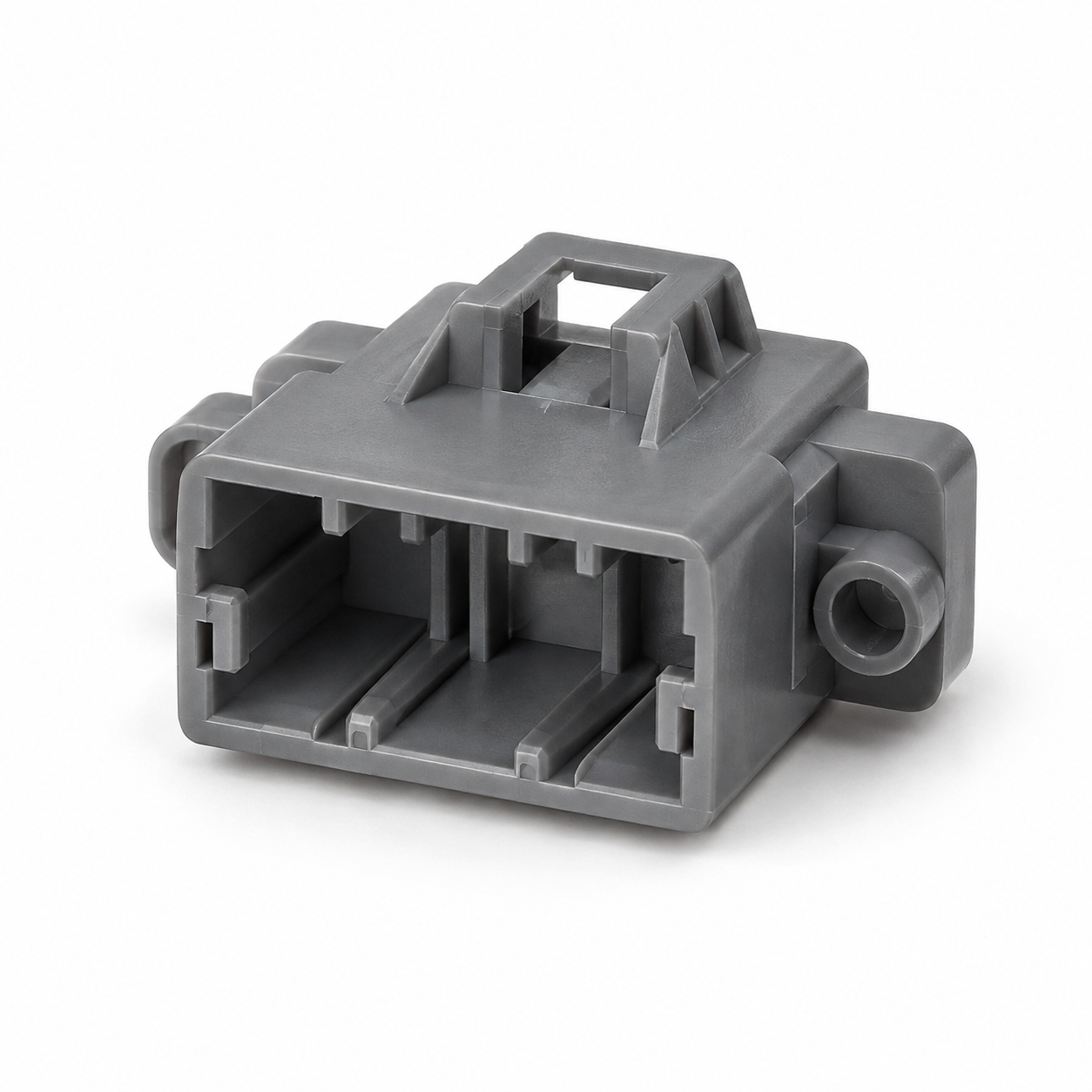
PET injection molding is widely used for electrical parts, housings, connectors, appliance components, and other engineering products. PET offers good strength, chemical resistance, electrical insulation, and dimensional stability. However, PET is a semi-crystalline material, so crystallization must be controlled carefully.
If crystallization is uneven, the part may show warpage, poor surface quality, dimensional change, or unstable shrinkage. In addition, moisture can damage PET during processing.
For stable PET injection molding, engineers need to control material drying, melt temperature, mold temperature, cooling, gate design, packing pressure, and cycle time.
At Fentor Mold, we normally review these points during DFM, mold design, mold trials, and production setup.
What Is PET?
PET stands for Polyethylene Terephthalate. It belongs to the polyester family.
PET is widely used because it offers:
- Good mechanical strength
- Good chemical resistance
- Good electrical insulation
- Good dimensional stability
- Good wear resistance
- Good surface quality
- Good heat resistance in reinforced grades
Common PET grades include:
- Unfilled PET
- Glass-filled PET
- Flame-retardant PET
- Impact-modified PET
- Mineral-filled PET
For engineering parts, glass-filled PET is common because it provides higher stiffness and better dimensional control.
For a wider comparison of common plastics, see our guide to injection molding materials.
Why Is Crystallization Important in PET Injection Molding?
PET is a semi-crystalline plastic.
During cooling, part of the polymer forms a crystalline structure. The amount of crystallization depends mainly on temperature and cooling speed.
As a result, crystallization affects:
- Shrinkage
- Warpage
- Surface appearance
- Stiffness
- Heat resistance
- Dimensional stability
- Cycle time
If PET cools too quickly, crystallization may remain too low.
On the other hand, uneven cooling can create different crystallization levels across the same part.
Therefore, PET injection molding requires stable mold temperature and balanced cooling.
PET Must Be Dried Before Molding
PET is hygroscopic, which means it absorbs moisture from the air.
If wet PET enters the barrel, moisture can react with the polymer at high temperature. As a result, the material may degrade.
Common problems include:
- Lower mechanical strength
- Brittle parts
- Silver streaks
- Poor surface quality
- Reduced impact strength
- Unstable viscosity
- Dimensional variation
Therefore, proper drying is essential before PET injection molding.
Drying conditions should follow the resin supplier’s recommendation.
Important factors include:
- Drying temperature
- Drying time
- Dryer dew point
- Hopper condition
- Storage condition
- Exposure time after drying
A dehumidifying dryer is usually preferred.
After drying, PET should stay protected from humid air. Otherwise, it may absorb moisture again before entering the barrel.
Mold Temperature Controls PET Crystallization
Mold temperature is one of the most important variables in PET injection molding.
If the mold is too cold, the part may cool too quickly.
As a result, you may see:
- Low crystallization
- Poor surface quality
- Higher internal stress
- Unstable dimensions
However, very high mold temperature can increase cycle time.
In addition, higher crystallization may increase shrinkage.
Therefore, the goal is not simply to use a high mold temperature. Instead, the temperature should remain stable and suitable for the selected PET grade.
Both mold halves should also stay as balanced as possible.
Uneven Cooling Creates Uneven Crystallization
Cooling balance has a strong effect on PET part quality.
For example, one area may cool quickly while another area stays hot.
As a result, the two areas can crystallize at different rates.
This may cause:
- Warpage
- Twisting
- Uneven shrinkage
- Flatness problems
- Hole position shift
- Dimensional drift
Cooling channels should be arranged evenly around the cavity and core.
Special attention is needed around:
- Thick bosses
- Deep ribs
- Core inserts
- Large flat areas
- Thick wall sections
- Local hot spots
When normal cooling lines cannot reach a hot area, baffles or bubblers may help.
In some cases, high-conductivity inserts can also improve cooling balance.
Wall Thickness Affects PET Crystallization
Uneven wall thickness changes the cooling speed.
Thick areas stay hot longer. In contrast, thin areas freeze earlier.
Therefore, different areas may crystallize at different rates.
This can cause:
- Sink marks
- Uneven shrinkage
- Warpage
- Surface variation
- Internal stress
For better PET injection molding, wall thickness should stay as uniform as possible.
Instead of using thick solid sections, consider:
- Cored-out structures
- Smooth wall transitions
- Proper ribs
- Controlled boss thickness
- Balanced part geometry
For example, a thick boss connected to a thin wall may create sink marks and local deformation.
Gate Location Affects Filling and Shrinkage
Gate position affects melt flow, packing, weld lines, and fiber orientation.
This is especially important for glass-filled PET.
If the gate forces most fibers in one direction, shrinkage may also become directional.
As a result, the part can bend or twist after cooling.
A better gate position can help balance flow and packing.
During injection mold design and manufacturing, Fentor Mold normally reviews gate location together with wall thickness, flow length, weld line position, and expected deformation.
For complex parts, Moldflow analysis can also help predict flow and shrinkage behavior.
Keep Melt Temperature Stable
PET needs enough heat to melt and flow properly.
However, excessive melt temperature can damage the material.
If the melt temperature is too low:
- Flow becomes poor
- Injection pressure rises
- Weld lines may become weak
- Filling may become unstable
If the melt temperature is too high:
- Material degradation may increase
- Color may change
- Mechanical strength may drop
- Residence time becomes more critical
Therefore, melt temperature should stay within the resin supplier’s recommended range.
If filling is difficult, do not increase temperature immediately.
Instead, also check:
- Gate size
- Runner size
- Wall thickness
- Injection speed
- Venting
Injection Speed Affects Surface Quality
Injection speed affects filling, air trapping, weld lines, and shear.
A higher speed can help fill thin areas. However, too much speed may create new problems.
These include:
- Burn marks
- Air traps
- Jetting
- High shear
- Surface streaks
For some PET parts, multi-stage injection gives better control.
For example:
- Use moderate speed through the gate.
- Increase speed during the main filling stage.
- Reduce speed near the end of filling.
As a result, cavity pressure becomes more stable and filling improves.
Packing Pressure Influences PET Shrinkage
Packing pressure helps compensate for shrinkage after filling.
Too little packing may cause:
- Sink marks
- Low part weight
- Short dimensions
- Poor dimensional consistency
However, excessive packing can also create problems.
For example, it may cause:
- High internal stress
- Flash
- Difficult ejection
- Oversized dimensions
- Warpage
Therefore, packing pressure and holding time should be optimized together.
Part weight is a useful reference during mold trials.
Once the gate freezes, extra holding time usually gives little benefit.
Glass-Filled PET Needs Extra Attention
Glass-filled PET is widely used for stronger engineering parts.
It offers:
- Higher stiffness
- Higher strength
- Better heat resistance
- Better dimensional stability under load
However, glass fiber also changes molding behavior.
Possible problems include:
- Fiber orientation
- Directional shrinkage
- Warpage
- Higher mold wear
- Surface fiber exposure
Therefore, gate design and cooling balance become even more important.
For glass-filled PET, flow direction can strongly affect final dimensions.
Common PET Injection Molding Problems
| Problem | Common Cause | Typical Improvement |
|---|---|---|
| Warpage | Uneven cooling or crystallization | Improve cooling balance |
| Silver streaks | Wet PET | Improve drying |
| Brittle parts | Moisture degradation or overheating | Improve drying and temperature control |
| Uneven shrinkage | Different cooling rates | Balance mold temperature |
| Sink marks | Thick sections or low packing | Reduce thickness and adjust packing |
| Weld lines | Poor flow or low temperature | Improve gate and process settings |
| Burn marks | Trapped air | Improve venting |
| Flash | Excessive pressure or mold fit issue | Reduce pressure and inspect shut-off |
| Surface variation | Uneven crystallization | Stabilize mold temperature |
| Dimensional drift | Unstable temperature or packing | Stabilize process conditions |
For broader troubleshooting, see our guide to common injection molding defects.
Amorphous PET vs Crystalline PET
The cooling history of PET affects its final structure.
More Amorphous PET
When PET cools very quickly, crystallization may stay low.
This can provide:
- Lower initial shrinkage
- Different surface appearance
- Lower heat resistance
- Higher internal stress in some cases
More Crystalline PET
When PET stays longer in the crystallization temperature range, more crystals can form.
As a result, the material may offer:
- Better heat resistance
- Higher stiffness
- More stable structure
However, higher crystallization can also increase shrinkage.
Therefore, the right balance depends on the part and the material grade.
PET Injection Molding Requires Stable Mold Temperature
A common mistake is to focus only on barrel settings.
However, crystallization mainly develops during cooling.
Therefore, mold temperature stability is critical.
For example, a cold mold may slowly heat up during the first production cycles.
As a result, part dimensions may change from cycle to cycle.
Therefore, the mold should reach a stable production temperature before final dimensions are approved.
In addition, cooling water temperature and flow should remain consistent during mass production.
Mold Design Matters More Than Process Adjustment
Machine settings can improve many molding problems. However, they cannot fully correct a poor mold design.
| Problem | Can Process Adjustment Fully Fix It? |
|---|---|
| Poor gate location | Usually no |
| Uneven wall thickness | No |
| Unbalanced cooling | Usually no |
| Poor fiber orientation | Only partly |
| Wet PET | No |
| Incorrect packing pressure | Yes |
| Incorrect injection speed | Yes |
| Incorrect melt temperature | Yes |
Therefore, DFM and mold design should reduce the main risks before steel cutting.
Once the mold is finished, major cooling or gate changes can become expensive.
How to Keep PET Injection Molding Stable in Production
One good sample does not mean the process is ready for mass production.
For stable PET injection molding, production teams should monitor:
- Material drying
- Melt temperature
- Mold temperature
- Cooling water temperature
- Injection pressure
- Packing pressure
- Part weight
- Cycle time
- Critical dimensions
- Warpage trend
In addition, glass-filled PET parts should be checked for flatness and fiber-related deformation.
The inspection timing should also remain consistent.
For projects that require tooling and production support, our injection molding production service covers mold trials, process setup, inspection, and production preparation.
Final Thoughts
PET injection molding can produce strong, stable, and heat-resistant engineering parts. However, crystallization must be controlled carefully.
For better results, focus on:
- Proper material drying
- Stable mold temperature
- Balanced cooling
- Uniform wall thickness
- Correct gate location
- Stable melt temperature
- Controlled injection speed
- Proper packing pressure
- Fiber orientation in glass-filled grades
- Consistent production conditions
Crystallization problems usually come from temperature imbalance rather than one machine setting.
Therefore, material drying, mold temperature, cooling design, gate location, and process control should work together.
When these factors remain stable, PET injection molding can achieve better dimensional accuracy, lower warpage, and more reliable mass production.