
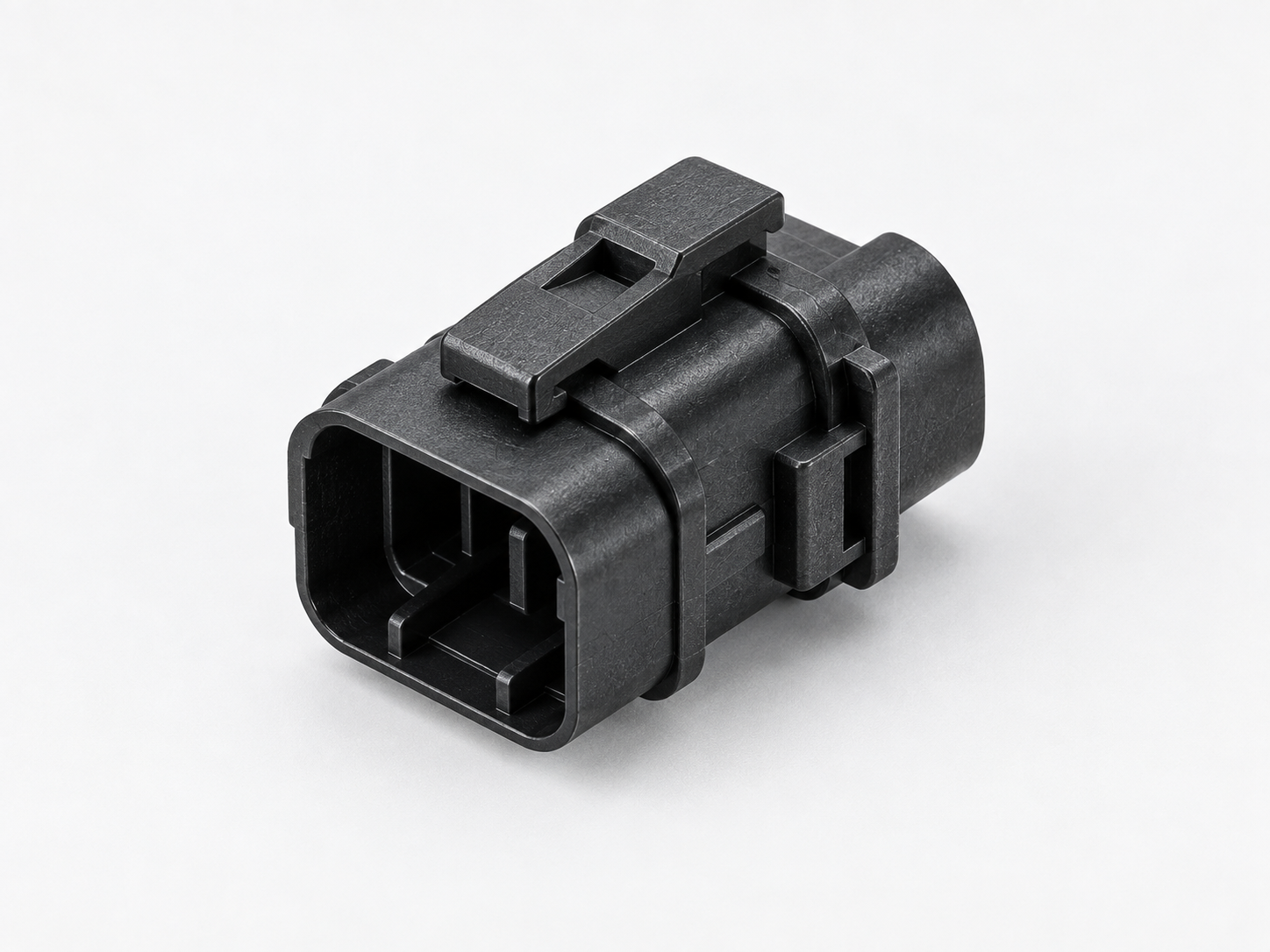
PA6 injection molding is widely used for automotive parts, electrical components, gears, housings, clips, brackets, and other engineering plastic parts. PA6 offers good strength, toughness, wear resistance, and chemical resistance. However, it also absorbs moisture easily. In addition, shrinkage and dimensional change can become difficult to control.
These problems become more obvious with glass-filled PA6. Therefore, stable molding requires good control of material drying, mold temperature, gate location, cooling, packing pressure, and final moisture condition.
At Fentor Mold, we normally review these factors during DFM, mold design, mold trials, and production setup.
What Is PA6?
PA6, also called Nylon 6, is a common engineering thermoplastic.
It is widely used because it offers:
- Good mechanical strength
- Good toughness
- Good wear resistance
- Good chemical resistance
- Good fatigue resistance
- Good flowability
- Good electrical insulation
Common PA6 grades include:
- Unfilled PA6
- PA6 GF15
- PA6 GF30
- PA6 GF50
- Flame-retardant PA6
- Impact-modified PA6
- Heat-stabilized PA6
Glass fiber improves stiffness and strength. However, it also changes shrinkage behavior. As a result, glass-filled grades often have a higher warpage risk.
For a wider comparison of common plastics, see our guide to injection molding materials.
Why Is Moisture Important in PA6 Injection Molding?
PA6 is hygroscopic. In simple terms, it absorbs moisture from the air.
This is one of the most important issues in PA6 injection molding.
When wet PA6 enters the barrel, moisture can react with the polymer at high temperature. As a result, the material may lose strength.
Common problems include:
- Silver streaks
- Bubbles
- Brittle parts
- Poor surface appearance
- Lower tensile strength
- Reduced impact strength
- Unstable dimensions
Sometimes the damage is not easy to see. For example, the surface may look acceptable while the material inside has already lost strength.
Therefore, PA6 should be dried correctly before molding.
Dry PA6 Properly Before Molding
Drying conditions should follow the resin supplier’s recommendation.
The main goal is simple: reduce moisture before the material enters the molding machine.
Important factors include:
- Drying temperature
- Drying time
- Dryer dew point
- Hopper condition
- Storage condition
- Exposure time after drying
A dehumidifying dryer is usually preferred because PA6 needs dry air, not only heat.
After drying, the material should stay covered. Otherwise, it may absorb moisture again.
For this reason, avoid leaving dried PA6 open beside the machine for a long time.
How Does Moisture Affect Final Dimensions?
Moisture matters even after molding.
PA6 can absorb water from the environment after the part leaves the mold. As a result, the part may expand slightly.
At the same time, its mechanical properties may also change.
This is especially important for parts with:
- Tight hole positions
- Bearing seats
- Snap fits
- Gear teeth
- Electrical connectors
- Small assembly gaps
- Flatness requirements
Therefore, engineers should not check critical dimensions only once.
For example, the customer and supplier should agree whether dimensions are measured:
- Immediately after molding
- After 24 hours
- After moisture conditioning
- At a fixed temperature and humidity
Without a clear inspection condition, the same part may produce different measurement results.
PA6 Injection Molding Shrinkage Must Be Controlled
Shrinkage is another major issue in PA6 injection molding.
The final shrinkage depends on several factors:
- Material grade
- Glass fiber content
- Part thickness
- Gate location
- Mold temperature
- Packing pressure
- Cooling time
- Fiber direction
Unfilled PA6 usually has higher overall shrinkage than heavily glass-filled PA6.
However, glass-filled PA6 often has more directional shrinkage.
In other words, the material may shrink differently along the flow direction and across it. Therefore, the part may bend or twist after cooling.
Gate Location Affects PA6 Dimensional Stability
Gate location affects flow direction, packing, weld lines, and fiber orientation.
This becomes even more important with glass-filled PA6.
If the gate forces most fibers in one direction, the part may shrink unevenly.
As a result, you may see:
- Bowing
- Twisting
- Flatness problems
- Hole position shift
- Assembly mismatch
A better gate position can help the melt spread more evenly.
During injection mold design and manufacturing, Fentor Mold normally reviews gate position together with wall thickness, flow length, weld lines, and expected deformation.
For difficult parts, Moldflow analysis can also help predict filling and fiber direction.
Keep Wall Thickness Consistent
Uneven wall thickness can cause uneven cooling.
For example, thick areas cool more slowly than thin areas. Therefore, they may continue shrinking after the thinner sections become stable.
This can cause:
- Sink marks
- Warpage
- Dimensional variation
- Internal stress
For better PA6 injection molding, avoid unnecessary thick sections.
Instead, use:
- Cored-out thick areas
- Smooth wall transitions
- Proper rib design
- Controlled boss thickness
- Balanced wall structure
A thick solid boss is a common problem. It may create both sink marks and local deformation.
In comparison, a thinner boss supported by ribs is usually more stable.
Mold Temperature Influences PA6 Part Quality
Mold temperature affects surface quality, crystallization, shrinkage, and dimensions.
If the mold is too cold, the material may freeze too quickly.
This can cause:
- Poor surface finish
- Higher internal stress
- Weak weld lines
- Unstable dimensions
On the other hand, a higher mold temperature can improve surface quality and crystallization.
However, it may also increase cycle time and shrinkage.
Therefore, the goal should be a stable mold temperature rather than simply a high temperature.
In addition, both mold halves should cool as evenly as possible.
Cooling Balance Is Critical
Cooling differences can quickly create warpage.
For example, if the cavity side cools faster than the core side, one surface may shrink before the other.
As a result, the part can bend after ejection.
Cooling design should focus on areas such as:
- Thick bosses
- Deep ribs
- Large flat surfaces
- Core inserts
- Long cores
- Local hot spots
When normal water lines cannot reach these areas, baffles or bubblers may help.
In some molds, high-conductivity inserts can also improve local cooling.
Use a Stable Melt Temperature
PA6 needs enough heat to flow well.
However, too much heat can damage the material.
If the melt temperature is too low:
- Filling becomes difficult
- Injection pressure rises
- Weld lines may become weak
- Surface quality may become poor
If the melt temperature is too high:
- Material degradation may increase
- Color may change
- Strength may drop
- Residence time becomes more critical
Therefore, melt temperature should stay within the resin supplier’s recommended range.
If filling is poor, do not increase barrel temperature immediately. Instead, also check the gate, runner, wall thickness, and venting.
Injection Speed Should Match the Part
Injection speed affects filling, surface quality, weld lines, and fiber orientation.
Higher speed can help fill thin sections. However, excessive speed can create new problems.
These may include:
- Burn marks
- Air trapping
- Jetting
- High shear
- Fiber exposure
For many parts, multi-stage injection gives better control.
For example:
- Use moderate speed through the gate.
- Increase speed during the main filling stage.
- Reduce speed near the end of filling.
As a result, filling becomes more stable and sudden pressure changes are reduced.
Packing Pressure Affects Dimensions
Packing pressure helps compensate for shrinkage after filling.
Too little packing may cause:
- Sink marks
- Low part weight
- Short dimensions
- Poor dimensional consistency
However, too much packing can also create problems.
For example, it may cause:
- High internal stress
- Flash
- Difficult ejection
- Oversized dimensions
- Warpage
Therefore, packing pressure and holding time should be optimized together.
Part weight is a useful reference during mold trials. Once the gate freezes, extra holding time usually gives little benefit.
Common PA6 Injection Molding Problems
| Problem | Common Cause | Typical Improvement |
|---|---|---|
| Silver streaks | Wet material | Improve drying |
| Warpage | Uneven cooling or fiber orientation | Optimize gate and cooling |
| Dimensional variation | Moisture or unstable packing | Control moisture and process |
| Brittle parts | Moisture degradation or overheating | Improve drying and temperature control |
| Sink marks | Thick sections or low packing | Reduce thickness and adjust packing |
| Weld lines | Poor flow or low temperature | Improve gate and process conditions |
| Burn marks | Trapped air | Improve venting |
| Flash | Excessive pressure or mold fit issue | Reduce pressure and inspect shut-off |
| Fiber exposure | High shear or poor surface flow | Optimize speed and gate design |
| Short shot | Low flow or poor venting | Improve filling conditions |
For broader troubleshooting, see our guide to common injection molding defects.
Unfilled PA6 vs Glass-Filled PA6
Material grade strongly affects molding behavior.
Unfilled PA6
Unfilled PA6 usually offers:
- Better toughness
- Better surface appearance
- Higher shrinkage
- Lower stiffness
- More uniform flow
It is generally easier to control from a fiber-orientation point of view.
However, overall shrinkage can still be relatively high.
Glass-Filled PA6
Glass-filled PA6 normally offers:
- Higher stiffness
- Higher strength
- Better heat resistance
- Better dimensional stability under load
However, it can also create:
- Strong fiber orientation
- Directional shrinkage
- Higher mold wear
- Greater warpage risk
- Visible surface fibers
Therefore, gate position and cooling become more important as glass fiber content increases.
PA6 Injection Molding Needs More Than One Dimensional Check
A common mistake in PA6 injection molding is checking dimensions only once.
A part may meet the drawing immediately after molding. However, its dimensions may change after moisture absorption.
For critical parts, it is better to define:
- Inspection time
- Storage condition
- Temperature
- Relative humidity
- Moisture conditioning
This gives both the customer and supplier a clear standard.
Otherwise, different inspection times can produce different results.
Mold Design Matters Before Process Adjustment
Machine settings can solve many molding problems. However, they cannot fully correct a poor mold design.
| Problem | Can Process Adjustment Fully Fix It? |
|---|---|
| Poor gate location | Usually no |
| Uneven wall thickness | No |
| Unbalanced cooling | Usually no |
| Poor fiber orientation | Only partly |
| Wet PA6 | No |
| Incorrect packing pressure | Yes |
| Incorrect injection speed | Yes |
| Incorrect melt temperature | Yes |
Therefore, DFM and mold design should reduce the main risks before steel cutting.
Once the mold is finished, major gate or cooling changes can become expensive.
How to Keep PA6 Injection Molding Stable in Production
One good sample does not mean the process is ready for mass production.
For stable PA6 injection molding, production teams should monitor:
- Material drying
- Melt temperature
- Mold temperature
- Injection pressure
- Part weight
- Cushion position
- Cooling time
- Cycle time
- Critical dimensions
- Moisture condition
For glass-filled PA6, flatness and hole positions also need close attention.
In addition, dimensional inspection should follow a fixed timing standard.
For projects that need tooling and production support, our injection molding production service covers mold trials, process setup, inspection, and production preparation.
Final Thoughts
PA6 injection molding can produce strong, durable, and precise plastic parts. However, moisture and dimensional change must be controlled throughout the process.
For better results, focus on:
- Proper material drying
- Controlled moisture exposure
- Stable melt temperature
- Stable mold temperature
- Correct gate location
- Balanced cooling
- Uniform wall thickness
- Proper packing pressure
- Defined inspection conditions
- Fiber orientation in glass-filled grades
For PA6, dimensional control does not end when the part leaves the mold.
Instead, moisture absorption can continue to change the part after molding. Therefore, mold design, process control, material drying, and inspection conditions should work together.
When these factors remain stable, PA6 injection molding can achieve better dimensional accuracy and more reliable mass production.