
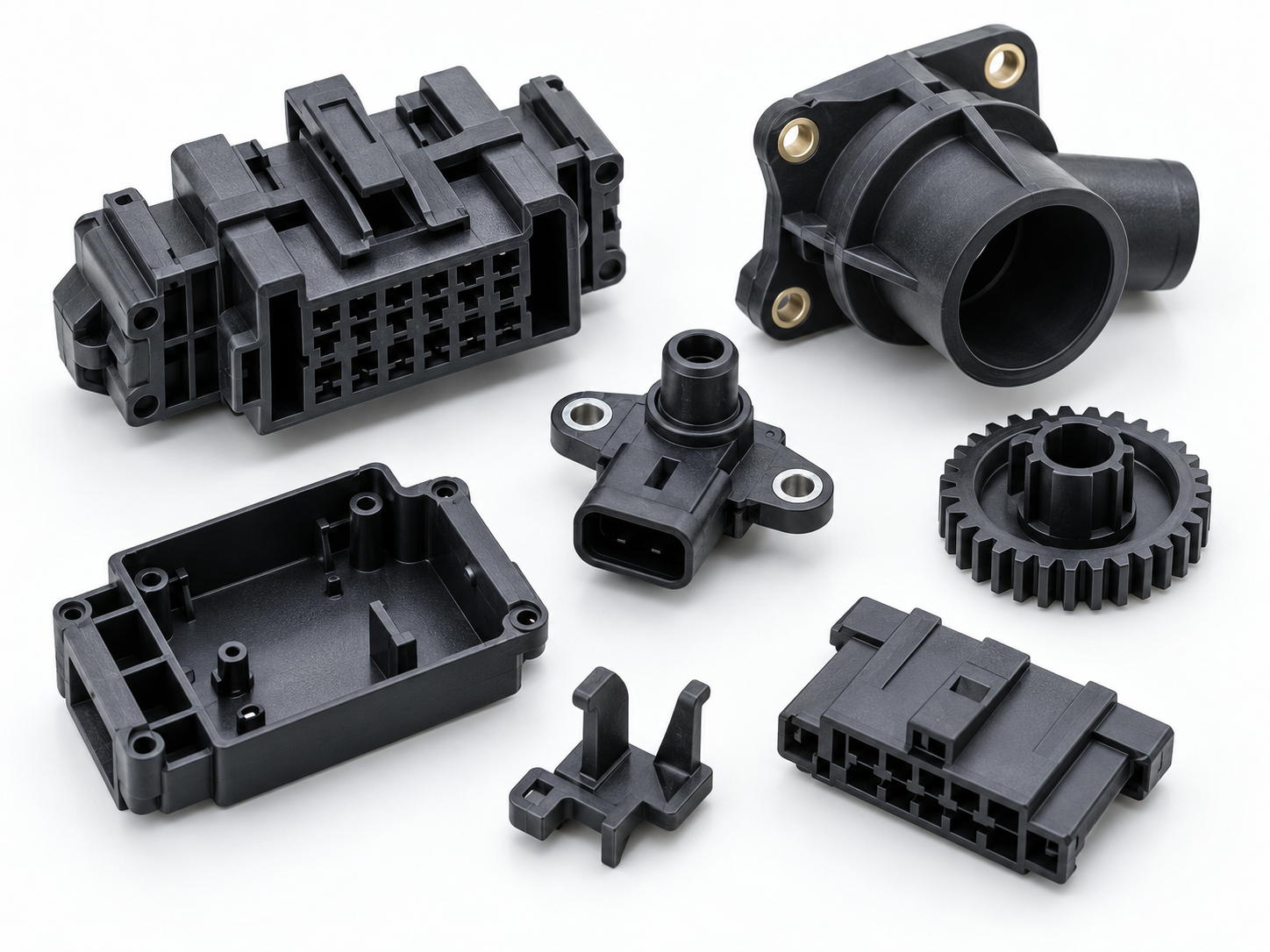
PBT injection molding is widely used for electrical connectors, automotive parts, sensor housings, appliance components, and other precision plastic products. PBT offers good dimensional stability, electrical insulation, chemical resistance, and heat resistance. However, it can absorb moisture before molding. In addition, glass-filled grades can show serious warpage if the gate, cooling, or flow direction is not well controlled.
For stable PBT injection molding, engineers need to manage material drying, melt temperature, mold temperature, gate location, fiber orientation, packing pressure, and cooling together.
At Fentor Mold, we normally review these points during DFM, mold design, mold trials, and production setup before mass production begins.
What Is PBT?
PBT stands for Polybutylene Terephthalate. It is an engineering thermoplastic from the polyester family.
PBT is commonly used because it offers:
- Good dimensional stability
- Good electrical insulation
- Good chemical resistance
- Good heat resistance
- Fast crystallization
- Good surface finish
- Good wear resistance
In addition, PBT is often reinforced with glass fiber when higher stiffness and strength are needed.
Common grades include:
- Unfilled PBT
- PBT GF10
- PBT GF20
- PBT GF30
- Flame-retardant PBT
- Mineral-filled PBT
- PBT blends
Compared with unfilled grades, glass-filled PBT provides much higher stiffness. However, it also makes PBT injection molding more sensitive to warpage and fiber orientation.
For a broader overview of engineering plastics, see our guide to injection molding materials.
Why Does Moisture Matter in PBT Injection Molding?
PBT can absorb moisture during storage and transportation.
If wet material enters the barrel, the moisture can react with the polymer at high temperature. As a result, the material can lose strength and stability.
Common problems include:
- Silver streaks
- Brittle parts
- Poor surface appearance
- Lower mechanical strength
- Dimensional variation
- Unstable molding
- Lower long-term reliability
In some cases, the molded part may look acceptable at first. However, the material can still be damaged inside.
Therefore, material drying is one of the most important steps in PBT injection molding.
Dry PBT Before Molding
PBT should be dried according to the material supplier’s recommendation.
The main goal is to reduce moisture before the pellets enter the molding machine.
Important drying factors include:
- Drying temperature
- Drying time
- Dew point
- Hopper condition
- Material exposure time after drying
A good drying system should provide stable hot, dry air. Simply heating the pellets is not enough.
In addition, dried PBT should not stay exposed to humid air for too long. Otherwise, it may absorb moisture again.
For this reason, production teams should keep dried material covered and feed it into the machine quickly.
For more detail, see our article on injection molding material drying.
Why Does Warpage Happen in PBT Injection Molding?
Warpage happens when different areas of the part shrink at different rates.
This is especially important for glass-filled grades.
Glass fibers usually follow the melt flow. Therefore, shrinkage is not equal in every direction. The part may shrink less along the fiber direction and more across it.
As a result, the part can bend, twist, or lift after cooling.
Warpage can become worse when the part also has:
- Uneven wall thickness
- Long flow length
- Poor gate location
- Unbalanced cooling
- Large flat surfaces
- Thick ribs
- Asymmetrical geometry
- Uneven packing
Because of this, warpage should be considered before mold machining starts.
Gate Location Strongly Affects Fiber Orientation
Gate position has a major effect on melt flow and fiber direction.
For glass-filled PBT, a poor gate location can force the fibers to align too strongly in one direction.
As a result, the part may show:
- Bowing
- Twisting
- Corner lifting
- Flatness failure
- Hole position shift
- Assembly mismatch
A better gate position can help the melt spread more evenly through the cavity.
During injection mold design and manufacturing, Fentor Mold checks gate position together with wall thickness, flow length, weld line location, and expected deformation.
For large or flat parts, Moldflow analysis can also help predict fiber orientation and warpage before steel cutting.
Keep Wall Thickness as Uniform as Possible
Uneven wall thickness is one of the main causes of unstable shrinkage.
Thick areas cool more slowly than thin areas. Therefore, they may shrink later and pull the part out of shape.
For better PBT injection molding, sudden thickness changes should be avoided.
Instead, use:
- Gradual wall transitions
- Cored-out thick sections
- Proper rib design
- Controlled boss thickness
- Balanced structural features
For example, a large solid boss connected directly to a thin wall can create sink marks and local warpage.
A thinner boss supported by ribs is usually more stable.
Be Careful With Rib Design
Ribs improve stiffness without making the whole part thicker.
However, oversized ribs can create sink marks and uneven shrinkage.
In glass-filled PBT, ribs can also change fiber flow. As a result, the part may bend toward one side after cooling.
When designing ribs, engineers should check:
- Rib thickness
- Rib direction
- Rib height
- Distance between ribs
- Base radius
- Draft angle
- Relationship to the main flow direction
The best rib direction depends on the part.
Therefore, stiffness, mold filling, and warpage should be reviewed together.
Control Mold Temperature
PBT is a crystalline material. Therefore, mold temperature affects crystallization, shrinkage, appearance, and dimensional stability.
If the mold temperature is too low, the surface may freeze too early.
Possible problems include:
- Poor surface finish
- Unstable dimensions
- Higher internal stress
- Uneven crystallization
On the other hand, very high mold temperature can increase cycle time.
The goal is not simply to use a high or low temperature. Instead, the mold temperature should remain stable during production.
In addition, both mold halves should cool as evenly as possible.
Unbalanced cooling is a common cause of part bending.
Balance the Cooling System
Cooling design is especially important for flat PBT parts and glass-filled components.
If one side cools faster than the other, shrinkage becomes uneven.
As a result, the part may show:
- Bowing
- Twisting
- Flatness problems
- Dimensional drift
Cooling channels should be placed as evenly as possible around the cavity and core.
Special attention is needed around:
- Deep ribs
- Thick bosses
- Large flat surfaces
- Core inserts
- Local hot spots
In some molds, baffles, bubblers, or high-conductivity inserts may help improve cooling balance.
Use the Correct Melt Temperature
PBT must melt fully before filling the cavity. However, too much heat can damage the material.
If the melt temperature is too low:
- Flow may become poor
- Weld lines may become weak
- Injection pressure may increase
- Filling may become unstable
If the melt temperature is too high:
- Material degradation may increase
- Color may change
- Mechanical strength may drop
In addition, high melt temperature makes residence time more critical.
Therefore, the melt temperature should stay within the resin supplier’s recommended processing range.
It is better to solve flow problems through good gate, runner, and wall design instead of simply increasing temperature.
Control Injection Speed
Injection speed affects surface appearance, fiber orientation, weld lines, and air trapping.
High injection speed can help fill thin sections. However, excessive speed may increase shear.
Possible problems include:
- Burn marks
- Fiber exposure
- Jetting
- Air trapping
- Strong directional fiber alignment
In many cases, multi-stage injection works better than one fixed speed.
For example:
- Use a controlled speed when the melt enters the gate.
- Increase speed during the main filling stage.
- Reduce speed near the end of filling.
As a result, the process becomes more stable and sudden pressure changes are reduced.
Packing Pressure Can Affect Warpage
Packing pressure helps compensate for shrinkage after filling.
However, too much packing can create uneven internal stress.
If one area is packed more heavily than another, the part may deform after ejection.
Too little packing may cause:
- Sink marks
- Low part weight
- Short dimensions
Too much packing may cause:
- High residual stress
- Difficult ejection
- Oversized areas
- Warpage
- Flash
Part weight is a useful reference during mold trials.
Once the gate freezes, extra holding time usually provides little benefit.
Common PBT Injection Molding Problems
| Problem | Common Cause | Typical Improvement |
|---|---|---|
| Warpage | Fiber orientation, uneven cooling | Improve gate and cooling design |
| Silver streaks | Wet material | Improve drying |
| Brittle parts | Moisture degradation | Control moisture and melt temperature |
| Sink marks | Thick sections | Reduce local thickness and optimize packing |
| Weld lines | Low temperature, poor gate position | Improve flow and gate design |
| Burn marks | Trapped air, excessive speed | Improve venting and reduce speed |
| Dimensional variation | Unstable cooling or packing | Stabilize process conditions |
| Poor surface finish | Low mold temperature | Adjust mold temperature |
| Flash | High pressure or mold fitting issue | Reduce pressure and inspect shut-off |
| Fiber exposure | High shear or surface flow | Adjust speed and gate design |
If several defects appear together, our guide to common injection molding defects provides a wider troubleshooting reference.
Unfilled PBT vs Glass-Filled PBT
The material grade changes the molding behavior.
Unfilled PBT
Unfilled PBT usually offers:
- Better surface appearance
- More uniform shrinkage
- Lower stiffness
- Easier flow behavior
Warpage can still occur. However, shrinkage is usually less directional than with glass-filled grades.
Glass-Filled PBT
Glass-filled PBT offers:
- Higher stiffness
- Higher strength
- Better dimensional resistance under load
However, it also creates:
- Stronger fiber orientation
- More directional shrinkage
- Higher mold wear
- Greater warpage risk
- More visible fiber on some surfaces
Therefore, gate location and cooling design become even more important.
Mold Design Matters More Than Process Adjustment
Machine settings can improve many problems, but they cannot fully correct poor mold design.
| Problem | Can Processing Fully Correct It? |
|---|---|
| Poor gate location | Usually no |
| Uneven wall thickness | No |
| Unbalanced cooling | Usually no |
| Thick boss design | No |
| Poor venting | Only partly |
| Incorrect injection speed | Yes |
| Incorrect packing pressure | Yes |
| Wet material | No, material must be dried |
For this reason, DFM and flow evaluation are valuable before mold manufacturing begins.
Once the mold is complete, major gate or cooling changes can become expensive.
How to Keep PBT Injection Molding Stable in Production
A good T1 sample does not always mean the process is ready for mass production.
For stable PBT injection molding, production teams should monitor key data over time.
Important items include:
- Material drying condition
- Melt temperature
- Mold temperature
- Injection pressure
- Part weight
- Cushion position
- Cycle time
- Critical dimensions
- Flatness
- Warpage trend
For glass-filled PBT, flatness and critical hole positions should be checked after the part has fully cooled.
Some deformation may continue after ejection. Therefore, immediate measurement alone may not show the final condition.
For projects that need tooling and production support, our injection molding production service covers mold trials, process setup, inspection, and production preparation.
Final Thoughts
PBT injection molding can produce strong, accurate, and heat-resistant plastic parts. However, moisture and warpage must be controlled from the beginning.
For better results, focus on:
- Proper material drying
- Stable mold temperature
- Balanced cooling
- Correct gate location
- Uniform wall thickness
- Controlled rib and boss design
- Stable injection speed
- Correct packing pressure
- Fiber orientation in glass-filled grades
For glass-filled PBT, warpage is often linked to flow direction and mold design rather than only machine settings.
Therefore, material drying, gate design, cooling, part geometry, and process conditions should be controlled together. When these factors are stable, PBT injection molding can achieve better dimensional accuracy and more reliable mass production.