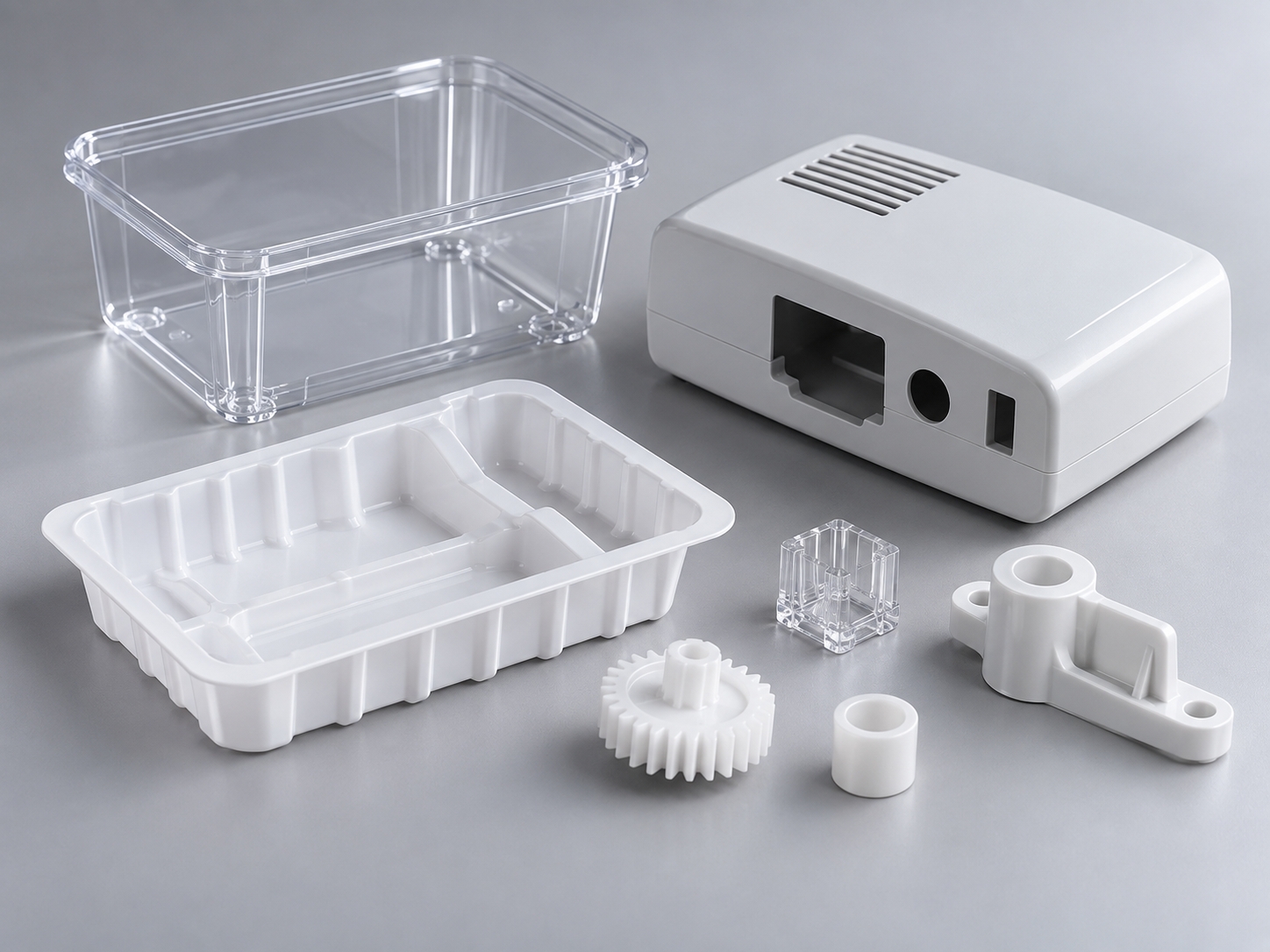
Polystyrene injection molding is widely used for plastic housings, trays, containers, packaging parts, disposable products, and many consumer products. PS has good flowability, low shrinkage, and a clean surface after molding. However, it can also become brittle or develop cracks, burn marks, flow marks, weld lines, and dimensional problems if the part design or process is not well controlled.
For better results, engineers should not focus only on machine settings. Part geometry, gate position, venting, cooling, ejection, and material grade all affect final quality.
At Fentor Mold, we normally review these factors before tooling starts and continue checking them during mold trials and production preparation.
What Is Polystyrene?
Polystyrene, usually called PS, is a thermoplastic made from styrene. It is commonly selected because it is easy to process and can produce stable dimensions with a good surface finish.
Typical advantages include:
- Good flowability
- Relatively low shrinkage
- Good dimensional stability
- Low material cost
- Easy coloring
- Good electrical insulation
- Good surface appearance
However, standard polystyrene is relatively brittle. Therefore, sharp corners, thick bosses, poor ejection, and excessive molding stress can easily cause cracking.
Two common grades are:
| Type | Main Characteristics | Typical Applications |
|---|---|---|
| GPPS | Clear, rigid, relatively brittle | Transparent housings, trays, containers |
| HIPS | Better impact resistance, opaque | Appliance housings, packaging, consumer products |
GPPS is usually selected when transparency matters. HIPS is better when the part needs higher impact resistance.
For a broader comparison of molding resins, you can also read our guide to injection molding materials.
Why Does Polystyrene Injection Molding Need Careful Control?
At first, polystyrene injection molding may look easy because PS flows well in the cavity.
The problem is that good flow does not always mean good part quality.
PS can develop internal stress during filling, packing, and cooling. If the part also contains sharp corners, sudden wall thickness changes, or poor gate locations, the molded part may look acceptable after ejection but crack later during assembly or use.
Common problems include:
- Cracking near screw bosses
- Brittle corners
- Flow marks
- Burn marks
- Silver streaks
- Sink marks
- Weld lines
- Gate stress
- Ejector marks
- Warpage
Many of these problems come from a combination of part design and mold design rather than one single process setting.
Keep Wall Thickness as Uniform as Possible
Wall thickness has a direct effect on filling, cooling, shrinkage, and cycle time.
Large thickness changes can create uneven cooling. Thick areas stay hot longer, while thin areas freeze earlier. As a result, the part may develop sink marks, warpage, or internal stress.
For polystyrene injection molding, gradual transitions are usually better than abrupt changes.
Instead of using large solid sections, consider:
- Hollowing out thick bosses
- Using ribs for stiffness
- Adding gradual wall transitions
- Avoiding heavy local material buildup
For example, a thick mounting boss connected directly to a thin housing wall can easily create a sink mark on the cosmetic surface.
A better design keeps the boss wall controlled and uses ribs for support.
Avoid Sharp Internal Corners
Sharp internal corners concentrate stress.
That is especially risky with PS because the material does not tolerate local deformation as well as tougher materials such as PP.
Adding a suitable radius can help improve:
- Melt flow
- Stress distribution
- Part strength
- Filling stability
- Ejection
Corners around bosses, ribs, slots, and housing walls should not be unnecessarily sharp.
However, the radius should not create another thick section. It still needs to match the surrounding wall structure.
Control Rib and Boss Design
Ribs are useful because they increase stiffness without making the whole wall thicker.
However, oversized ribs can create sink marks on the opposite surface.
The same applies to screw bosses.
For better polystyrene injection molding results, rib and boss design should consider:
- Rib thickness
- Rib height
- Draft angle
- Base radius
- Distance between ribs
- Connection to the main wall
- Ejection direction
If appearance is important, designers should pay particular attention to ribs located directly behind the visible surface.
Thick rib roots often cause visible sinks even when the part fills well.
Choose the Gate Position Carefully
Gate location can strongly affect part quality.
A poor gate position may create:
- Weld lines
- Air traps
- Jetting
- Excessive flow length
- High residual stress
- Visible gate marks
- Unbalanced filling
The melt should enter the cavity in a controlled way and flow through the part without sudden changes in direction.
For large flat parts, a very small gate far from the main flow area may require excessive injection pressure.
For cosmetic parts, the gate should also be kept away from important appearance areas whenever possible.
Fentor Mold evaluates gate position together with flow direction, weld line location, venting, and product appearance during injection mold design and manufacturing.
Use a Stable Injection Speed
Injection speed should be fast enough to fill the cavity before the melt freezes, but excessive speed can create new problems.
Typical problems caused by excessive speed include:
- Burn marks
- Jetting
- Gate blush
- Air trapping
- High internal stress
In many cases, a multi-stage injection profile works better than one fixed high speed.
For example:
- Use a controlled speed when the melt first enters the cavity.
- Increase speed during the main filling stage.
- Reduce speed before the cavity is completely full.
This approach can reduce sudden pressure changes and improve surface quality.
Avoid Excessive Injection Pressure
High injection pressure is not always a solution.
If polystyrene injection molding requires unusually high pressure, the first step should be to check the mold and part design.
Possible causes include:
- Gate too small
- Runner too small
- Poor venting
- Excessive flow length
- Thin wall sections
- Low melt temperature
- Low mold temperature
Too much pressure can increase residual stress inside the part.
That stress may later cause cracking during:
- Screw tightening
- Snap assembly
- Drop testing
- Temperature changes
- Chemical exposure
Therefore, the goal is not simply to use enough pressure to fill the cavity. The process should fill the part without overpacking it.
Set Packing Pressure Correctly
Packing pressure compensates for shrinkage after the cavity is almost full.
Too little packing may cause:
- Sink marks
- Low part weight
- Short dimensions
Too much packing may cause:
- Difficult ejection
- Flash
- Stress cracking
- Oversized dimensions
- High gate stress
Part weight is a useful reference during trials.
If additional holding time no longer increases part weight, the gate has probably frozen. Extending holding time beyond this point usually provides little benefit.
Provide Enough Mold Venting
Air must leave the cavity as the plastic enters.
Poor venting can cause:
- Burn marks
- Short shots
- Weld line problems
- Unstable filling
- Higher injection pressure
Important venting locations often include:
- End-of-fill areas
- Deep ribs
- Bosses
- Weld line zones
- Insert areas
However, vent depth must be controlled carefully. If the vent is too deep, flash may occur.
For more detail, see our guide to injection mold venting design.
Keep Mold Temperature Stable
Very low mold temperature can reduce cycle time, but it may also create flow marks, poor weld lines, or high internal stress.
Stable mold temperature improves filling and surface consistency.
More importantly, the cooling on both sides of the cavity should be reasonably balanced.
Uneven cooling can cause:
- Warpage
- Dimensional variation
- Uneven shrinkage
- Longer stabilization time after molding
Cooling design should therefore be considered during mold development, not only after the first trial.
Pay Attention to Part Ejection
PS can be brittle, so aggressive ejection is risky.
Typical ejection problems include:
- White stress marks
- Cracks
- Broken ribs
- Ejector pin marks
- Distorted walls
The ejector system should distribute force across suitable areas of the part.
For deep housings, enough draft is also important.
If the part grips the core too tightly, the molding machine may need excessive ejection force, increasing the risk of cracking.
Common Polystyrene Injection Molding Defects
| Defect | Common Cause | Typical Improvement |
|---|---|---|
| Cracking | High residual stress, sharp corners | Add radius, reduce stress, improve geometry |
| Burn marks | Air trapping, excessive speed | Improve venting, reduce speed |
| Flow marks | Low temperature, unstable filling | Adjust temperature and injection profile |
| Sink marks | Thick sections, weak packing | Reduce local thickness, adjust packing |
| Warpage | Uneven cooling | Improve cooling balance |
| Weld lines | Poor gate position, low temperature | Improve gate position and melt flow |
| Ejector marks | High ejection force | Improve draft and ejection layout |
| Jetting | High initial speed, poor gate design | Adjust gate and speed profile |
| Flash | High pressure or mold fitting issue | Reduce pressure, inspect shut-off |
| Stress whitening | Excessive deformation | Improve part geometry and ejection |
If several defects appear at the same time, it is useful to review our guide to common injection molding defects.
GPPS vs HIPS Injection Molding
The molding strategy may change depending on the PS grade.
GPPS
GPPS is suitable when transparency and rigidity are important.
However, it is more sensitive to impact and stress cracking.
When using GPPS, avoid:
- Sharp corners
- Heavy snap deformation
- Excessive screw tightening
- High molding stress
HIPS
HIPS has better impact resistance and is often used for housings and consumer products.
It is more forgiving than GPPS in applications where the part may receive impact during assembly or use.
However, HIPS is usually opaque, so it is not suitable when high transparency is required.
The material should be selected based on product requirements, not just price.
Mold Design Matters More Than Machine Adjustment
Machine settings can correct some problems, but they cannot fully compensate for poor design.
| Problem | Can Machine Settings Fully Solve It? |
|---|---|
| Thick boss | No |
| Poor gate location | Usually no |
| Sharp internal corner | No |
| Insufficient draft | No |
| Poor venting | Only partly |
| Unbalanced cooling | Usually no |
| Incorrect injection speed | Yes |
| Incorrect packing pressure | Yes |
This is why DFM review is important before mold machining starts.
Once steel has been cut, every design change becomes slower and more expensive.
For projects that require tooling and production from one supplier, our injection molding production service covers mold trial, process adjustment, sampling, and production preparation.
How to Keep Polystyrene Injection Molding Stable in Production
A good T1 sample does not automatically mean the process is ready for mass production.
For stable polystyrene injection molding, production teams should monitor key process data over time.
Important items include:
- Part weight
- Critical dimensions
- Surface appearance
- Injection pressure
- Cushion position
- Mold temperature
- Cooling time
- Cycle time
If these values remain stable, the process is more likely to produce consistent parts.
If part weight, pressure, or dimensions begin to drift, the team should investigate the cause before the reject rate increases.
At Fentor Mold, mold trials are used not only to confirm that the cavity fills, but also to identify risks before the mold enters stable production.
Final Thoughts
Polystyrene injection molding can produce accurate, clean, and cost-effective plastic parts, but PS needs careful control because of its relatively brittle behavior.
For better part quality, focus on:
- Uniform wall thickness
- Smooth corner radii
- Proper rib and boss design
- Correct gate position
- Stable injection speed
- Controlled packing pressure
- Good mold venting
- Balanced cooling
- Reliable ejection
Most quality problems are easier to solve during product and mold design than after the mold is finished.
When material selection, part design, mold structure, and process settings are considered together, polystyrene injection molding can achieve stable dimensions, better appearance, and more reliable mass production.