
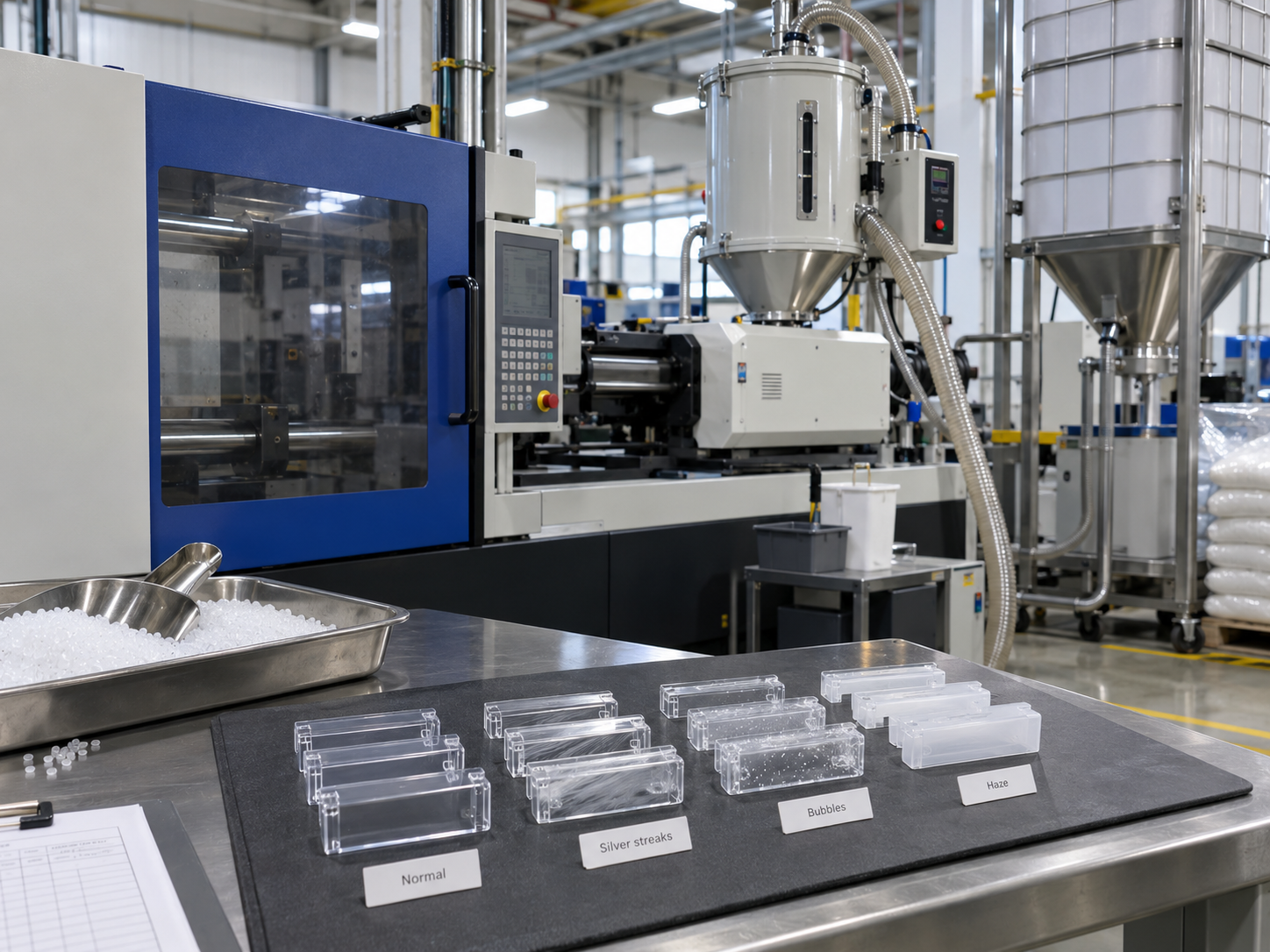
Injection molding material drying may look like a simple production step, but it has a major effect on part quality.
If moisture-sensitive resin contains too much water, the molding process can become unstable. You may see silver streaks, bubbles, weak parts, poor surface finish, or dimensional changes. In some cases, moisture can also damage the resin during processing.
Therefore, poor drying should never be treated as a minor issue.
At Fentor Mold, we usually check the resin type, drying temperature, drying time, and material handling before changing the mold. This helps us avoid unnecessary mold work when moisture is the real cause.
Why Injection Molding Material Drying Matters
Plastic pellets can absorb moisture from the air.
Some materials absorb very little. Others absorb moisture quickly and need drying before molding.
Common moisture-sensitive materials include:
- PC
- PA
- PET
- PBT
- TPU
- PMMA
- ABS in some applications
If too much water stays inside the resin, the heat inside the barrel can trigger material breakdown.
As a result, the part may lose strength, show surface defects, or become harder to mold consistently.
Therefore, injection molding material drying should match the actual resin grade.
Poor Drying Can Cause Silver Streaks
Silver streaks are one of the most common signs of wet resin.
They often appear as bright or silver lines on the molded surface.
Possible causes include:
- Moisture in the resin
- Excessive melt temperature
- Material degradation
- Trapped air
- High shear
However, if silver streaks appear after opening a new bag or after long material exposure, check drying first.
This problem is especially common with PC and PA.
If the resin is still wet, increasing injection pressure or changing the gate will usually not solve the real problem.
Moisture Can Create Bubbles and Voids
Wet resin can release gas during molding.
That gas may form bubbles inside the plastic.
Transparent parts make this defect even easier to see.
For example, PC or PMMA parts may show internal bubbles, haze, or cloudy areas.
Thicker sections may also develop voids.
Therefore, confirm the drying condition before changing packing pressure or gate size.
Otherwise, the team may adjust the mold while the real cause remains unchanged.
Poor Injection Molding Material Drying Can Reduce Strength
Not every moisture problem is visible.
This point matters.
Some plastics can suffer hydrolysis when moisture remains in the resin at high processing temperature.
As a result, the polymer chains become shorter.
The part may still look normal, but its mechanical strength can drop.
Possible effects include:
- Lower impact strength
- Reduced tensile strength
- Cracking during assembly
- Brittle failure
- Shorter service life
Therefore, injection molding material drying affects both appearance and performance.
This is especially important for functional engineering parts.
Wet Resin Can Increase Scrap Rate
Poor drying can create several defects at the same time.
For example:
- Silver streaks
- Bubbles
- Surface haze
- Weak parts
- Color variation
- Burn marks
- Unstable dimensions
As a result, the reject rate may increase quickly.
However, the defects may not always look the same.
One batch may show silver streaks. Another may show poor surface quality or weak parts.
Therefore, production records should include drying conditions for moisture-sensitive materials.
This makes troubleshooting much easier.
Drying Temperature Must Be Correct
Higher drying temperature is not always better.
If the temperature is too low, moisture may stay inside the pellets.
On the other hand, too much heat can damage the resin. It may also cause discoloration or softening.
Therefore, follow the resin supplier’s recommended drying temperature.
The exact material grade also matters.
For example, two PC grades may require different drying conditions.
So, do not rely only on the general material name.
Drying Time Is Just as Important
Temperature alone cannot remove moisture effectively.
The resin also needs enough time to dry.
If production starts too early, moisture may still remain inside the pellets.
Therefore, both drying temperature and drying time need control.
Also, avoid mixing freshly dried resin with wet material from an open bag.
That can quickly reduce the benefit of proper drying.
Dew Point Affects Drying Performance
For highly moisture-sensitive materials, hot air alone may not be enough.
The drying air must also stay dry.
This is why many factories use dehumidifying dryers.
A low dew point helps pull moisture from the pellets more effectively.
If the dryer reaches the correct temperature but the air stays humid, the resin may still contain too much moisture.
Therefore, check dryer performance when moisture defects keep returning.
Material Can Absorb Moisture Again After Drying
Proper drying does not mean the resin will stay dry forever.
Many plastics start absorbing moisture again after they leave the dryer.
This can happen during:
- Material transfer
- Hopper loading
- Long machine stops
- Open-bag storage
- Humid workshop conditions
Therefore, protect dried resin from ambient air as much as possible.
For long production runs, a sealed conveying system can help keep moisture more stable.
Regrind Can Create Drying Problems
Regrind needs extra attention.
It often has more exposed surface area, so it can absorb moisture faster than virgin resin.
In addition, regrind may come from parts that stayed in workshop air for a long time.
Therefore, mixing regrind into virgin resin without drying control can cause unstable quality.
The regrind ratio should stay controlled.
Its drying condition also needs a clear standard.
If scrap rises after adding regrind, check this area early.
Injection Molding Material Drying Should Be Part of the Control Plan
Drying should not depend only on operator experience.
For moisture-sensitive materials, the production team should record key drying information.
Useful items include:
- Material grade
- Supplier
- Lot number
- Drying temperature
- Drying time
- Dryer number
- Start time
- Material loading time
- Regrind ratio
This improves production stability.
It also improves traceability.
For example, if one batch shows defects, the team can quickly check whether the drying conditions changed.
You can also read our article on injection molding control plan for more information about production checks.
Do Not Blame the Mold Too Quickly
This is a common mistake.
When surface defects appear, teams often start changing the mold.
They may enlarge vents, polish the cavity, move the gate, or change process settings.
However, wet resin can make these changes useless.
Therefore, check the material condition before changing steel.
At Fentor Mold, we normally separate material problems from mold problems first.
This reduces unnecessary rework and saves trial time.
Transparent Parts Are More Sensitive to Moisture
Transparent plastic parts show moisture defects very clearly.
Silver streaks, bubbles, haze, and black spots are easy to see.
Therefore, drying control is especially important for clear PC and PMMA parts.
The molding machine also needs to stay clean.
Any degraded resin left in the barrel may affect appearance.
For this reason, transparent parts need both good drying and careful material handling.
You can read more in our guide to transparent plastic parts.
What Buyers Should Ask Their Supplier
Buyers do not need to manage every dryer setting.
However, several simple questions can reveal whether the supplier controls moisture correctly.
Ask:
- Is the resin hygroscopic?
- What drying temperature do you use?
- How long do you dry the material?
- Do you use a dehumidifying dryer?
- How do you protect dried resin from ambient air?
- Do you dry regrind separately?
- Do you record drying conditions?
- Do you check moisture when defects appear?
These questions are especially useful when part quality changes between batches.
Final Thoughts
Good injection molding material drying can prevent many production problems before they begin.
Wet resin can cause silver streaks, bubbles, haze, weak parts, and higher scrap.
Therefore, the team should control drying temperature, drying time, dryer condition, material handling, and regrind.
Most importantly, do not modify the mold before confirming the material condition.
At Fentor Mold, we treat resin drying as part of process stability, especially for engineering plastics and appearance-sensitive parts.
If your project requires mold manufacturing or injection molding production, you can learn more about our injection mold manufacturing and injection molding production services.