
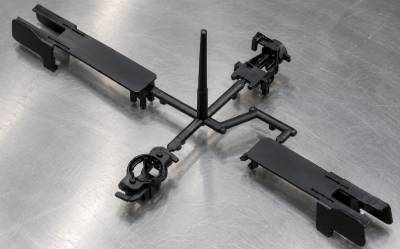
If one product contains several plastic components, building a separate mold for every part is not always necessary.
For many projects, especially low- to medium-volume production, family mold injection molding can place several different parts into one mold and significantly reduce tooling investment.
However, a family mold should not simply be judged by whether the parts use the same material or have exactly the same production quantity. The real question is whether the mold can produce each part efficiently and with acceptable quality.
What Is a Family Mold?
A family mold contains two or more different cavities in one mold.
For example, one mold may contain:
- Upper housing
- Lower housing
- Cover
- Button frame
These parts may be molded together in one cycle. Alternatively, individual cavities can sometimes be selected and molded separately.
This is different from a multi-cavity mold, which normally produces several identical parts.
For more general mold structure considerations, see our Injection Mold Design Guide.
When Is a Family Mold a Good Choice?
Family molds are especially suitable when the parts:
- belong to the same product
- have similar size and weight
- have similar shapes
- use similar molding conditions
- have relatively low cosmetic requirements
- are required in similar quantities
When these conditions are close, runner balancing and process adjustment are much easier.
As a result, one mold can replace several individual molds and reduce both tooling cost and project management work.
Can Different Materials or Colors Use One Family Mold?
Yes, in some low-volume projects.
Different materials or colors do not automatically mean separate molds are required.
The runner system can be designed with runner shut-offs or changeable flow paths, allowing selected cavities to be opened or closed.
For example:
- Cavities A and B can run ABS.
- Cavities C and D can be shut off.
- Later, the runner direction can be changed and Cavities C and D can run PC.
The same method can also be used for different colors.
Therefore, when annual demand is small, one family mold may still be more economical than building several separate molds.
This strategy is particularly useful for low-volume injection molding, where tooling investment often matters more than achieving the shortest possible cycle time.
What If Production Quantities Are Different?
Different quantities can also be managed.
For example, suppose one component needs 20,000 pieces while another only needs 5,000 pieces.
The mold does not necessarily need to produce both parts every cycle.
With suitable runner shut-offs, the higher-demand cavity can continue production after the required quantity of the other part has been completed.
Therefore, production quantity differences should be evaluated together with mold structure rather than used as an automatic reason to reject a family mold.
Can Parts With Different Sizes Share One Mold?
They can, especially when production volume is low.
However, the larger the difference in part size and weight, the more difficult runner balancing becomes.
One cavity may fill quickly while another requires much more material.
For simple functional parts, this may still be acceptable.
For parts with strict appearance or dimensional requirements, however, the risk becomes much higher.
The Most Important Limitation: Appearance Requirements
Family molds are generally easier to apply to functional plastic parts with moderate appearance requirements.
They become more difficult when the mold contains several cosmetic parts with different:
- sizes
- weights
- wall thicknesses
- flow lengths
- gate requirements
For cosmetic parts, filling behavior should be evaluated before the mold structure is finalized.
At Fentor Mold, we normally recommend filling analysis for family molds involving appearance-sensitive parts. This helps check whether all cavities can fill under a practical molding window before steel cutting begins.
Fentor Mold also provides engineering review as part of our injection mold manufacturing process.
Family Mold vs. Separate Molds
A family mold is usually worth considering when the main goal is to reduce initial tooling cost.
Separate molds are often better when:
- production volume is high
- each part requires independent process optimization
- appearance requirements are strict
- cycle times differ significantly
- future part changes are likely
In contrast, for prototype or small-batch projects, combining several parts into one mold can be much more economical.
For very small quantities, prototype injection molding may also be worth comparing before committing to full production tooling.
How Fentor Mold Evaluates a Family Mold
Before recommending a family mold, we mainly compare:
- part size and weight
- material and color
- required quantities
- appearance requirements
- gate locations
- filling balance
- whether individual cavities need to run separately
The goal is simple: save tooling cost without creating unnecessary molding problems later.
Conclusion
A family mold does not have to be limited to parts with identical materials, colors, or production quantities.
For low-volume projects, runner shut-offs and selective cavity production can make one mold suitable for several different production requirements.
However, the safest applications are still parts with similar size, weight, and shape, especially when appearance requirements are not very high.
If several cosmetic parts must share one mold, filling analysis should be completed before the mold design is finalized.
A well-planned family mold can save a substantial amount of tooling investment. A poorly planned one can simply move that cost into production problems.