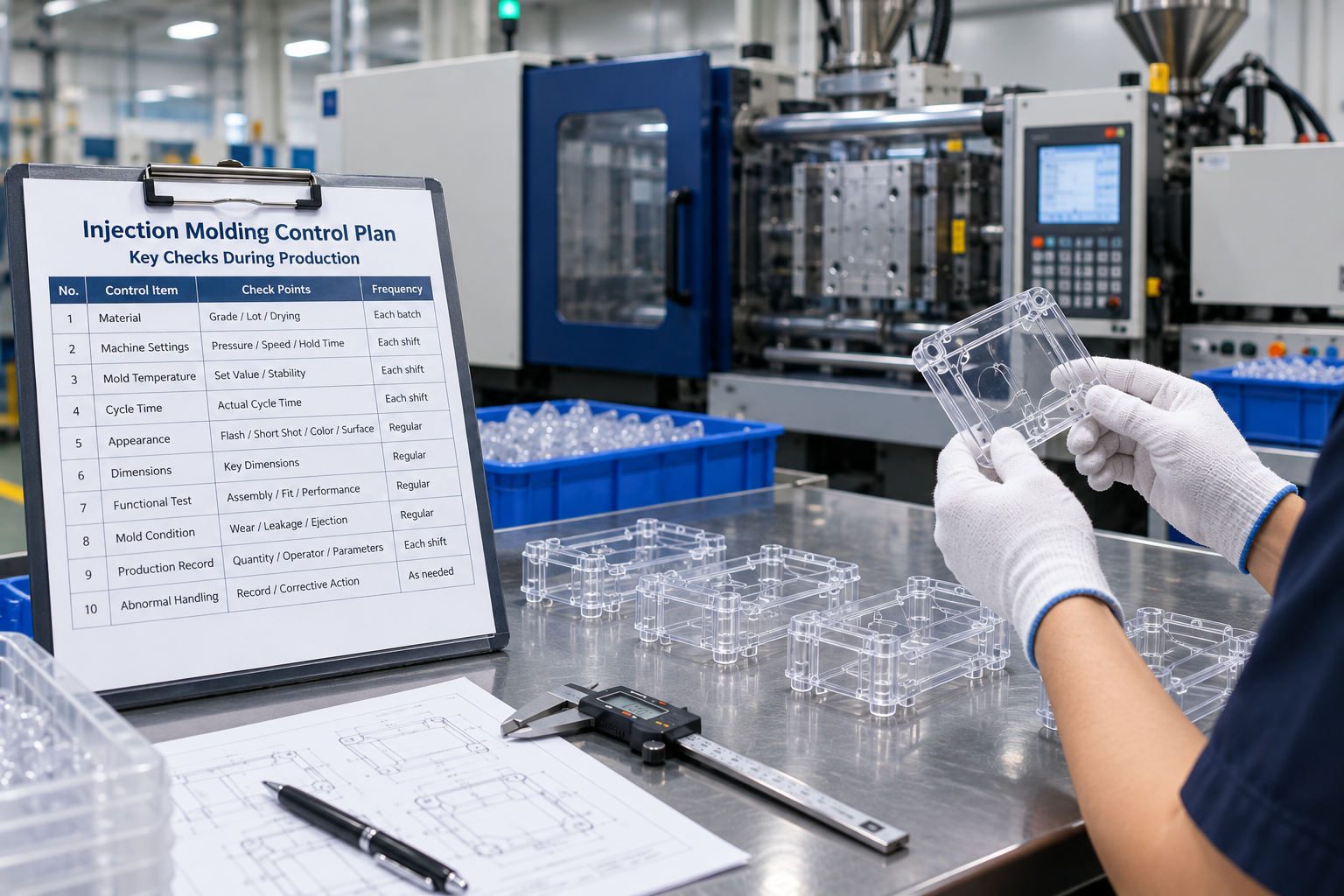
An injection molding control plan helps keep production quality stable after the mold enters mass production.
A good T1 sample does not guarantee that every later batch will have the same quality. Material changes, machine settings, mold temperature, cycle time, operator actions, and mold wear can all affect the final part.
Therefore, production control should not depend only on final inspection.
Instead, the process should define what needs to be checked, how often it should be checked, and what action should be taken if something changes.
At Fentor Mold, we treat the control plan as part of production management. It helps reduce repeated defects, avoid unstable batches, and make quality problems easier to trace.
What Is an Injection Molding Control Plan?
An injection molding control plan is a document or process that defines the key production checks for a molded part.
It normally covers:
- Material
- Machine settings
- Mold temperature
- Cycle time
- Product dimensions
- Appearance
- Functional requirements
- Inspection frequency
- Sampling quantity
- Reaction plan
- Production records
The purpose is simple.
Production should remain close to the approved sample and approved process.
Without a clear control plan, quality often depends too much on individual operators.
For example, one operator may reduce holding pressure to remove flash. Another may increase injection speed to improve filling.
Both changes may solve one problem but create another.
Therefore, key process conditions should be controlled instead of adjusted freely.
Start with an Approved Production Standard
A control plan needs a clear reference.
In most projects, this reference should include:
- Approved sample
- 2D drawing
- Critical dimensions
- Appearance standard
- Material specification
- Functional requirements
The approved sample is especially useful for appearance.
It gives production and quality teams a real reference for color, gloss, weld lines, gate marks, texture, and other visual conditions.
However, the sample should not replace the drawing.
Dimensions and tolerances should still follow the approved 2D specification.
Our article on injection molding sample approval explains why buyers should define the production standard before mass production starts.
Material Control in an Injection Molding Control Plan
Material should be checked before production begins.
The team should confirm:
- Resin grade
- Supplier
- Lot number
- Color
- Additives
- Regrind ratio
- Drying condition
- Storage condition
This is important because even the same material family can behave differently between grades.
For example, two PC grades may have different flow properties. As a result, the same machine settings may not produce the same part quality.
Moisture-sensitive materials also need controlled drying.
If drying is poor, defects may appear even when the mold and machine are correct.
Typical problems include:
- Silver streaks
- Bubbles
- Poor surface quality
- Reduced strength
Therefore, material drying should be part of the injection molding control plan when the resin requires it.
Machine Parameters Should Stay Within a Stable Range
Machine settings strongly affect molded part quality.
Important parameters may include:
- Injection speed
- Injection pressure
- Holding pressure
- Holding time
- Screw speed
- Back pressure
- Melt temperature
- Cushion position
- Changeover position
However, the goal is not to record every machine value.
Instead, the control plan should focus on the parameters that have a real effect on the product.
For example, holding pressure may directly affect sink marks and part dimensions.
Injection speed may affect flow marks, weld lines, and burn marks.
Therefore, critical settings should have an acceptable range.
If a parameter moves outside that range, the operator should not continue production without checking the result.
Mold Temperature Must Be Controlled
Mold temperature can affect both appearance and dimensions.
If it changes too much, the same mold may produce different results.
Possible problems include:
- Uneven gloss
- Flow marks
- Warpage
- Shrinkage
- Dimensional drift
- Weld line changes
Therefore, mold temperature should be monitored during production.
This is especially important for appearance parts, engineering plastics, and parts with tight tolerances.
Cooling water should also remain stable.
Blocked channels, scale, leaks, or poor water flow can change local mold temperature.
For this reason, cooling condition should not be ignored during long production runs.
You can also read our guide on injection mold cooling test for more information.
Cycle Time Is an Important Production Check
Cycle time is often treated only as a cost item.
However, it is also a quality control item.
If cycle time becomes too short, the part may not cool enough.
This can cause:
- Warpage
- Deformation
- Ejection marks
- Unstable dimensions
On the other hand, a much longer cycle may also indicate a process or mold problem.
For example, operators may extend cooling time because the part has become difficult to eject.
Therefore, the injection molding control plan should define the normal cycle time and an acceptable range.
A sudden change should trigger a process check.
Appearance Checks Should Be Simple and Clear
Appearance standards should be easy for operators and inspectors to understand.
Common checks include:
- Flash
- Short shot
- Sink marks
- Flow marks
- Burn marks
- Weld lines
- Black spots
- Silver streaks
- Scratches
- Color difference
- Gate marks
- Texture damage
However, not every small mark has the same importance.
The visible surface should be clearly defined.
For example, a small ejector mark on the hidden back side may be acceptable. The same mark on a customer-facing surface may not be acceptable.
Therefore, the control plan should separate critical appearance areas from non-critical areas.
This makes inspection faster and reduces unnecessary arguments.
Dimension Checks Should Focus on Critical Features
Checking every dimension on every production batch is not practical.
Instead, the control plan should focus on critical dimensions.
These may include:
- Assembly dimensions
- Hole positions
- Snap-fit dimensions
- Sealing areas
- Flatness
- Parallelism
- Insert positions
- Functional clearances
The inspection frequency depends on the risk.
A critical dimension may need regular sampling during production.
A less important dimension may only need first-piece and final inspection.
At Fentor Mold, we normally recommend linking inspection frequency to the actual function of the part rather than checking everything at the same frequency.
First-Piece Inspection Should Come Before Full Production
Before a production run starts, the first pieces should be checked.
This is especially important after:
- Mold installation
- Material change
- Machine change
- Mold maintenance
- Tool repair
- Long production stop
The first-piece inspection should confirm that the process is back to the approved standard.
Typical checks include:
- Appearance
- Key dimensions
- Material
- Machine settings
- Mold temperature
- Cycle time
Only after the first pieces pass should full production continue.
This simple step can prevent a large quantity of defective parts.
In-Process Inspection Keeps Quality Stable
A good injection molding control plan does not rely only on first-piece inspection.
Production should also include in-process checks.
These checks can be based on:
- Time
- Production quantity
- Machine cycle count
- Batch change
For example, a part may be checked every two hours or every few thousand shots.
The exact frequency depends on risk.
High-risk features should be checked more often.
Stable and non-critical features may need less frequent inspection.
The purpose is to detect changes before they affect a large batch.
Mold Condition Should Be Part of the Control Plan
Product defects do not always come from process settings.
Sometimes the mold itself is changing.
During long production runs, the team should watch for:
- Flash increasing
- Slider wear
- Ejector pin marks
- Parting line damage
- Water leakage
- Rust
- Scratches
- Loose inserts
- Poor ejection
- Abnormal noise
These signs may show that the mold needs maintenance.
If flash slowly becomes worse over time, increasing clamping force is not always the right solution.
The real cause may be mold wear.
Our guide on injection mold wear inspection explains how mold wear can affect production stability.
Traceability Makes Quality Problems Easier to Solve
When a defect is found, the production team should be able to trace the affected batch.
Useful records may include:
- Production date
- Machine number
- Mold number
- Material lot
- Operator
- Process settings
- Inspection results
- Quantity produced
This information helps identify what changed.
For example, if a defect appears only in one material lot, the problem may not come from the mold.
Similarly, if the issue appears only on one machine, the machine condition should be checked.
Therefore, traceability is an important part of the injection molding control plan.
A Reaction Plan Is Just as Important as Inspection
Inspection alone does not prevent defects.
The control plan should also define what happens when something is wrong.
A simple reaction plan may include:
- Stop or hold production.
- Separate suspect parts.
- Check the machine and mold.
- Confirm material and process settings.
- Adjust only after the cause is understood.
- Recheck the first parts.
- Record the action.
This prevents operators from making random adjustments.
For example, if flash appears, the first reaction should not always be to reduce injection pressure.
The team should first check whether the mold is fully closed, whether the parting line is damaged, and whether the process has changed.
What Buyers Should Ask the Supplier to Control
Buyers do not need to manage every machine setting.
However, they should confirm that the supplier has a clear production control method.
Important questions include:
- Is there an approved sample?
- Are critical dimensions defined?
- Are appearance limits clear?
- Are material lots recorded?
- Are key machine settings controlled?
- Is mold temperature monitored?
- Is first-piece inspection required?
- Is in-process inspection defined?
- Is traceability available?
- Is there a reaction plan for defects?
These questions are more useful than simply asking whether the supplier has QC.
A control plan shows how quality is maintained during real production.
Final Thoughts
A good injection molding control plan helps keep mass production close to the approved standard.
It should control the most important factors, not create unnecessary paperwork.
Material, machine settings, mold temperature, cycle time, appearance, dimensions, mold condition, and traceability are usually the main areas to watch.
In addition, inspection frequency should match the real production risk.
Most importantly, the plan should define what to do when something changes.
At Fentor Mold, we use production checks together with mold maintenance and process control to keep molded parts stable from batch to batch.
If your project requires tooling and production support, you can learn more about our injection mold manufacturing and injection molding production services.