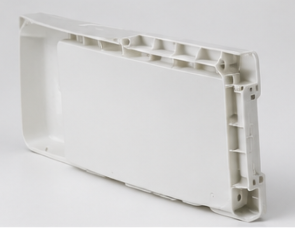
Gas assist injection molding uses high-pressure nitrogen to create a hollow section inside a plastic part.
It is mainly used for large, thick, or structural plastic parts where conventional molding may cause excessive weight, sink marks, or long cooling times.
The process can work very well, but the part must be designed for gas penetration from the beginning.
What Makes Gas Assist Injection Molding Different?
In conventional injection molding, the cavity is filled with plastic.
In gas assist molding, nitrogen enters the molten plastic and pushes material toward the cavity wall. This creates a controlled hollow section inside the part.
The main benefits are:
- Lower part weight
- Less material consumption
- Reduced sink marks in thick areas
- Lower internal shrinkage
- Possible reduction in cooling time
Gas assist is especially useful when a product needs thick sections for strength but does not need those sections to be completely solid.
For general mold design principles, see our Injection Mold Design Guide.
Short-Shot or Full-Shot Gas Assist?
There are two common approaches.
Short-Shot Gas Assist
The mold is only partly filled with plastic first.
Nitrogen is then injected and pushes the molten plastic forward until the cavity is filled.
This method can create a larger hollow section and save more material.
However, the initial shot volume must be controlled carefully.
Too much plastic leaves little space for the gas. Too little plastic may cause incomplete filling.
Full-Shot Gas Assist
The cavity is filled first, and gas is injected afterward into selected thick sections.
This can provide better control of the outside surface, but gas penetration is usually more difficult to control.
The correct method depends on the product geometry and appearance requirements.
Gas Entry Position Is Critical
The gas pin position is one of the most important decisions in a gas assist mold.
Nitrogen naturally follows the area with the lowest resistance.
If the gas enters from the wrong location, it may:
- Travel into the wrong area
- Create uneven hollow sections
- Break through the outer wall
- Cause visible gas marks
- Leave uneven wall thickness
For this reason, the gas entry position must be considered together with the plastic flow direction.
Gate position is equally important. You can read more in our Injection Mold Gate Design Guide.
Wall Thickness Must Support Gas Penetration
Gas assist works best when the product contains sections thick enough for the nitrogen to travel through.
If the section is too thin, the plastic may freeze before the gas can penetrate.
Large and sudden wall-thickness changes can also make the gas path difficult to control.
A better design uses a clear gas channel and smooth thickness transitions.
This should be reviewed before mold manufacturing starts.
Our Injection Mold Design Checklist covers many of the checks normally completed during the early DFM stage.
The Gas Pin Needs Special Attention
A gas assist mold requires a reliable way to introduce high-pressure nitrogen into the part.
The gas pin must provide:
- Stable gas entry
- Good sealing
- Accurate positioning
- Easy cleaning
- Easy replacement
Poor sealing can cause gas leakage and unstable pressure.
Therefore, the gas pin should not be treated as a simple standard mold component. Its position and structure directly affect production stability.
Common Gas Assist Problems
Gas Breakthrough
Gas breakthrough happens when nitrogen reaches the outer surface of the part.
Typical causes include:
- Gas pressure is too high
- Plastic wall is too thin
- Gas enters too early
- Gas pin position is incorrect
Uneven Hollow Section
The internal gas channel may not stay in the center of the part.
This happens because gas follows the easiest flow path.
Complex geometry and large thickness changes increase this risk.
Gas Marks
Gas penetration can sometimes leave visible marks on the outside surface.
For cosmetic parts, this risk should be evaluated before tooling begins.
Short Shot
A short shot may occur when:
- The initial plastic shot is too small
- Gas enters too early
- Flow resistance is too high
For general short-shot troubleshooting, see our guide on Injection Molding Short Shot Defects.
When Should Gas Assist Be Considered?
Gas assist injection molding is most useful for:
- Large plastic parts
- Thick structural sections
- Tubular plastic parts
- Handles
- Large housings
- Furniture components
- Appliance parts
- Parts with serious sink-mark risk
It is usually less suitable for small, thin, simple plastic parts.
If a conventional mold can produce the part easily, adding a gas system may only increase tooling cost and process complexity.
Gas Assist and Sink Marks
One of the most useful applications of gas assist is reducing sink marks in thick sections.
Instead of leaving a large solid mass of plastic inside the part, gas creates a hollow core.
This reduces internal material shrinkage and can improve the outside surface.
For more information about this defect, see How to Fix Sink Marks in Injection Molding Parts.
How Fentor Mold Reviews Gas Assist Projects
For a gas assist project, Fentor Mold mainly reviews:
- Part thickness
- Areas that should become hollow
- Plastic flow direction
- Gate location
- Gas entry position
- Expected gas path
- Appearance requirements
The main question is not whether gas assist can be used.
The more important question is whether it provides a clear advantage over a conventional injection mold.
For suitable large or thick plastic parts, gas assist can reduce weight, material use, and sink-mark risk. For other products, a normal mold may be simpler and more economical.
Conclusion
Gas assist injection molding is mainly about controlling where the nitrogen travels inside the plastic part.
The key points are:
part thickness, gate location, gas entry position, and gas penetration path.
If these are planned correctly, gas assist can be an effective solution for large and thick plastic parts.
If you are unsure whether your product is suitable for gas assist molding, Fentor Mold can review the 3D part design and compare it with a conventional mold solution before tooling starts.