
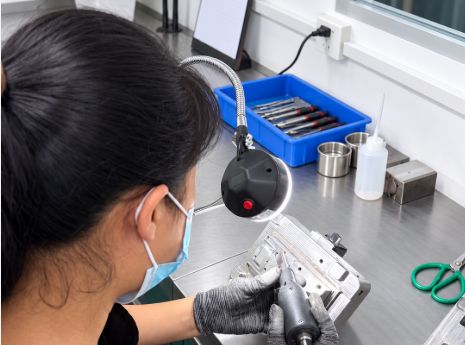
Surface finish is an important part of injection mold design. A mold can be dimensionally correct but still produce plastic parts with the wrong gloss, texture, or visible machining marks.
For cosmetic housings, medical products, automotive parts, appliances, and consumer products, buyers often specify an SPI mold finish standard such as SPI A-2, B-2, or C-1.
However, an SPI grade alone is not always enough. The final result also depends on the plastic resin, mold steel, machining quality, polishing process, draft angle, and molding conditions.
At Fentor Mold, we normally review surface requirements during the DFM and mold design stage instead of waiting until the mold is finished.
What Is the SPI Mold Finish Standard?
SPI surface finish grades provide a common way to describe the condition of mold cavity and core surfaces.
The main grades are divided into four groups:
| SPI Series | Surface Type | Typical Appearance | Common Use |
|---|---|---|---|
| A | Diamond polished | High gloss to mirror | Optical and premium cosmetic parts |
| B | Fine abrasive paper | Semi-gloss | Consumer and visible functional parts |
| C | Stone finish | Matte | General housings and functional parts |
| D | Dry blast | Textured | Grip surfaces and low-gloss parts |
Among these groups, A-level surfaces require the most careful machining and polishing. B and C grades are more common for general plastic products, while D grades create a noticeably textured surface.
For complicated products, different surfaces can use different grades. For example, the visible front face may require A-2, while hidden internal areas may only require C-2 or an as-machined finish.
During the injection mold design stage, these areas should be clearly marked on the product drawing.
SPI Finish Grades and Roughness Reference
Surface roughness is commonly measured using Ra and Rz, normally in micrometers (μm).
- Ra represents the arithmetic average surface roughness.
- Rz represents the average peak-to-valley height over the measured surface.
The following values come from the engineering comparison chart supplied with this article and can be useful as a practical workshop reference.
| Surface Grade | Ra (μm) | Rz (μm) |
|---|---|---|
| ▽1 | 50 | 200 |
| ▽2 | 25 | 100 |
| ▽3 | 12.5 | 50 |
| ▽4 | 6.3 | 25 |
| ▽5 | 3.2 | 12.5 |
| ▽6 | 1.60 | 6.3 |
| ▽7 | 0.80 | 6.3 |
| ▽8 | 0.40 | 3.2 |
| ▽9 | 0.20 | 1.60 |
| ▽10 | 0.100 | 0.80 |
| ▽11 | 0.050 | 0.40 |
| ▽12 | 0.025 | 0.20 |
| ▽13 | 0.012 | 0.100 |
| ▽14 | — | 0.050 |
For mold polishing, the supplied reference also gives the following practical comparison:
| SPI Grade | Reference Ra (μm) | Surface Description |
|---|---|---|
| A-1 | 0.005 | Extremely high gloss, mirror effect |
| A-2 | 0.01 | High gloss, no visible abrasive marks |
| A-3 | 0.02 | Lower gloss than A-2, smooth surface |
| B-1 | 0.05 | Low gloss with very fine abrasive marks |
| B-2 | 0.10 | Low gloss with fine abrasive marks |
| B-3 | 0.20 | Lower gloss with more visible abrasive pattern |
These Ra values are useful for engineering comparison and inspection, but they should not be treated as a universal official SPI-to-Ra conversion. Different inspection standards, polishing processes, steels, and measurement equipment can produce different results.
For critical cosmetic parts, the molded sample should remain the final approval standard.
Choosing Between SPI A, B, C and D
The highest SPI grade is not automatically the best choice.
A practical selection depends mainly on the product appearance and function.
| Requirement | Typical Choice | Main Consideration |
|---|---|---|
| Mirror or optical surface | A-1 | Steel quality and polishing must be excellent |
| Premium glossy housing | A-2 / A-3 | Good balance of appearance and cost |
| General visible housing | B-1 / B-2 | Easier and less costly than A finish |
| Functional internal area | B-3 / C series | Appearance is less critical |
| Matte surface | C series | Reduces reflections and hides minor marks |
| Strong textured surface | D series | Draft and ejection need extra attention |
For example, specifying A-1 on every mold surface can add polishing time without improving the product.
A more practical design might use:
| Product Area | Suggested Finish |
|---|---|
| Main cosmetic surface | SPI A-2 |
| Secondary visible surface | SPI B-2 |
| Internal visible area | SPI C-2 |
| Completely hidden area | As-machined |
This approach reduces tooling cost while protecting the surfaces that actually matter to the customer.
Mold Steel Has a Major Effect on SPI Finish
High-gloss polishing starts long before the polishing worker begins.
The steel must have suitable cleanliness, hardness, structure, and polishing performance.
Common steels used for cosmetic molds include:
| Mold Steel | Typical Use |
|---|---|
| S136 | High polishing and corrosion-resistant molds |
| 718 / 718H | General cosmetic plastic molds |
| NAK80 | Good polishing and dimensional stability |
| 1.2316 | Corrosion-resistant applications |
| P20 | General mold applications |
| H13 / 8407 | Higher strength and demanding tooling areas |
The reference chart, for example, lists S136 at about 54 HRC and 8407 at about 52 HRC for very high-gloss applications.
However, choosing S136 does not automatically create an A-1 surface. Poor CNC machining, EDM damage, steel inclusions, or incorrect polishing can still leave visible defects.
This is why mold surface quality should be considered as part of the complete injection mold manufacturing process rather than as a separate final operation.
CNC, EDM and Polishing All Affect the Final Surface
Polishing cannot correct every manufacturing problem.
Before polishing begins, the cavity should already have a controlled and uniform machined surface.
| Process | Possible Surface Problem | Recommended Control |
|---|---|---|
| CNC | Tool marks and cutter lines | Use stable cutting parameters and proper finishing allowance |
| EDM | Recast layer and EDM texture | Use fine EDM parameters before polishing |
| Grinding | Directional marks | Control abrasive direction |
| Polishing | Waves or rounded edges | Progress gradually through abrasive grades |
| Manual finishing | Uneven gloss | Keep polishing direction and pressure consistent |
This becomes especially important around ribs, shut-offs, small corners, lettering, and sealing surfaces.
Over-polishing a shut-off edge can slightly round the steel. As a result, the mold may look excellent but produce flash during molding.
Therefore, cosmetic surfaces and functional sealing surfaces should not always receive the same polishing method.
Plastic Material Changes the Appearance
The same polished cavity does not produce exactly the same appearance with every plastic.
Different resins have different surface replication characteristics.
| Plastic | Typical Surface Consideration |
|---|---|
| ABS | Good surface replication and cosmetic appearance |
| PC | Can achieve high gloss but molding conditions are important |
| PC+ABS | Common for cosmetic housings |
| PP | Natural appearance differs from ABS or PC |
| PA | Surface depends strongly on material grade and moisture |
| PA+GF | Glass fiber can reduce gloss and create fiber appearance |
| POM | Naturally different gloss and surface behavior |
Therefore, a glossy mold does not guarantee a mirror-like molded part.
This is particularly important with glass-filled materials. Fiber orientation, flow marks, weld lines, and resin characteristics may remain visible even when the steel surface is highly polished.
At Fentor Mold, we normally evaluate the mold finish together with the specified production material rather than approving the steel finish alone.
Texture, Draft Angle and Mold Release
SPI finish and decorative texture are not the same thing.
An SPI grade describes a general surface condition. Automotive grain, leather grain, chemical etching, and special decorative patterns normally require a separate texture specification.
Textured surfaces also increase mold release resistance.
The required draft depends on:
| Factor | Effect on Ejection |
|---|---|
| Texture depth | Deeper texture normally needs more draft |
| Side-wall height | Large walls create more friction |
| Plastic material | Different materials have different shrinkage |
| Ejection direction | Texture should not lock against release |
| Surface area | Larger textured areas increase drag |
| Part geometry | Ribs and corners may increase sticking |
For this reason, texture should be reviewed during DFM.
Adding a deep texture after the mold has already been manufactured can create serious ejection problems if the original draft angle is too small.
How Should Buyers Specify Mold Finish?
Instead of writing only:
“High-gloss mold surface.”
A better drawing specification is:
| Mold Area | Requirement |
|---|---|
| Main exterior surface | SPI A-2 |
| Secondary cosmetic surface | SPI B-2 |
| Internal surface | SPI C-2 |
| Hidden mold area | As-machined |
| Special texture area | Texture supplier + texture number |
| Critical appearance | Molded sample approval required |
For highly cosmetic products, buyers can also provide:
- Approved color and resin
- Texture reference number
- Physical appearance sample
- Gloss requirement
- Ra requirement when necessary
- Defined cosmetic area
- Molded sample approval standard
Clear specifications reduce arguments during mold approval.
Inspect the Plastic Part, Not Only the Mold
A polished mold surface may look perfect before the first trial, but actual molding can still reveal:
- Flow marks
- Weld lines
- Gloss differences
- Stress marks
- Ejection marks
- Fiber exposure
- Uneven texture replication
Mold temperature, injection speed, packing pressure, resin condition, and cooling can all affect the surface.
Therefore, final appearance should be confirmed during an actual injection mold trial using the correct production material.
For projects moving into long-term production, stable tooling and molding parameters are equally important. Our injection molding production capability covers the transition from mold validation to stable molded-part production.
Final Thoughts
The SPI mold finish standard is a useful language between product designers, buyers, mold makers, and polishing technicians. However, an SPI number alone cannot define the complete appearance of a molded plastic part.
The final surface depends on the combination of:
| Mold Side | Production Side |
|---|---|
| SPI finish | Plastic resin |
| Mold steel | Mold temperature |
| CNC quality | Injection speed |
| EDM quality | Packing pressure |
| Polishing process | Cooling |
| Texture depth | Ejection |
| Draft angle | Process stability |
The best approach is to define the cosmetic areas early, select the required SPI level, review the plastic material and steel, and confirm the result with molded samples.
For critical cosmetic parts, Fentor Mold recommends treating the approved plastic sample—not simply the polished steel surface—as the final appearance standard.