
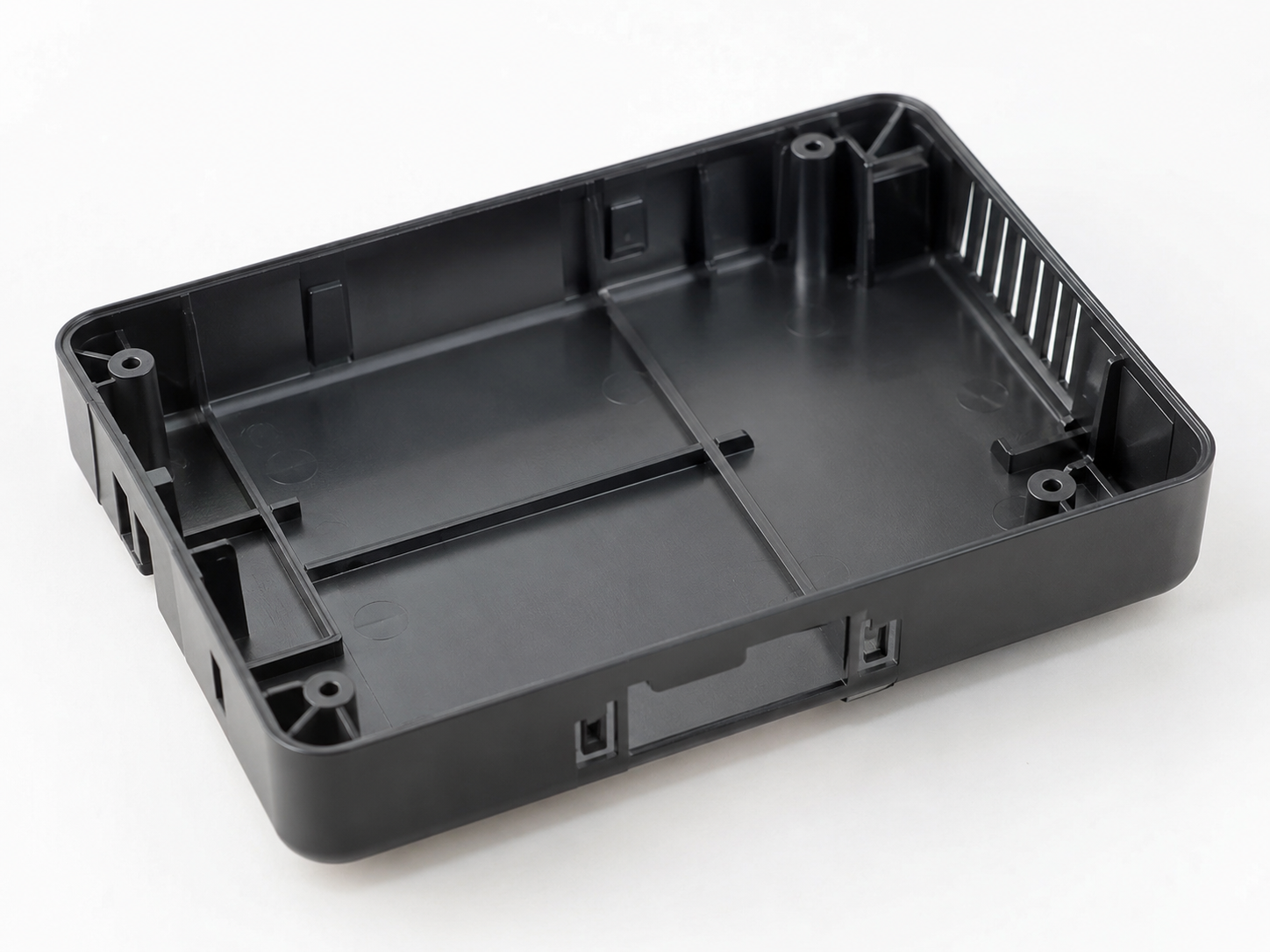
Thin-wall injection molding looks simple from the outside. The part is thin, so the mold may seem easier to build.
In reality, the opposite is often true.
Thin walls leave very little time for the molten plastic to fill the cavity. The material cools quickly, pressure rises fast, and small problems in gate design, venting, steel strength, cooling, or mold accuracy can become serious.
Therefore, the mold must support fast filling, high pressure, stable cooling, and clean ejection at the same time.
At Fentor Mold, we normally review these points early because many thin-wall problems are difficult to correct after the mold is completed.
Why Thin-Wall Injection Molding Is More Demanding
The main challenge is filling speed.
A normal plastic part may allow more time for the melt to reach the end of the cavity. A thin-wall part does not.
The melt begins to cool as soon as it enters the mold.
As a result, the process often needs:
- Higher injection speed
- Higher injection pressure
- Faster response from the machine
- Better venting
- More efficient cooling
- Stronger mold construction
If any of these areas are weak, the part may short shot or become unstable.
Therefore, thin-wall injection molding needs both good mold design and a capable molding machine.
Thin Walls Need Faster Filling
Thin sections lose heat quickly.
If the melt slows down too much, the flow front can freeze before the cavity fills.
This may cause:
- Short shots
- Flow marks
- Weld lines
- Hesitation marks
- Poor surface quality
Therefore, the gate position must support a short and direct flow path.
Long flow distances increase the risk.
For the same reason, the material should also have enough flow ability for the wall thickness and part size.
A design that works in standard molding may fail when the wall becomes much thinner.
Gate Design Is Critical in Thin-Wall Injection Molding
Gate size and location have a major effect on filling.
If the gate is too small, the melt sees high shear.
This can increase pressure and create more heat.
On the other hand, a gate that is too large may leave a poor gate mark or create difficult trimming.
Therefore, the gate must balance filling speed, pressure, appearance, and gate removal.
Common gate options may include:
- Edge gates
- Fan gates
- Tab gates
- Hot runner valve gates
- Multiple gates for larger parts
For larger thin-wall parts, one gate may not be enough.
In that case, multiple gates can shorten the flow path.
However, they may also create weld lines.
So, gate quantity and location should be reviewed carefully before steel cutting.
Thin-Wall Injection Molding Needs Good Venting
Fast filling pushes air through the cavity very quickly.
If the air cannot escape, it becomes trapped.
This may cause:
- Burn marks
- Short shots
- Flow hesitation
- Local surface defects
- High injection pressure
Therefore, venting is especially important for thin-wall molds.
Vents are often needed at the end of fill, around ribs, and near trapped-air areas.
However, the vents cannot be too deep.
Otherwise, flash may appear.
So, the vent must release air without allowing molten plastic to escape.
Mold Strength Becomes More Important
Thin-wall parts often require high injection pressure.
This pressure loads the mold cavity, core, inserts, sliders, and mold plates.
If the mold structure is weak, the steel may move slightly during filling.
Even a small movement can create:
- Flash
- Dimensional changes
- Parting line mismatch
- Poor repeatability
Therefore, mold strength must be checked early.
For larger parts, plate thickness and support are especially important.
The designer should also check whether the cavity and core have enough steel around thin sections.
At Fentor Mold, this is one of the areas we focus on during mold design review.
Mold Accuracy Is More Sensitive
Thin-wall parts often have a narrow process window.
Because of this, small mold deviations can create large differences in filling.
For example, a small wall-thickness difference may change flow resistance.
One side may fill too early, while another side may short shot.
Therefore, cavity and core accuracy is very important.
Key areas include:
- Wall thickness
- Insert height
- Parting line fit
- Slider position
- Core alignment
- Gate dimensions
Good machining alone is not enough.
The final fitting and assembly also need tight control.
You can learn more about our precision mold components manufacturing capabilities.
Cooling Must Be Fast and Balanced
Thin-wall molding usually aims for short cycle time.
Therefore, cooling needs to remove heat quickly.
However, fast cooling is not enough by itself.
The cooling must also stay balanced.
Uneven cooling can cause:
- Warpage
- Uneven shrinkage
- Dimensional drift
- Local deformation
- Difficult ejection
For this reason, cooling channels should be placed as evenly as possible.
Core areas, deep ribs, and local hot spots may need extra attention.
If one area stays hotter than the rest, the part can twist after ejection.
Ejection Can Be Difficult
Thin parts can deform easily.
If ejector force is too high or too concentrated, the part may bend, crack, or show visible marks.
Therefore, ejection design needs good balance.
Useful options include:
- More ejector pins
- Larger ejector areas
- Stripper plates
- Air assist
- Controlled draft angle
The part also needs enough cooling before ejection.
If it is still too soft, even a good ejector layout may cause deformation.
So, cooling time and ejection design need to work together.
Thin-Wall Injection Molding Needs Enough Draft
Thin walls often create a large surface area compared with part thickness.
This can increase friction during ejection.
Therefore, draft angle still matters.
If the draft is too small, the part may stick or drag.
Possible results include:
- Scratches
- White marks
- Deformation
- Difficult ejection
Textured surfaces need even more attention.
Deep texture increases friction and usually needs more draft.
For appearance parts, draft should be reviewed together with texture before the mold is built.
Material Choice Affects Mold Difficulty
Not every plastic works equally well for thin-wall molding.
The material needs enough flow for the wall thickness and flow distance.
Common choices may include:
- PP
- PE
- ABS
- PC+ABS
- PA
- Special high-flow engineering grades
High-viscosity materials can be more difficult.
They may need higher pressure and higher temperature.
As a result, mold strength and venting become even more important.
Therefore, the material should be confirmed before mold design is finalized.
Machine Capability Also Matters
A good mold cannot fully solve a machine limitation.
Thin-wall molding often needs a machine with:
- Fast injection response
- High injection speed
- Stable pressure control
- Good repeatability
- Enough clamping force
If the machine injects too slowly, the melt may freeze before the cavity fills.
If pressure control is unstable, part weight and dimensions may change from shot to shot.
Therefore, the mold and machine should be reviewed as one system.
Thin-Wall Parts Have a Narrower Process Window
A standard molded part may tolerate some variation.
Thin-wall parts often do not.
A small change in one setting may create a defect quickly.
For example:
- Lower melt temperature may cause short shots
- Lower mold temperature may create flow marks
- Higher speed may cause burns
- Lower pressure may reduce filling
- Shorter cooling may cause warpage
Therefore, the process window needs to be developed carefully.
Once stable settings are found, production should control them closely.
A clear injection molding control plan can help keep the process stable.
What Buyers Should Check Before Approving the Mold
Buyers do not need to review every mold detail.
However, for thin-wall injection molding, several points deserve attention.
Check:
- Wall thickness
- Flow length
- Gate quantity
- Gate position
- Venting
- Mold steel thickness
- Support structure
- Cooling layout
- Ejection method
- Draft angle
- Machine requirement
For complex parts, Moldflow analysis can also help.
It can show filling pressure, flow balance, weld lines, air traps, and possible short-shot areas.
This is useful before steel cutting.
Why T1 Samples Are Not Enough
A mold may produce good parts during the first trial.
However, thin-wall production also needs repeatability.
The real test is whether the mold can keep running at the required cycle time and quality level.
During trials, the team should check:
- Filling stability
- Part weight
- Flash
- Short shots
- Warpage
- Surface defects
- Ejection
- Cycle time
- Mold temperature
If the process only works inside a very narrow setting range, the mold may become difficult in mass production.
Therefore, production stability matters as much as the first good sample.
Final Thoughts
Thin-wall injection molding is difficult because everything happens faster.
The melt cools quickly, filling pressure rises, and the process has less room for error.
Therefore, gate design, venting, mold strength, machining accuracy, cooling, ejection, material, and machine capability all need to work together.
A thin part is not automatically a simple mold.
In many cases, it requires more careful engineering than a thicker part.
At Fentor Mold, we review thin-wall projects early to reduce filling problems, flash, warpage, and unstable production.
If your project includes thin housings, covers, containers, or other thin-wall plastic parts, you can learn more about our injection mold manufacturing and injection molding production services.