
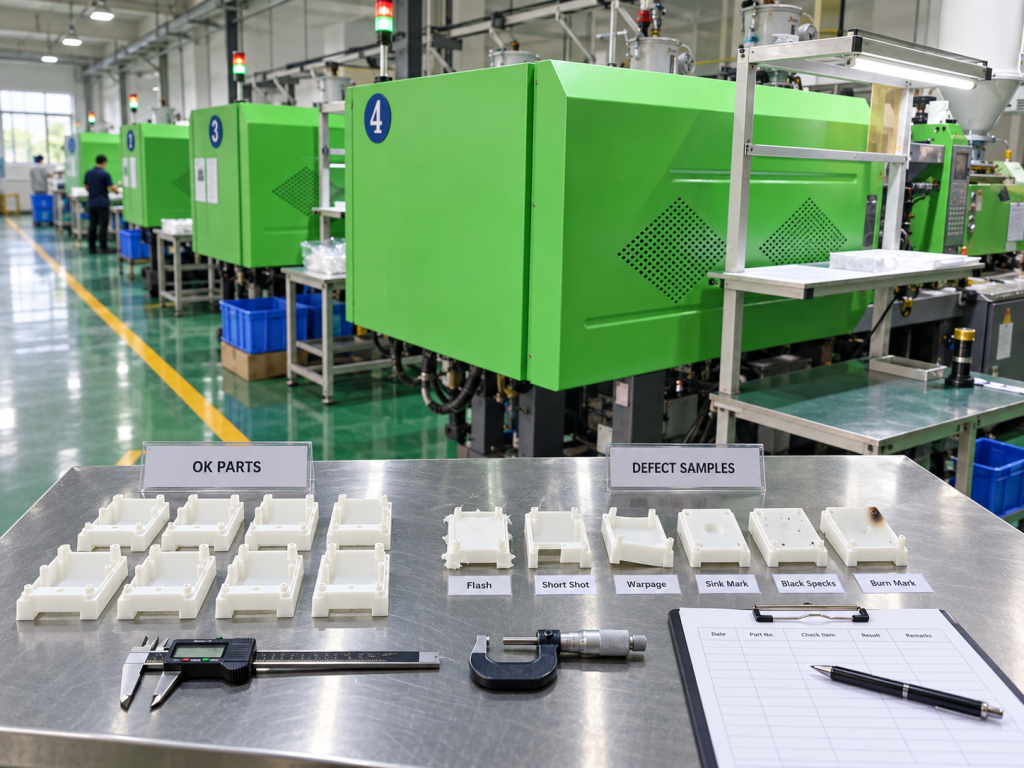
A high injection molding reject rate is not only a quality problem. It also increases material cost, labor cost, machine time, inspection work, and delivery risk.
In many factories, scrap does not come from one single cause.
For example, a part may be rejected because of flash, short shots, sink marks, warpage, black spots, dimensional problems, or surface defects. However, the real cause may come from the mold, material, machine, process settings, or inspection standard.
Therefore, the first step is not to adjust random parameters.
Instead, the team should identify where the scrap comes from. It should also check whether the problem is repeated or linked to certain batches.
At Fentor Mold, we usually look at the reject pattern first. This makes it easier to separate mold problems from process or material problems.
What Is a Normal Injection Molding Reject Rate?
There is no single reject rate that fits every project.
The acceptable level depends on:
- Part size
- Product complexity
- Material
- Appearance requirements
- Tolerance level
- Automation level
- Production volume
- Mold condition
For example, a simple PP part may have a different target from a transparent PC housing.
Likewise, a standard housing and a tight-tolerance engineering part may require different quality levels.
Therefore, the percentage alone does not tell the full story.
A more useful question is:
Why are the rejects happening, and are they increasing?
If the reject rate rises from one batch to the next, something in production may be changing.
High Injection Molding Reject Rate Often Starts with Repeated Defects
One repeated defect can create most of the scrap.
Common examples include:
- Flash
- Short shots
- Sink marks
- Warpage
- Burn marks
- Weld lines
- Black spots
- Silver streaks
- Flow marks
- Gate defects
- Dimensional drift
- Ejection damage
Therefore, reject data should be grouped by defect type.
This is more useful than only recording the total scrap rate.
For example, if 70% of rejects come from flash, the team can focus on the mold closing condition. The parting line, shut-off areas, clamping force, and process pressure should also be checked.
On the other hand, if many different defects appear at the same time, the issue may be process stability.
Material Problems Can Increase the Reject Rate
Material is one of the first areas to check.
Problems may come from:
- Wrong resin grade
- Mixed materials
- Poor drying
- High moisture
- Too much regrind
- Contamination
- Color variation
- Different material lots
For moisture-sensitive resins such as PC, PA, and PET, drying is especially important.
Poor drying can cause silver streaks, bubbles, weak parts, and surface defects.
Therefore, if scrap increases after a material change, check the material lot first.
Do not modify the mold immediately.
The same rule applies to regrind.
If the regrind ratio changes too much, the flow and appearance may also change.
Process Settings Can Drive High Scrap
A stable mold can still produce unstable parts if the process is not controlled.
Important process variables include:
- Injection speed
- Injection pressure
- Holding pressure
- Holding time
- Melt temperature
- Mold temperature
- Back pressure
- Cooling time
- Screw recovery
However, not every setting affects every defect.
For example, excessive holding pressure may cause stress or flash. In contrast, low holding pressure may create sink marks or unstable dimensions.
Therefore, each defect should be linked to the most relevant process settings.
Random adjustment usually wastes time.
Instead, a clear injection molding control plan can help keep key settings within a stable range.
Mold Problems Can Slowly Increase Scrap
Some mold problems do not appear suddenly.
Instead, they become worse over time.
Common examples include:
- Parting line wear
- Shut-off wear
- Loose sliders
- Worn guide components
- Ejector pin wear
- Cooling blockage
- Water leakage
- Insert movement
- Surface damage
At first, the reject rate may still be low.
Later, flash or dimensional problems may become more frequent.
Therefore, a rising injection molding reject rate can be an early sign of mold wear.
For example, increasing clamping force may temporarily reduce flash. However, if the parting line is damaged, the flash will often return.
Our guide on injection mold wear inspection explains what to check when production becomes less stable.
Cooling Problems Can Create Hidden Scrap
Cooling is often ignored because the mold can still run.
However, poor cooling can create several quality problems.
These include:
- Warpage
- Uneven shrinkage
- Long cycle time
- Dimensional drift
- Surface differences
- Difficult ejection
For example, a blocked cooling channel may affect only one area of the part.
As a result, the problem may look like a product design defect.
Therefore, cooling flow and mold temperature should be checked when defects appear in the same local area.
You can also read our guide on injection mold cooling test.
Machine Condition Can Affect Reject Rate
Sometimes the mold and process settings are correct. However, the machine is not stable.
Possible causes include:
- Unstable injection pressure
- Heater problems
- Screw wear
- Check-ring wear
- Poor repeatability
- Temperature variation
- Hydraulic problems
For example, the same mold may run well on one machine but poorly on another.
In that case, machine condition should be investigated.
Therefore, production records should include the machine number.
This makes reject patterns easier to compare.
Appearance Standards Can Create Unexpected Scrap
Not all rejected parts are functionally bad.
Some are rejected because of appearance.
Typical cosmetic problems include:
- Flow marks
- Black spots
- Weld lines
- Scratches
- Gloss differences
- Gate marks
- Color differences
If appearance limits are unclear, different inspectors may judge the same part differently.
As a result, the reject rate may look unstable.
Therefore, the buyer and supplier should agree on clear acceptance standards.
An approved sample is useful for this purpose.
For appearance-critical parts, the standard should define visible areas and acceptable defect limits.
Our article on injection molding sample approval explains why this should be confirmed before mass production.
Tight Tolerances Can Also Increase Rejects
Dimensional scrap is common on precision molded parts.
Possible causes include:
- Unstable shrinkage
- Uneven cooling
- Material variation
- Mold wear
- Process drift
- Measurement method
However, before changing the mold, check the measurement method as well.
For example, soft plastic parts may measure differently depending on the fixture or inspection force.
Therefore, not every dimensional reject is automatically a mold problem.
Critical dimensions should use a stable inspection method.
Poor Ejection Can Create Repeated Rejects
Ejection problems often create visible damage.
Common issues include:
- White marks
- Ejector marks
- Deformation
- Scratches
- Cracks
- Sticking
These problems may become worse during long production runs.
For example, a cavity surface may become dirty. A slider may also start moving less smoothly.
In addition, parts may deform if they are ejected too hot.
Therefore, both mold condition and cooling time should be checked.
High Scrap May Come from Several Small Problems
Sometimes there is no single major issue.
Instead, several small problems happen together.
For example:
- Material is slightly too wet
- Mold temperature is unstable
- Cooling time is too short
- One slider has minor wear
- Inspection limits are very strict
Each issue alone may not create serious scrap.
However, together they can push the process outside its stable range.
Therefore, the full production system should be reviewed.
The goal is not only to fix one defective part.
Instead, the goal is to make the whole process stable again.
Use Reject Data to Find the Real Cause
A simple reject report can be very useful.
Useful data includes:
- Defect type
- Reject quantity
- Production date
- Machine number
- Material lot
- Mold number
- Cavity number
- Shift
- Process settings
This makes patterns easier to see.
For example, if one cavity creates most defects, the issue is likely local.
On the other hand, if the defect appears across all cavities, the cause may be related to material or process settings.
At Fentor Mold, this type of pattern is often more useful than checking rejected parts one by one.
Cavity-by-Cavity Tracking Is Important
For multi-cavity molds, total scrap alone is not enough.
Instead, each cavity should be checked separately when possible.
One cavity may have:
- Different cooling
- Venting problems
- Gate imbalance
- Local wear
- Insert movement
- Dimensional variation
For example, if only one cavity creates rejects, the mold may only need a local repair.
Without cavity tracking, the team may adjust the whole process unnecessarily.
Therefore, cavity identification can save troubleshooting time.
What Buyers Should Ask When Scrap Is High
If your supplier reports a high injection molding reject rate, ask for more than the final percentage.
Useful questions include:
- What are the main defect types?
- Which defect causes the most scrap?
- Is the issue linked to one cavity?
- Did the problem start after a material change?
- Did the machine change?
- Has the mold been inspected?
- Are process settings stable?
- Is mold temperature stable?
- Are cooling channels working correctly?
- Has the reject rate increased over time?
These questions help separate temporary production problems from deeper tooling problems.
In addition, they make it easier to decide whether the next action should focus on the mold, material, machine, or process.
Do Not Fix Every Reject by Changing the Mold
This is an important point.
A mold modification should only be made when the cause is confirmed.
For example, if short shots come from poor drying or unstable machine pressure, enlarging the gate may create new problems.
Similarly, if flash comes from excessive pressure, welding the parting line may be unnecessary.
Therefore, the cause should be verified before steel is changed.
This reduces rework and protects the mold.
Final Thoughts
A high injection molding reject rate usually means that something in production is unstable.
The cause may come from material, machine settings, cooling, mold wear, inspection standards, or several factors together.
Therefore, start by studying the reject pattern.
First, group the defects. Next, track cavities and compare material lots. Then, review process settings and inspect the mold condition.
Most importantly, avoid random parameter changes.
Instead, use clear standards, stable settings, and traceable records.
At Fentor Mold, we combine tooling review, mold maintenance, and process control to reduce repeated defects during injection molding production.
If your project needs mold manufacturing or production support, you can learn more about our injection mold manufacturing and injection molding production services.