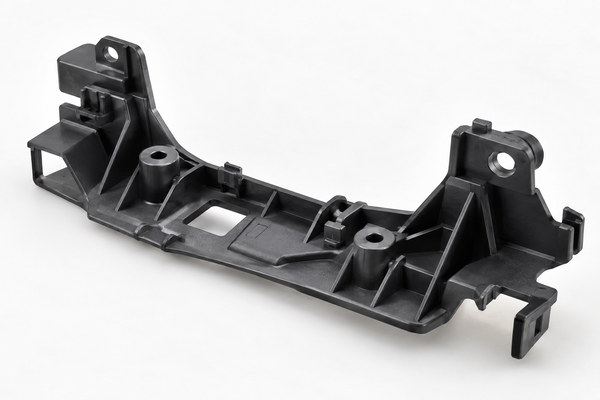
Rapid injection molding helps companies get real plastic parts in a shorter time. It is often used for prototypes, testing, bridge production, and low-volume orders.
Compared with a full production mold, rapid tooling can reduce both the first investment and development time. However, fast tooling does not mean cutting every cost. Mold design, steel choice, part structure, cavity number, and surface finish still affect the final price.
For this reason, the best approach is to simplify the mold where possible while keeping the part quality stable.
At Fentor Mold, we review the part, material, mold structure, and expected quantity before tooling starts. This helps avoid extra machining and costly changes later.
What Is Rapid Injection Molding?
Rapid injection molding is a faster way to make injection molds and molded plastic parts.
The basic process is still similar to normal mold making:
- Review the part design.
- Prepare a DFM analysis.
- Design the mold.
- Machine the core and cavity.
- Assemble the mold.
- Run the first trial.
- Check the samples.
- Make changes if needed.
- Start production.
The main difference is the tooling strategy.
For example, engineers may use a simpler mold base, fewer complex actions, or easier machining methods. Aluminum can also be used for some short-run projects.
As a result, the mold can often be completed faster.
When Is Rapid Injection Molding a Good Choice?
Rapid injection molding works well when a project does not yet need a long-life production mold.
Typical applications include:
| Application | Main Benefit |
|---|---|
| Functional prototypes | Uses real production plastic |
| Design testing | Checks fit and function |
| Market testing | Produces parts before a large launch |
| Bridge production | Supplies parts while production tooling is being built |
| Low-volume production | Reduces initial tooling investment |
| Engineering testing | Checks part strength and performance |
| Pre-production samples | Provides realistic molded samples |
In these projects, maximum mold life is usually not the first goal.
Instead, the main goal is to get reliable parts quickly while keeping the first tooling cost under control.
For early product development, our prototype injection molding service can support part testing before full production tooling.
How Rapid Injection Molding Reduces Lead Time
Production molds can include hardened steel, complex inserts, hot runners, sensors, and automatic systems.
All of these features can increase lead time.
Rapid tooling focuses on what the project really needs. By removing unnecessary complexity, the mold becomes easier to design, machine, and test.
Simplify the Mold Structure
Simple molds are normally faster to build.
A basic open-and-close mold, for example, takes less time than a mold with several moving systems.
Complex features may include:
- sliders;
- lifters;
- hydraulic cylinders;
- unscrewing systems;
- multi-stage ejection;
- complicated inserts.
Part design therefore has a direct effect on tooling time.
Whenever possible, reducing unnecessary undercuts can save both time and money.
Choose the Right Material for Rapid Injection Molding
Not every mold needs premium hardened steel.
For short runs, aluminum or softer mold steel may be enough. However, the best choice depends on resin, part structure, tolerance, and expected mold life.
| Mold Material | Typical Use | Main Benefit |
|---|---|---|
| Aluminum | Prototype and short runs | Fast machining |
| P20 | Low to medium volume | Good cost balance |
| NAK80 | Appearance parts | Good polishing |
| H13 | Higher production volume | Good wear resistance |
| S136 | Clear or corrosion-sensitive parts | Good polish and corrosion resistance |
Aluminum is not always the cheapest choice in the long term.
For example, glass-filled resin can wear a soft mold faster. Thin walls or deep ribs may also need stronger tooling.
In these cases, steel can provide better stability and mold life.
You can also review our custom injection mold manufacturing service for both rapid and production tooling.
Remove Unnecessary Mold Features
Some mold features add cost but provide little value during an early production stage.
A rapid mold may not need:
- full automation;
- automatic degating;
- a complex hot runner;
- many interchangeable inserts;
- advanced mold sensors;
- very long mold life.
Removing these features can shorten design and machining time.
However, important mold functions should remain. Good cooling, venting, ejection, alignment, and mold strength are still necessary.
A cheaper mold is useful only when it can produce stable parts.
What Affects Rapid Injection Molding Cost?
Rapid injection molding cost depends on both tooling and part requirements.
The main factors are:
| Cost Factor | Effect |
|---|---|
| Part size | Larger molds need more steel and machining |
| Part complexity | Sliders and lifters increase cost |
| Mold material | Hardened steel usually costs more |
| Cavity quantity | More cavities increase mold complexity |
| Surface finish | Polishing and texture require extra work |
| Tolerance | Tight tolerance needs more precision |
| Plastic resin | Some materials need stronger tooling |
| Production volume | Higher volume may require better mold materials |
Therefore, two plastic parts of the same size can have very different mold prices.
A simple housing may use a basic two-plate mold. Another housing of similar size may need several sliders, inserts, and special shut-offs.
Naturally, the second mold will cost more.
How to Lower Rapid Injection Molding Cost
Lower cost should come from smart engineering rather than poor mold quality.
Several methods can help.
Simplify the Plastic Part
Try to reduce unnecessary undercuts, deep ribs, and complex internal features.
If a part can release directly from the mold, fewer sliders or lifters may be needed.
That reduces both tooling cost and lead time.
Use Standard Mold Components
Standard mold bases, ejector pins, guides, and other components are easier to source.
They can also shorten mold building time.
In addition, standard parts are easier to replace during future maintenance.
Use Practical Tolerances
Not every dimension needs a very tight tolerance.
Tight tolerances increase machining and inspection work. They can also make mold fitting more difficult.
For this reason, use tight tolerances mainly on critical dimensions. Less important areas can often accept a wider range.
Avoid Unnecessary Surface Finish
A mirror finish can require many hours of hand polishing.
If the plastic part does not need a high-gloss surface, a standard finish may be enough.
This simple change can reduce both cost and delivery time.
Rapid Injection Molding vs Production Tooling
Rapid tooling and production tooling serve different needs.
| Item | Rapid Injection Molding | Production Tooling |
|---|---|---|
| Tooling cost | Usually lower | Usually higher |
| Lead time | Shorter | Longer |
| Mold life | Low to medium | Medium to very high |
| Mold structure | Usually simpler | Can be more complex |
| Best volume | Low to medium | Medium to high |
| Design changes | Easier during early stages | More costly after tooling |
| Main goal | Speed and flexibility | Long-term production |
Rapid tooling is often a better fit during product development.
Once demand becomes stable, a production mold may offer a lower part cost over a larger quantity.
For higher-volume programs, our injection molding production service covers mold trials, molding, inspection, and ongoing production.
Does Rapid Injection Molding Always Use Aluminum?
No.
This is a common misunderstanding.
Rapid injection molding describes a faster tooling and production approach. It does not mean the mold must be made from aluminum.
Many rapid molds use P20 or other mold steels.
Modern CNC and EDM machines can process steel efficiently. Steel can also provide better support for higher pressure, tighter tolerance, or more demanding plastic materials.
The mold material should match:
- production quantity;
- resin type;
- part shape;
- mold life;
- dimensional tolerance;
- surface requirements;
- future production plans.
In some projects, a simple steel mold offers better value than an aluminum mold.
Can Rapid Injection Molding Produce Quality Parts?
Yes.
Rapid tooling can use many of the same plastics as normal production molding.
Common materials include:
- ABS;
- PC;
- PC/ABS;
- PP;
- PE;
- PA;
- POM;
- TPE;
- TPU.
Because of this, the molded parts can be used for fit checks, function tests, assembly tests, and low-volume sales.
Still, good tooling and process control are important.
Poor venting, weak cooling, bad gate design, or incorrect ejection can cause defects such as:
- sink marks;
- short shots;
- flash;
- weld lines;
- warpage;
- burn marks;
- unstable dimensions.
So, even a rapid mold needs proper engineering.
Why DFM Matters in Rapid Injection Molding
A DFM review can find problems before mold machining starts.
Engineers normally check:
- draft angle;
- wall thickness;
- undercuts;
- gate position;
- ejector position;
- parting line;
- slider direction;
- sink mark risk;
- weld line risk;
- mold structure.
Early changes are usually easier and cheaper.
For example, moving a rib or changing an undercut in the 3D file may take only a short time. Making the same change after steel has been machined can take much longer.
Therefore, DFM can help shorten the total project time.
Rapid Mold or Production Mold?
The correct choice depends on the product stage and expected quantity.
Rapid tooling is often suitable when:
- the design may still change;
- demand is not yet clear;
- samples are needed quickly;
- production volume is relatively low;
- market testing is still in progress.
A production mold makes more sense when:
- the design is stable;
- annual demand is high;
- long mold life is required;
- cycle time is important;
- automation is needed.
Some companies use both approaches.
They first build a rapid mold for testing and early orders. After the product is confirmed, they invest in a full production mold.
This can reduce early project risk.
How Fentor Mold Supports Rapid Injection Molding
Fentor Mold first reviews the real needs of each project.
We look at the expected quantity, resin, part size, tolerance, surface quality, and future production plan. Then, we choose a suitable mold concept.
Depending on the project, the solution may include:
- a simpler mold structure;
- practical mold steel;
- standard mold components;
- DFM analysis;
- Moldflow analysis when needed;
- CNC and EDM machining;
- mold trials;
- sample inspection;
- low-volume production.
The goal is to balance tooling cost, lead time, mold life, and part quality.
Final Thoughts
Rapid injection molding is a useful way to move from a 3D design to real molded parts in less time.
However, simply choosing the cheapest mold is not enough.
A good rapid tooling project needs the right mold structure, material, tolerance, and production plan. Simple choices can reduce cost, while critical mold functions must still remain reliable.
By matching the tooling level to the real production need, companies can lower early investment, shorten development time, and get usable plastic parts faster.