Yes, same material overmolding is possible and can be an effective two-shot injection molding solution for many plastic parts. The process uses the same or highly compatible polymer for both the first-shot substrate and the second-shot layer. It can create different colors, add local reinforcement, improve surface features, or produce complex geometries while maintaining consistent material properties.
However, using the same plastic does not automatically guarantee a strong bond. Material grade, substrate temperature, mold design, gate location, cooling, and processing conditions all affect the final result. For this reason, same material overmolding should be evaluated during the DFM and injection mold design stages.
What Is Same Material Overmolding?
Same material overmolding is a two-shot injection molding process in which the first shot creates a plastic substrate and the second shot uses the same or a highly compatible material over selected areas of that substrate.
For example, a manufacturer may mold a PP substrate during the first shot and then inject PP over part of the substrate during the second shot. The two shots may use different colors or slightly different grades, depending on the application and required bonding performance.
This process is different from conventional multi-material overmolding, where two different polymers such as rigid ABS and soft TPU are combined.
Same material overmolding is mainly used when manufacturers want to maintain similar material properties while changing the part’s color, texture, thickness, or geometry.
Typical applications include:
- Multi-color plastic components
- Local structural reinforcement
- Grip and texture features
- Thickened sections around mounting areas
- Decorative plastic components
- Automotive interior components
- Consumer electronics housings
- Industrial plastic components
How Does Same Material Overmolding Work?
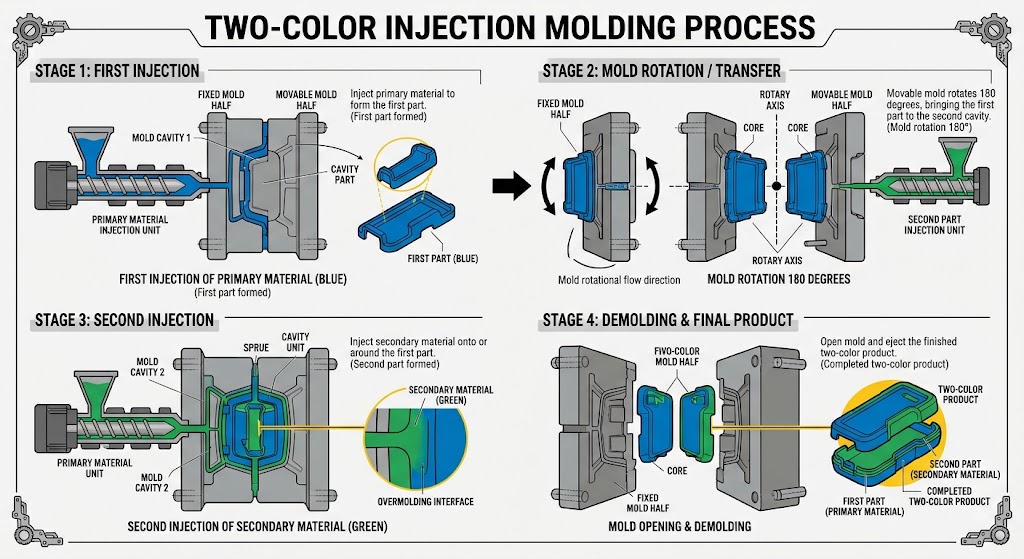
The basic process consists of two injection stages.
First Shot: Mold the Plastic Substrate
During the first shot, molten plastic is injected into the first cavity to create the base component.
The substrate must have sufficient dimensional stability because it will become part of the final molded component. Its geometry should also provide enough surface area for the second shot.
The mold designer needs to consider:
- Wall thickness
- Draft angles
- Parting line location
- Ejection method
- Gate location
- Cooling layout
- Second-shot bonding area
A poorly designed first shot can make the second shot difficult even when the same material is used.
Second Shot: Overmold the Same Plastic
After the first shot is completed, the substrate is transferred or rotated into the second molding position.
The second injection unit then introduces the same polymer onto the selected area.
Depending on the mold and injection machine, the substrate may be transferred using:
- Rotary platen systems
- Core-back mechanisms
- Mold slides
- Robotic transfer
- Manual transfer for selected applications
The second shot must flow across the intended surface while the substrate remains at a suitable temperature and position.
This is one of the most important stages of the process because the interface between the first and second shots directly affects bonding quality.
Does Same Material Overmolding Create a Strong Bond?
Yes, it can create a strong bond, but the result depends heavily on processing conditions.
When the second shot contacts a sufficiently warm substrate made from the same polymer family, the molten material can interact with the surface of the first shot. Molecular diffusion and interfacial bonding can contribute to the connection between the two layers.
However, “same material” needs to be defined carefully.
Two materials may both be identified as PP or PA66 while having different:
- Melt flow rates
- Additives
- Fillers
- Reinforcement levels
- Colorants
- Flame-retardant packages
- Processing temperatures
For example, a glass-filled grade and an unfilled grade of the same polymer may behave differently during overmolding.
Therefore, material compatibility should be confirmed before finalizing the mold design.
Which Materials Work for Same Material Overmolding?
Several common thermoplastics can potentially be used in same material overmolding.
| Material | General Suitability | Main Consideration |
|---|---|---|
| PP | Good candidate | Substrate temperature and shrinkage |
| TPU | Good candidate | Melt temperature and substrate condition |
| PA6 | Possible | Moisture control and processing temperature |
| PA66 | Possible | Drying, temperature, and shrinkage |
| ABS | Possible | Surface condition and processing temperature |
| PC | Possible | Higher processing temperature and residual stress |
| PE | Application dependent | Surface characteristics and bonding conditions |
| POM | More challenging | Narrow processing window |
| PEEK | Highly application dependent | Very high processing temperature |
This table should be treated as an engineering starting point rather than a universal material compatibility chart.
The specific resin grade, additives, fillers, processing history, and molding conditions can change the final result.
For production tooling, the material datasheet and sample molding should be used to validate the proposed process.
What Are the Benefits of Same Material Overmolding?
Same material overmolding can provide several advantages when the application does not require two fundamentally different polymers.
Consistent Material Properties
Using the same polymer family can help maintain similar chemical, thermal, and mechanical characteristics throughout the finished component.
This can be useful when the part needs to withstand temperature changes or chemical exposure without introducing a completely different polymer.
Multi-Color Plastic Parts
One common application is multi-color molding.
For example, a black PP substrate can be combined with a red PP second shot.
The material chemistry remains similar while the visual appearance changes.
Depending on the product, this approach can reduce the need for painting or other secondary decoration.
Local Structural Reinforcement
A second shot can add plastic to selected areas that require additional thickness.
This can be useful around:
- Screw bosses
- Mounting points
- Clips
- Handles
- Stress concentration areas
- Connection features
However, reinforcement geometry still needs to be designed carefully to control shrinkage and warpage.
Surface Texture and Functional Features
The second shot can also create localized textures or geometric features without introducing a completely different polymer.
This can be useful for grips, buttons, labels, and other functional surfaces.
Simplified Material Management
Using the same polymer family for both shots can simplify material sourcing and reduce some compatibility concerns associated with multi-material molding.
However, the exact material grades still need to be controlled carefully.
What Are the Challenges of Same Material Overmolding?
Same material overmolding is not automatically easier simply because both shots use the same plastic.
Several engineering challenges need to be considered.
Substrate Temperature
The temperature of the first-shot substrate has a major effect on the second-shot interface.
If the substrate is too cold, the second shot may not achieve the desired interfacial bonding.
If it is too hot, the second shot can deform or remelt areas of the first shot that need to remain dimensionally stable.
The correct temperature window depends on the polymer, mold design, part geometry, and processing conditions.
Shrinkage and Warpage
The second shot introduces additional material and another cooling stage.
If the two sections have significantly different wall thicknesses, different cooling rates can create internal stresses and dimensional changes.
This is particularly important for:
- Thin-wall housings
- Long components
- Flat panels
- Precision assemblies
- Parts with tight dimensional tolerances
The cooling system should therefore be considered during the initial injection mold design.
Bond Line Appearance
Even when the bond is mechanically strong, the interface between the first and second shots may remain visible.
This can be a concern for cosmetic consumer products.
Gate location, flow direction, surface finish, and color selection can all influence the appearance of the bond line.
Material Grade Differences
Two materials can both be called PP or PA66 while having different processing windows.
For this reason, the exact resin grade should be specified before tooling begins.
How Do You Design a Mold for Same Material Overmolding?
Good mold design is essential for achieving consistent results.
Provide Enough Second-Shot Contact Area
The second shot needs sufficient contact with the first-shot substrate.
Very small bonding areas can create inconsistent results, particularly when the finished part experiences mechanical loading.
The bonding area should therefore be designed according to the required strength and application conditions.
Control Wall Thickness
Large differences in wall thickness can increase shrinkage and warpage.
Whenever possible, maintain relatively uniform wall thickness and use gradual transitions.
For reinforcement features, avoid simply adding a large block of material to a thin substrate.
Plan the Gate Location
The second-shot gate should provide a controlled flow path across the intended overmolded area.
Gate location can influence:
- Filling pressure
- Weld lines
- Air traps
- Surface appearance
- Bonding conditions
- Packing behavior
For complex parts, mold flow analysis can help evaluate the proposed gating strategy before steel is machined.
Add Proper Venting
Air trapped between the first shot and second shot can cause incomplete filling, burn marks, or weak areas.
Vents should be positioned according to the expected flow front and potential air-trap locations.
Consider Ejection Carefully
The first-shot substrate must be transferred without deformation.
Ejector pin locations should provide balanced support, particularly for thin or flexible components.
The second-shot cavity also needs an ejection strategy that prevents damage to newly molded features.
Same Material Overmolding vs Two-Shot Molding
These terms are related but not exactly identical.
Two-shot molding describes the manufacturing process of injecting material twice to create one finished component.
Same material overmolding describes a specific application where the material used for the first and second shots is the same or highly compatible.
| Process | First Shot | Second Shot |
|---|---|---|
| Same material overmolding | PP | PP |
| Multi-material overmolding | ABS | TPU |
| Two-shot molding | PC | PC |
| Two-shot molding | ABS | PMMA |
Therefore, same material overmolding can be considered one type of two-shot molding.
If you are comparing different two-shot processes, see our guide to two-shot molding and its applications.
When Should You Choose Same Material Overmolding?
Same material overmolding can be a good choice when you need to change the appearance or geometry of a plastic part without introducing a fundamentally different polymer.
It is particularly useful when you need:
- Multiple colors
- Local reinforcement
- Different surface textures
- Additional material in selected areas
- A consistent material system
- A two-shot manufacturing process
However, if your product requires a soft-touch grip, sealing layer, vibration damping, or another substantially different material property, multi-material overmolding may be more appropriate.
For complex products, this decision should be made during DFM rather than after the mold design has been completed.
Can Same Material Overmolding Reduce Manufacturing Cost?
It can, but the answer depends on the part design, production volume, and required secondary operations.
Using one material can simplify material sourcing and reduce some compatibility concerns. However, two-shot tooling generally requires more complicated mold construction and molding equipment than conventional single-shot injection molding.
Additional tooling requirements may include:
- Rotary mechanisms
- Additional injection systems
- Separate gates
- Additional cooling circuits
- Transfer mechanisms
- More complex mold inserts
Therefore, using the same material does not automatically mean lower tooling cost.
The better question is whether the second-shot process eliminates enough secondary operations or provides enough design benefits to justify the additional mold complexity.
For more information, see our guide on reducing injection molding costs.
How Fentormold Evaluates Same Material Overmolding Projects
At Fentormold, we evaluate same material overmolding from both the part design and mold manufacturing perspectives.
Before tooling begins, our engineers can review:
- Material compatibility
- First-shot and second-shot geometry
- Bonding area
- Wall thickness
- Gate locations
- Cooling requirements
- Ejection strategy
- Mold transfer mechanism
- Expected shrinkage and warpage
- Production volume
This approach helps identify potential molding problems before they become expensive mold modifications.
For complex two-shot structures, our injection mold manufacturing services can support the project from DFM review through mold manufacturing and production.
Planning a Two-Shot Molding Project?
Send your 3D CAD file to Fentormold for a DFM review and material compatibility assessment.
Frequently Asked Questions
Can you overmold the exact same material?
Yes. The same polymer can be used for both the first and second shots. However, the exact resin grade, processing conditions, substrate temperature, surface condition, and part design should be evaluated to achieve reliable bonding.
Is same material overmolding the same as two-shot molding?
Not exactly. Two-shot molding is the broader manufacturing process, while same material overmolding specifically refers to using the same or highly compatible polymer for both shots.
Can you use different colors of the same plastic?
Yes. Different colors of the same polymer can be used for the first and second shots. This is one of the common reasons manufacturers choose same material overmolding.
Does same material overmolding always create a strong bond?
No. Material compatibility alone does not guarantee strong bonding. Substrate temperature, melt temperature, injection speed, contact area, cooling, and mold design all affect the final interface.
Is same material overmolding better than multi-material overmolding?
It depends on the application. Same material overmolding is useful when you need color, texture, geometry, or local reinforcement while maintaining similar material properties. Multi-material overmolding is better when the product requires substantially different properties, such as a rigid core with a soft-touch layer.
Does same material overmolding require a special mold?
Usually, yes. A two-shot application may require a rotary mold, transfer mechanism, core-back system, or another method for moving the first-shot substrate into the second-shot molding position.
The required tooling depends on the part geometry, production volume, machine configuration, and second-shot design.
Final Thoughts
Yes, you can overmold the same material in two shots. Same material overmolding can be an effective solution for multi-color components, local reinforcement, surface features, and other applications where maintaining a consistent polymer system is important.
However, using the same plastic for both shots does not eliminate the need for careful engineering. Material grade, substrate temperature, bonding area, wall thickness, gate location, cooling, venting, and transfer method all need to be considered during mold development.
For production applications, evaluating these factors during DFM and injection mold design can reduce the risk of weak bonding, warpage, dimensional problems, and costly mold modifications.
If you are considering a same material overmolding project, Fentormold can review your part design and recommend a suitable two-shot mold and molding approach.