
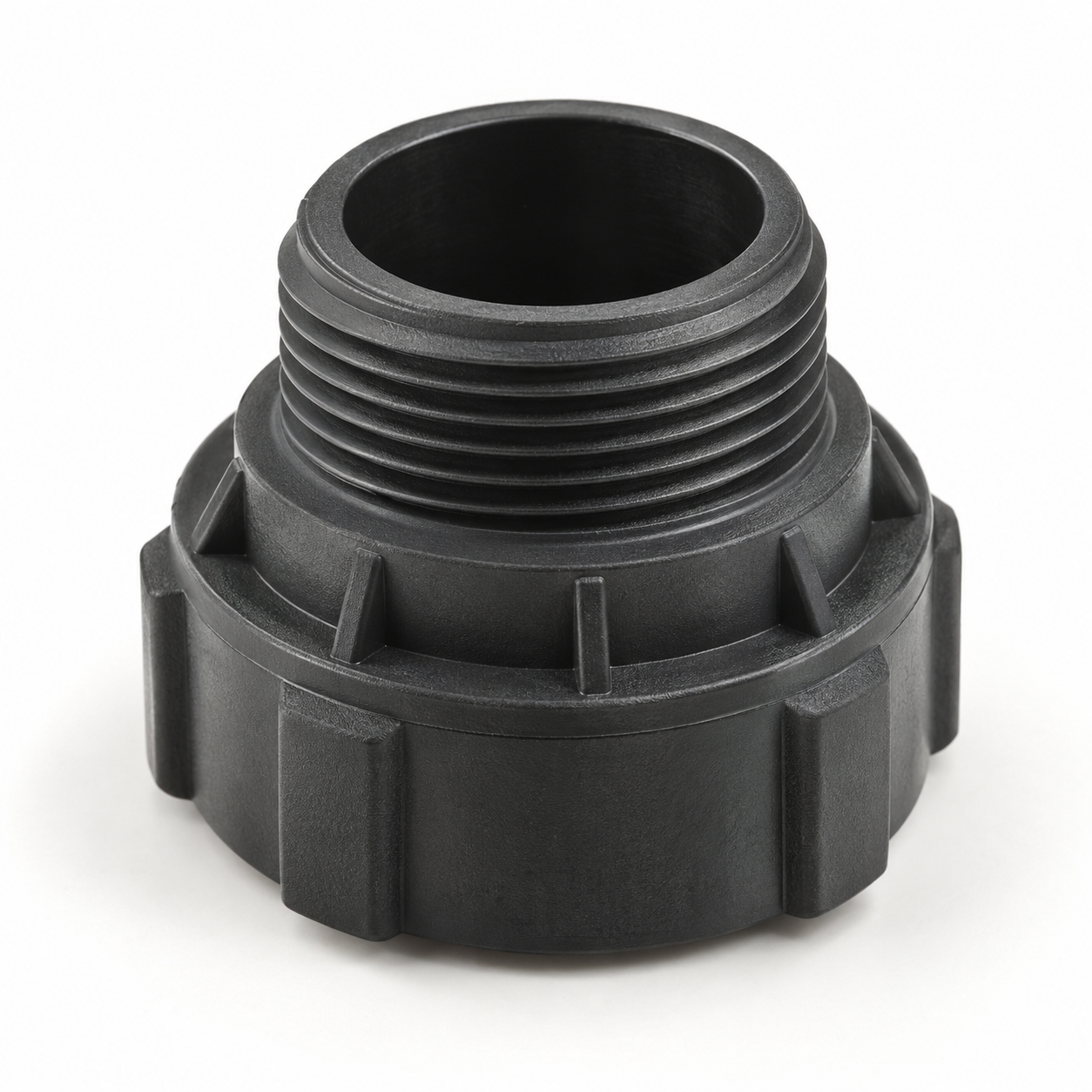
Threaded plastic parts look simple, but they often create more tooling risk than ordinary molded parts.
The main challenge is not forming the thread itself. The real difficulty is how to release the molded thread without damaging the part, the mold, or the thread profile.
For this reason, thread direction, depth, pitch, material, wall thickness, and demolding method should be reviewed before mold manufacturing starts.
At Fentor Mold, we usually check these details during the early mold review because a poor thread design can quickly increase mold complexity, cost, and maintenance.
Why Threaded Plastic Parts Are Difficult to Mold
A normal plastic part can usually be pushed out of the mold by ejector pins.
However, threaded plastic parts are different.
If the thread creates an undercut, the part cannot move straight out of the cavity. The mold needs another way to release it.
Common solutions include:
- Unscrewing cores
- Collapsible cores
- Sliders
- Lifters
- Stripping threads
- Hand-loaded inserts
The correct solution depends on the thread structure and production requirement.
If the wrong system is selected, the mold may run slowly, wear quickly, or damage the thread during ejection.
Threaded Plastic Parts and Thread Direction
Thread direction is one of the first things to check.
An external thread and an internal thread require different mold structures.
External Threads
External threads are often easier because they can sometimes be formed by:
- Sliders
- Split cavities
- Stripping
- Collapsible systems
However, deep external threads may still require a more complex release method.
Internal Threads
Internal threads usually create greater tooling difficulty.
Typical solutions include:
- Unscrewing cores
- Collapsible cores
- Threaded inserts
- Special lifter systems
For high-volume production, an automatic unscrewing system is often more stable than manual inserts.
However, it also increases mold cost and mold thickness.
Choosing the Right Demolding Method
The best demolding method should match the thread geometry.
| Thread Condition | Common Tooling Method |
|---|---|
| Shallow flexible thread | Stripping |
| Deep internal thread | Unscrewing core |
| External side thread | Slider |
| Limited mold space | Collapsible core |
| Low-volume prototype | Hand-loaded insert |
There is no single best solution for all threaded plastic parts.
The choice should consider:
- Thread depth
- Thread pitch
- Material flexibility
- Production quantity
- Cycle time
- Mold size
- Required thread accuracy
A simple mold structure is usually better if it can still meet the product requirement.
Threaded Plastic Parts With Unscrewing Cores
Unscrewing is one of the most common solutions for internal threads.
The threaded core rotates during mold opening and releases the molded part.
This system can use:
- Hydraulic motors
- Servo motors
- Rack-and-pinion systems
- Gear-driven mechanisms
The advantage is clear.
The thread shape can stay accurate, and the part does not need to deform during ejection.
However, the tooling risk is also higher.
The mold needs accurate control of:
- Rotation angle
- Core position
- Gear movement
- Lubrication
- Thread timing
- Cooling
- Ejection sequence
If the core stops in the wrong position, the mold may close incorrectly.
Therefore, anti-rotation and reset confirmation are very important.
The Mold Often Becomes Much Thicker
Unscrewing molds usually need more space behind the core.
This makes the mold thicker than a normal injection mold.
Extra space may be needed for:
- Motor
- Gear
- Rack
- Bearing
- Core movement
- Cooling connections
As a result, the mold may require a larger injection molding machine even if the plastic part itself is small.
This is an important cost factor.
Before finalizing the mold structure, the supplier should check the machine tie-bar spacing, mold thickness range, and ejector stroke.
Thread Accuracy Depends on More Than Machining
Good CNC or EDM machining is important, but it is not enough.
Thread accuracy also depends on molding conditions.
Possible sources of variation include:
- Plastic shrinkage
- Uneven cooling
- Core temperature
- Packing pressure
- Material moisture
- Warpage
- Mold wear
Therefore, the steel thread may be dimensionally correct while the molded thread still does not fit the mating part.
This is why the real mating component should be checked during mold trials whenever possible.
At Fentor Mold, we prefer to verify threaded plastic parts with the actual mating part or a confirmed thread gauge during sample inspection.
Plastic Shrinkage Must Be Considered
Plastic shrinks after molding.
This affects both the major diameter and minor diameter of the thread.
The amount of shrinkage depends on:
- Resin type
- Glass fiber content
- Mold temperature
- Part thickness
- Packing
- Cooling rate
For example, PP, ABS, PA, and POM do not behave the same way.
Glass-filled materials may also shrink differently in different flow directions.
Therefore, simply copying the nominal thread size into the mold steel may not produce the correct final fit.
The toolmaker should apply a suitable shrinkage allowance and confirm the result during mold trials.
Threaded Plastic Parts Need Good Core Cooling
Threaded cores are often difficult to cool.
This becomes more serious when the core is:
- Long
- Small in diameter
- Deep inside the part
- Connected to an unscrewing system
Poor cooling can create:
- Long cycle time
- Thread deformation
- Difficult ejection
- Part sticking
- Dimensional instability
For this reason, cooling should be considered early in the injection mold design.
If the core is too small for conventional cooling, alternative cooling methods may be required.
Avoid Weak Thread Roots
A sharp thread root creates stress concentration.
This is risky for both the plastic part and the mold insert.
For threaded plastic parts, the thread root should avoid unnecessary sharp corners.
A reasonable radius can help:
- Improve plastic flow
- Reduce stress
- Improve mold strength
- Reduce cracking risk
- Improve mold life
This is especially important when the mold insert around the thread is thin.
If the steel becomes too weak, repeated injection pressure can cause cracking over time.
Stripping Threads Can Reduce Tooling Cost
Not every threaded part needs an unscrewing mold.
Some shallow threads can be stripped directly from the core.
This can reduce:
- Mold cost
- Mold thickness
- Cycle time
- Maintenance
However, stripping only works when the plastic can deform without permanent damage.
Suitable conditions usually include:
- Flexible resin
- Shallow thread
- Rounded thread profile
- Limited undercut
- Good draft
- Enough wall thickness
PP and PE are often more suitable than brittle materials.
By contrast, PC, PMMA, or glass-filled engineering plastics usually have less tolerance for aggressive stripping.
Therefore, the material must be reviewed together with the thread profile.
Threaded Plastic Parts With Sliders
Side threads may be released using sliders.
This is common when the thread direction is perpendicular to the mold opening direction.
The slider forms the threaded area and moves away before ejection.
This method can work well, but the mold designer should check:
- Slider travel
- Locking force
- Wear plates
- Guide length
- Thread alignment
- Shut-off surfaces
If the slider becomes loose after long production, the thread may develop mismatch or flash.
Therefore, the slider structure should have enough support and reliable positioning.
For related tooling design issues, you can also review our article on injection mold interlock design.
Parting Lines Through Threads Need Careful Control
Sometimes the parting line passes through the threaded area.
This is possible, but it creates additional risk.
Even a small mold mismatch can produce:
- Flash on the thread
- Poor assembly
- Tightening problems
- Visible step lines
For functional threads, the parting line should be kept away from critical thread contact areas whenever possible.
If it cannot be avoided, mold alignment becomes more important.
The mold may require:
- Precision interlocks
- Accurate inserts
- Better shut-off fitting
- Higher machining accuracy
A small mismatch that is acceptable on a cosmetic surface may be unacceptable on a thread.
Material Selection Affects Tooling Risk
Material has a major effect on threaded plastic parts.
| Material | Typical Thread Consideration |
|---|---|
| PP | Flexible, often suitable for stripping |
| PE | Good flexibility, lower stiffness |
| ABS | Good general molding performance |
| PC | Strong but less suitable for aggressive stripping |
| POM | Good for functional threads and wear |
| PA | Strong but moisture can affect dimensions |
| PA+GF | High strength but more mold wear |
Glass-filled materials increase wear on threaded cores.
Therefore, hardened steel and good surface treatment may be needed for long production runs.
In addition, abrasive materials can increase maintenance frequency.
Common Tooling Problems With Threaded Plastic Parts
Several problems appear repeatedly in thread molds.
Thread Damage During Ejection
The thread may deform, tear, or whiten if the part is forced out incorrectly.
Unscrewing Core Wear
Repeated rotation can wear the core, bearings, gears, and guide components.
Poor Thread Fit
Shrinkage or process variation may make the final thread too tight or too loose.
Flash on the Thread
This often comes from poor fitting, mold wear, or weak alignment.
Core Sticking
Insufficient draft, poor cooling, or surface finish can make the part difficult to release.
Long Cycle Time
Complex unscrewing systems can add several seconds to each molding cycle.
These issues should be considered before the mold is built.
Prototype Before Committing to a Complex Mold
For a new threaded product, especially one with unusual geometry, it may be useful to test the concept before building a high-cost production mold.
Possible methods include:
- CNC-machined samples
- 3D printed samples
- Prototype molds
- Single-cavity trial tooling
This can help verify:
- Thread fit
- Assembly force
- Product strength
- Thread profile
- Material behavior
Once the design is confirmed, the production mold can be built with lower risk.
This is especially useful when the thread mates with another customer component.
Check the Real Mating Part During Mold Trials
For functional threaded plastic parts, visual inspection alone is not enough.
The samples should be tested with:
- Actual mating components
- GO/NO-GO gauges
- Torque testing
- Assembly testing
- Dimensional measurement
A molded thread may look perfect but still fail during assembly.
Therefore, final approval should be based on function, not only appearance.
During injection molding production, stable thread fit should also be checked over repeated cycles.
How Fentor Mold Reduces Thread Tooling Risk
For threaded plastic parts, Fentor Mold reviews the thread structure before mold manufacturing begins.
The main points include:
- Thread direction
- Demolding method
- Material flexibility
- Thread depth
- Shrinkage
- Core cooling
- Mold strength
- Slider or unscrewing mechanism
- Mating-part requirement
The goal is not to make the mold more complicated.
Instead, the goal is to use the simplest mold structure that can produce stable threads during long-term production.
Final Thoughts
Threaded plastic parts require more tooling planning than ordinary molded parts.
The main risks come from thread release, shrinkage, mold wear, cooling, alignment, and long-term mechanism stability.
An unscrewing core may give excellent thread quality, but it also increases mold cost and complexity.
A stripping system may be much simpler, but only when the material and thread geometry allow it.
Therefore, the correct mold structure should be selected based on the actual thread, resin, production volume, and quality requirement.
Good thread tooling is not about using the most complex mechanism.
It is about making sure the molded thread releases safely, fits correctly, and stays stable throughout production.