Two shot injection molding, also known as 2K molding or dual-shot molding, is an advanced manufacturing process that combines two materials or colors into one finished plastic part.
Instead of molding two separate components and assembling them afterward, two shot injection molding integrates both materials during the molding process. This can reduce assembly work, improve consistency, and create products with different colors, textures, or material properties.
For product developers and purchasing teams, the important questions are usually practical: How does two shot molding work? Which materials can be combined? How much does a two-shot mold cost? And when is two shot molding a better choice than overmolding?
This guide explains the process, materials, mold systems, benefits, costs, applications, and key considerations when choosing a two shot injection molding supplier.
2. What Is Two Shot Injection Molding?
Two shot injection molding is a manufacturing process that uses two injection steps to produce one finished plastic component.
During the first shot, the primary material is injected into the mold to create the base section of the part. The mold or molded component is then repositioned, allowing the second material to be injected into another section.
The final result is one integrated component containing two materials or two colors.
Common combinations include:
- ABS + TPE for rigid parts with soft-touch areas
- PC + TPU for rigid housings with flexible or protective sections
- PP + TPE for automotive and consumer products
- Two compatible colors of the same plastic for visual differentiation
The main advantage is that the two materials can be integrated into one component instead of producing separate parts and joining them later.
For custom tooling requirements, see our Injection Mold Manufacturing service.
🟢 3. How Two Shot Injection Molding Works
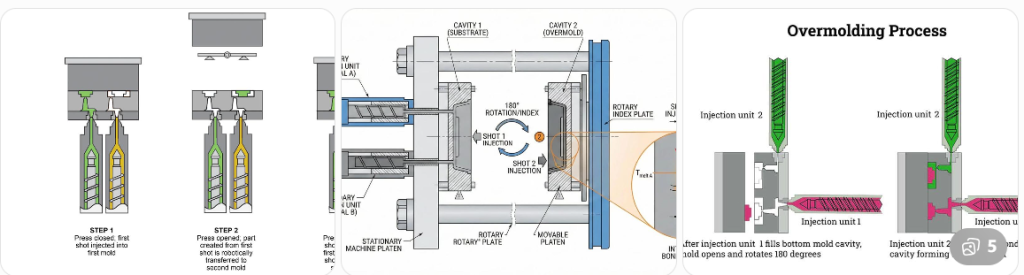
The exact two shot injection molding process depends on the machine, mold design, materials, and part geometry. However, most projects follow four basic stages.
Step 1: First Shot
The first plastic material is injected into the mold cavity.
This material normally forms the main structure of the component. The mold must be designed with enough space and the correct geometry for the second material.
Step 2: Mold Transfer
After the first shot is molded, the mold or molded component is moved into the position required for the second shot.
Depending on the tooling design, this can be achieved using:
Rotary platen systems
Core-back mechanisms
Mold indexing
Robot transfer systems
The best system depends on the part design, production volume, machine configuration, and tooling requirements.
Step 3: Second Shot
The second material is injected into the remaining cavity.
This material can provide a different color, softer surface, improved grip, flexibility, sealing, or impact protection.
At this stage, material compatibility is critical. The two materials must work properly together under the selected molding conditions.
Step 4: Cooling and Ejection
After both materials have been molded, the finished component is cooled and ejected from the mold.
The result is a single plastic part containing two materials or two colors.
- Types of Two Shot Injection Molding Systems
Different two shot injection molding systems can be used depending on the product and production requirements.
Rotary Platen System
A rotary platen rotates the mold or mold half between injection positions.
This approach is well suited to automated, high-volume production because the first and second shots can be completed within an integrated molding cycle.
Core-Back System
A core-back system changes part of the mold cavity after the first shot.
This can be useful when the part geometry allows the second material to be molded by opening additional cavity space.
Robot Transfer System
A robot transfers the first-shot component into another cavity or molding position.
This approach can provide flexibility for certain complex products, although the transfer process and tooling need to be carefully designed.
The right system depends on the part geometry, materials, production volume, machine capability, and target cycle time.
🟢 5. Key Benefits

Two shot injection molding can provide several advantages when the product design and production volume justify the tooling investment.
Reduced Assembly
Two materials or colors can be molded into one finished component.
This can eliminate some secondary assembly operations and reduce the number of separate components that need to be handled.
Stronger Product Integration
When the materials are compatible and the mold is properly designed, the two materials can form an integrated part with reliable bonding or mechanical interlocking.
This can be particularly useful for products combining rigid and flexible sections.
Better Design Flexibility
Two shot molding allows designers to combine different material properties within one component.
For example, a rigid material can provide structural support while TPE or TPU provides grip, cushioning, or flexibility.
Improved Appearance
Multiple colors and textures can be created during molding without painting or assembling separate colored components.
This is useful for consumer products, electronics, automotive components, and home appliances.
Potentially Lower Assembly Costs
Two-shot tooling usually costs more than a conventional single-material mold.
However, the process can reduce assembly labor and secondary operations during mass production.
For high-volume products, these savings may offset the higher tooling investment.
6. Two Shot Injection Molding Materials
For projects that require both tooling and production, our injection molding production service can support the transition from mold trials to volume manufacturing.
Material compatibility is one of the most important factors in two shot injection molding.
Not every combination of plastics will bond properly. The material pair must be evaluated based on processing temperature, shrinkage, hardness, chemical compatibility, and the required performance of the finished part.
Common First-Shot Materials
Typical rigid materials include:
- ABS
- PC
- PP
- PA / Nylon
- POM
- PC/ABS
Common Second-Shot Materials
Common soft or flexible materials include:
- TPE
- TPU
- SEBS-based materials
- Other suitable elastomers
For example, ABS + TPE may be used for products requiring a rigid structure with a soft-touch surface.
PC + TPU can be considered when a rigid housing needs flexible or protective sections.
However, the material combination should be confirmed before mold construction. A supplier should consider both the manufacturer’s material data and the actual molding requirements.
Important factors include:
- Chemical compatibility
- Bonding strength
- Melt temperature
- Processing temperature
- Shrinkage
- Hardness
- Thermal expansion
- Chemical resistance
- Final application requirements
7. Two Shot Injection Molding vs Overmolding
Two shot injection molding and overmolding can both combine different materials into one finished component, but the manufacturing processes are different.
| Factor | Two Shot Injection Molding | Overmolding |
|---|---|---|
| Basic process | Two materials molded within an integrated two-shot process | Second material molded over an existing part or insert |
| Tooling cost | Generally higher | Often lower |
| Automation | Highly suitable for automation | Can be manual, semi-automatic, or automated |
| Production volume | Well suited to medium and high volume | Suitable for low to high volume |
| Material compatibility | Important | Important |
| Assembly requirement | Can reduce secondary assembly | May still require insert handling |
| Best suited for | Integrated two-material products | Flexible two-material or insert-based applications |
When Should You Choose Two Shot Molding?
Two shot injection molding may be a better choice when:
- Production volume is relatively high
- Automated production is important
- Two materials need precise positioning
- Secondary assembly should be reduced
- The part geometry is suitable for two-shot tooling
When Is Overmolding Better?
Overmolding may be more suitable when:
- Production volume is lower
- An existing insert needs to be overmolded
- Tooling flexibility is important
- A two-shot machine is not necessary
- The production process involves an existing component
The right choice depends on your part design, materials, production volume, tooling investment, and assembly requirements.
8. Two Shot Injection Molding Cost
Two shot injection molding generally requires a higher tooling investment than standard single-material injection molding.
The reason is simple: the mold needs to accurately control two molding operations while maintaining the correct position between the first and second shots.
The final cost depends on several factors, including:
- Part size
- Part complexity
- Number of cavities
- Mold steel
- Rotary or core-back mechanism
- Hot runner requirements
- Material combination
- Surface finish
- Expected tool life
- Production volume
- Machine requirements
- Automation requirements
Why Does a Two-Shot Mold Cost More?
A standard injection mold controls one molding operation.
A two-shot mold may require:
- Additional cavity features
- Rotary mechanisms
- Core-back systems
- Multiple injection systems
- More complex cooling
- More complicated ejection
- More detailed mold engineering
However, the higher tooling cost does not necessarily mean a higher total production cost.
If two-shot molding eliminates separate assembly, reduces labor, and improves production efficiency, the overall cost per finished part can become attractive at higher volumes.
Therefore, buyers should compare the total production cost, rather than looking only at the initial mold quotation.
9. Two Shot Injection Molding Applications
Two shot injection molding is used across many industries.
Automotive
Typical applications include:
- Interior controls
- Door handles
- Switches
- Buttons
- Decorative trims
- Soft-touch components
The process can combine rigid structural sections with softer surfaces or different colors.
Electronics
Applications may include:
- Remote controls
- Electronic housings
- Buttons
- Protective components
- Consumer electronic parts
Two-shot molding can combine appearance and functional requirements in one component.
Medical Products
Depending on the application and regulatory requirements, two-shot molding may be used for:
- Device handles
- Diagnostic components
- Medical equipment parts
- Grip surfaces
Material selection and process control are especially important for medical applications.
Home Appliances
Two shot injection molding can be used for:
- Appliance buttons
- Control panels
- Handles
- Knobs
- Grip components
- Decorative parts
This makes the process useful when a product requires both functional and aesthetic features.
10. Two Shot Injection Molding Design Considerations
A successful two-shot project starts with the part design.
The two materials and molding sequence should be considered before the mold is manufactured.
Wall Thickness
Large variations in wall thickness can increase the risk of:
- Sink marks
- Warpage
- Uneven cooling
- Dimensional variation
Material Shrinkage
Different materials can have different shrinkage rates.
This needs to be considered when designing both the first and second shots.
Draft Angles
Adequate draft helps the molded part release from the mold without damage.
Bonding Area
The interface between the two materials should provide enough area for the required bonding performance.
Mechanical Interlocking
When chemical bonding is limited, ribs, holes, undercuts, or other geometric features can provide mechanical interlocking.
Gate Location
Gate locations need to be considered for both shots.
Poor gate positioning can lead to:
- Weld lines
- Flow problems
- Air traps
- Appearance defects
- Uneven filling
If you are developing a two-shot part, the injection mold design should be reviewed before tooling starts.
11. Common Challenges in Two Shot Injection Molding
Two shot injection molding offers significant benefits, but it also requires careful engineering.
Material Compatibility
The two materials may not bond properly if the combination is unsuitable.
Higher Tooling Cost
Two-shot tooling normally requires more engineering and more complex mechanisms than a conventional injection mold.
Complex Mold Design
The mold needs to accurately control both shots, including positioning, cooling, ejection, and material flow.
Process Control
Both injection stages require stable processing conditions.
Changes in temperature, pressure, injection speed, or cooling can affect the finished part.
Longer Development
Because the tooling and material interaction are more complex, development may require additional engineering work and mold trials.
These challenges can be managed more effectively when material selection, part design, mold design, and processing conditions are considered together from the beginning.
12. How to Choose a Two Shot Injection Molding Company
Choosing the right two shot injection molding company is important because two-shot production requires more than a standard injection molding machine.
Before placing an order, buyers should ask the supplier about several areas.
Two-Shot Machine Capability
Ask what type of two-shot machines the supplier has and what part sizes, materials, and production volumes they can support.
Two-Shot Mold Design Experience
The supplier should understand:
- Rotary systems
- Core-back mechanisms
- Part transfer
- Cooling
- Ejection
- Material interfaces
Material Experience
Ask whether the supplier has experience with your specific material combination.
A supplier should also be able to discuss potential bonding and processing issues before tooling begins.
DFM Support
Design for manufacturing review is especially important for two-shot parts.
A proper DFM review can identify potential issues with:
- Wall thickness
- Draft
- Gate locations
- Material interfaces
- Shrinkage
- Ejection
- Mold movement
Tooling and Production Capability
If the project is expected to move into mass production, it is useful to work with a supplier that can support both mold manufacturing and injection molding production.
Fentormold provides both custom mold manufacturing and Injection Molding Production for customers requiring a complete tooling-to-production solution.
Quality Control
Ask how the supplier checks:
- Critical dimensions
- Material bonding
- Appearance
- Mold performance
- First-shot and second-shot alignment
- Trial samples
13. What Should Buyers Include in a Two Shot Injection Molding RFQ?
A clear RFQ helps a two shot injection molding company evaluate the project accurately.
If you are still evaluating the tooling approach, our prototype injection molding service can also be considered for early-stage product validation.
When requesting a quotation, provide as much of the following information as possible:
- 3D CAD files
- 2D drawings
- First-shot material
- Second-shot material
- Material hardness
- Color requirements
- Surface finish
- Expected annual volume
- Estimated lifetime quantity
- Target tool life
- Target production date
- Quality requirements
If the material combination has not been finalized, tell the supplier.
The mold designer can then consider suitable material combinations before the tooling structure is finalized.
14. Is Two Shot Injection Molding Right for Your Project?
Two shot injection molding is worth considering when a product requires two materials or colors and the production volume can justify the tooling investment.
It may be a good choice if you want to:
- Combine rigid and soft materials
- Reduce secondary assembly
- Improve product appearance
- Add integrated grip surfaces
- Produce multiple colors
- Increase production automation
- Reduce assembly labor
However, two-shot molding is not automatically the best solution for every project.
For smaller production quantities or products that require separate inserts, overmolding or another process may provide a better balance between tooling cost and production flexibility.
The decision should be based on the complete production plan rather than the mold price alone.
15. Why Choose Fentormold for Two Shot Injection Molding?
Fentormold supports customers with injection mold manufacturing and plastic injection molding solutions for projects requiring complex tooling and multi-material production.
Our capabilities include:
- Two shot injection molding
- 2K molding
- Injection mold design
- Custom injection mold manufacturing
- Overmolding solutions
- Low-volume injection molding
- Production injection molding
- Mold components manufacturing
Our engineering team can review your part design, material combination, expected production volume, and target schedule before recommending a suitable tooling approach.
You can learn more about our Injection Mold manufacturing capabilities or our Injection Molding Production service.
Conclusion
Two shot injection molding provides a practical way to combine two materials or colors into one finished plastic component.
The process can reduce assembly operations, improve product appearance, add different material properties, and support automated production.
However, successful two-shot molding depends on more than choosing a two-shot machine.
Material compatibility, part design, mold structure, tooling cost, production volume, tool life, and processing conditions all need to be considered before the project begins.
For high-volume products that require precise two-material integration, two shot injection molding can be more efficient than producing separate components and assembling them afterward.
If you are unsure whether two-shot molding or overmolding is better for your project, send us your 3D CAD file, material requirements, expected production volume, and target schedule.
Our engineering team can review your project and recommend a suitable tooling and molding solution.
Contact Fentormold for a free quotation and project evaluation.
FAQ About Two Shot Injection Molding
What is two shot injection molding?
Two shot injection molding is a process that uses two injection steps to combine two materials or colors into one finished plastic part.
What is the difference between two shot molding and 2K molding?
They generally refer to the same basic manufacturing concept. “2K molding” is commonly used to describe a two-component or two-material injection molding process.
What materials can be used in two shot injection molding?
Common combinations include rigid materials such as ABS, PC, PP, and PA with softer materials such as TPE or TPU. The exact combination depends on material compatibility and the application.
Is two shot injection molding more expensive than standard injection molding?
The tooling is usually more expensive because the mold and machine must handle two injection stages. However, the process can reduce assembly and labor costs in high-volume production.
What is the difference between two shot injection molding and overmolding?
Two shot molding normally integrates both materials within a dedicated two-shot molding process. Overmolding typically involves molding one material over an existing part or insert. The better option depends on the part design, materials, production volume, and tooling requirements.
How do I choose a two shot injection molding company?
Look for a supplier with experience in two-shot mold design, material compatibility, DFM, tooling, mold trials, quality control, and production molding. It is also important to confirm that the supplier can support your expected part size, material combination, production volume, and tool life.
What information should I provide when requesting a two-shot mold quotation?
Provide your 3D CAD file, 2D drawing, material specifications, color requirements, annual production volume, expected tool life, surface finish, and target schedule. This allows the supplier to evaluate the project more accurately.
Can two shot injection molding reduce assembly costs?
Yes. Because two materials or colors can be integrated into one molded component, some secondary assembly operations can be eliminated. Whether the overall cost is lower depends on tooling investment, production volume, labor, and part design.