
Thermoset plastic is a polymer material that undergoes a permanent chemical change during curing. Unlike thermoplastics, it cannot be melted and reshaped after it has fully cured.
This permanent structure gives thermoset plastics useful properties for demanding applications. Depending on the material, they can provide good heat resistance, dimensional stability, chemical resistance, electrical insulation, and long-term mechanical performance.
For manufacturers and purchasing teams, choosing a thermoset material is not only a material decision. The material also affects the molding process, tooling design, cycle conditions, part performance, and production requirements.
At Fentormold, we work with customers on custom tooling and plastic manufacturing projects where material selection needs to match the actual application and production conditions.
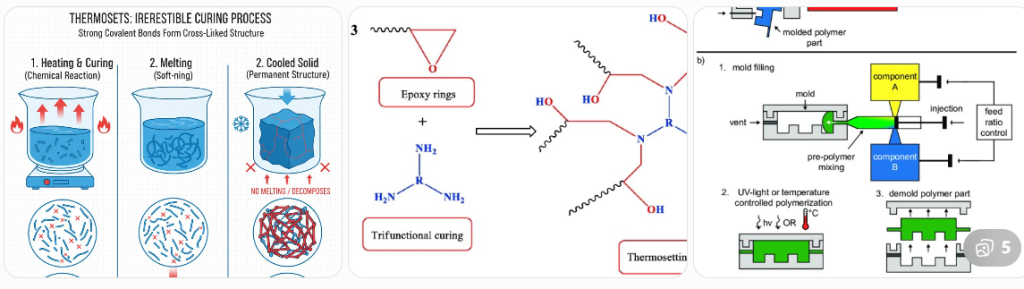
How Does Thermoset Plastic Work?
The key difference between thermoset and thermoplastic materials is what happens during heating.
Thermoplastics soften or melt when heated and become solid again when cooled. This process can generally be repeated.
Thermoset materials behave differently. During molding, heat, pressure, or chemical additives trigger a curing reaction. Polymer chains form a cross-linked three-dimensional structure. Once this structure is fully developed, the material becomes permanently set.
That is why a cured thermoset part cannot simply be heated and molded into a new shape.
The curing process also explains why processing conditions need to be controlled carefully. Mold temperature, material preparation, pressure, curing time, and part geometry can all affect the final result.
For a manufacturer, the tooling therefore needs to be designed around the specific thermoset material and molding process rather than treating it like a standard thermoplastic injection molding project.
What Are the Main Properties of Thermoset Plastic?
The properties of thermoset plastics vary considerably between material families. However, several characteristics make them suitable for demanding engineering applications.
Heat Resistance
Many thermoset materials maintain their shape and mechanical performance at temperatures where some conventional plastics may soften or deform.
This makes them useful around engines, electrical equipment, industrial machinery, and other heat-generating components.
Dimensional Stability
Because the cured material has a cross-linked structure, many thermoset plastics have good dimensional stability during long-term use.
This can be important for components where excessive deformation could affect assembly or function.
Chemical Resistance
Certain thermoset materials can provide good resistance to oils, fuels, solvents, and other chemicals.
The actual resistance depends on the specific resin and the chemical environment, so the material should always be selected according to the application.
Electrical Insulation
Some thermoset materials provide excellent electrical insulation.
For this reason, they are commonly considered for electrical housings, insulating components, circuit protection, and other applications where electrical performance is important.
Mechanical Strength
Many thermoset formulations provide good strength and stiffness. Reinforcements and fillers can further modify the mechanical properties to meet specific application requirements.
For buyers comparing materials, it is important to review the supplier’s material data rather than selecting a resin based only on its general material category.
What Are the Main Types of Thermoset Plastic?
Different thermoset materials are suited to different applications. The most common families include epoxy, phenolic, polyester, and certain polyurethane systems.
Epoxy Resin
Epoxy materials are widely used where strong adhesion, chemical resistance, electrical insulation, and dimensional stability are required.
They are common in electrical, electronic, industrial, coating, and composite applications.
Phenolic Resin
Phenolic materials are known for their heat resistance, dimensional stability, and electrical insulation.
They have been used for many years in electrical components, industrial parts, and applications where resistance to elevated temperatures is important.
Polyester Resin
Unsaturated polyester resins are widely used in fiberglass-reinforced products and composite applications.
They can be found in automotive, electrical, construction, and industrial products.
Thermoset Polyurethane
Some polyurethane systems are formulated as thermosets and are used where flexibility, impact resistance, wear resistance, or protective performance is required.
The specific formulation has a major effect on the final properties.
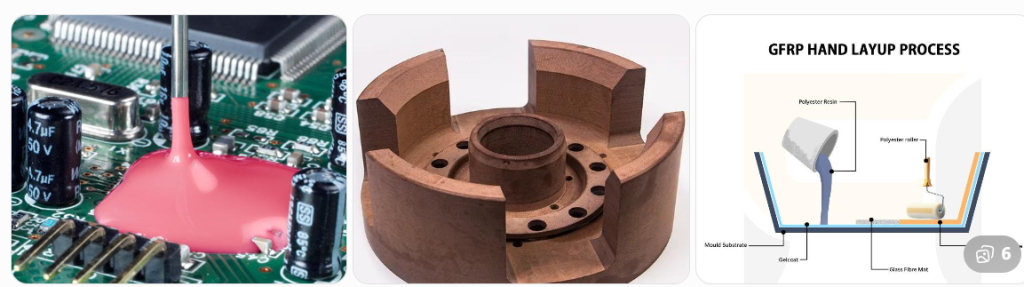
What Are the Advantages of Thermosetting Plastics?
The advantages of thermosetting plastics come mainly from their permanent cross-linked structure.
Key benefits can include:
- Good heat resistance
- Good dimensional stability
- Strong electrical insulation
- Resistance to many chemicals
- Good mechanical strength
- Long-term structural stability
- Low tendency to soften after curing
However, these advantages do not mean that thermoset materials are automatically better than thermoplastics.
The right choice depends on the application.
For example, a component that needs repeated heating and reshaping may be better suited to a thermoplastic. A component that needs to maintain its shape in a high-temperature environment may benefit from a suitable thermoset material.
Thermoset Plastic vs Thermoplastic: What Is the Difference?
The simplest difference is how the material responds to heat.
| Property | Thermoset Plastic | Thermoplastic |
|---|---|---|
| Heating after curing | Does not melt and reshape | Can soften or melt |
| Chemical structure | Cross-linked after curing | Generally linear or branched |
| Reshaping | Not possible after full cure | Possible when reheated |
| Heat resistance | Often high | Depends on material |
| Recycling | More difficult after curing | Generally easier to remelt |
| Processing | Requires curing | Melting and cooling |
| Typical applications | Electrical, automotive, industrial | Consumer, automotive, electronics, appliances |
The comparison should not be reduced to “thermosets are stronger” or “thermoplastics are cheaper.” Both material groups contain many different grades.
If you are comparing the two material families for a project, see our guide to thermoplastic vs thermoset materials.
How Is Thermoset Plastic Molded?
Thermoset moulding uses heat and pressure to form the material and complete the curing process.
The exact process depends on the resin and application.
Compression Molding
In compression molding, a measured amount of thermoset material is placed into the mold. The mold closes and applies pressure while heat causes the material to cure.
This process is widely used for larger or relatively simple thermoset components.
Transfer Molding
Transfer molding places the material in a separate chamber before transferring it into the mold cavities under pressure.
This process can provide better control for certain detailed components and is commonly used for electrical and industrial parts.
Reaction Injection Molding
Reaction injection molding, or RIM, uses reactive liquid components that are mixed and injected into the mold. The chemical reaction then forms the final polymer structure.
RIM is particularly useful for certain larger components and specialized polyurethane applications.
The important point is that thermoset moulding is based on curing rather than simply melting and cooling the material.
This difference affects mold design, temperature control, material handling, and cycle time.
For readers who are also comparing general plastic molding processes, our injection molding guide explains how conventional injection molding works.
How Does Thermoset Molding Affect Mold Design?
Material selection should be considered before the mold design is finalized.
A thermoset mold needs to accommodate the material’s curing behavior, processing temperature, shrinkage characteristics, and production requirements.
Several areas deserve particular attention.
Mold Temperature
The mold temperature has a direct effect on curing. If the temperature is not properly controlled, the material may not cure consistently throughout the part.
Venting
Proper venting is important because trapped air and gases can affect part quality.
The mold designer needs to consider vent locations, depth, and the geometry of the part.
Gate and Runner Design
Where the selected molding process uses gates and runners, their design needs to match the material’s flow behavior and curing characteristics.
An unsuitable layout can lead to incomplete filling, weld lines, excessive pressure, or inconsistent part quality.
Mold Surface and Wear
Some thermoset materials contain fillers or reinforcing fibers that can increase mold wear.
For production tooling, the expected material, production volume, and mold life should therefore be considered when selecting mold steel and wear components.
What Are the Common Uses of Thermosetting Plastics?
Thermosetting plastic uses cover a wide range of industrial and engineering applications.
Automotive
Thermoset materials can be used for selected engine-related, electrical, braking, and under-hood components where heat resistance and dimensional stability are important.
Electrical and Electronics
Electrical insulation is one of the major application areas for thermoset materials.
They can be used in insulating components, electrical housings, connectors, circuit protection, and other components depending on the material grade.
Industrial Equipment
Industrial applications may require materials that can withstand heat, chemicals, mechanical stress, or continuous operation.
Thermoset materials can meet these requirements in appropriately designed components.
Aerospace and Composite Applications
Thermoset resins are also widely used in fiber-reinforced composite structures.
Epoxy and other resin systems can provide a useful combination of strength, stiffness, and relatively low weight when combined with suitable reinforcement.
What Are the Limitations of Thermoset Plastic?
Thermoset plastics also have limitations that should be considered before material selection.
The most obvious limitation is that a fully cured thermoset cannot be melted and reshaped like a thermoplastic.
This makes conventional recycling more difficult.
Thermoset molding also requires careful process control because curing is a chemical reaction. Incorrect temperature, pressure, material preparation, or curing time can affect the final part.
Some thermoset materials can also be relatively brittle compared with certain engineering thermoplastics. The actual impact performance depends heavily on the resin, fillers, reinforcement, and formulation.
Therefore, the material should be selected based on the complete application rather than one property alone.
When Should You Choose Thermoset Plastic?
Thermoset plastic may be a good option when the application requires a combination of:
- High-temperature performance
- Dimensional stability
- Electrical insulation
- Chemical resistance
- Long-term rigidity
- Resistance to softening after curing
However, the decision should also consider production volume, part geometry, molding method, tooling cost, expected service life, and material availability.
For high-volume plastic parts that need repeated reshaping or a high level of material flexibility during processing, a suitable thermoplastic may be a better choice.
The best material is the one that meets the actual operating and manufacturing requirements.
What Should Buyers Consider Before Ordering Thermoset Tooling?
For purchasing teams, material selection and mold selection should be discussed together.
Before requesting a tooling quotation, it is useful to provide:
- The 3D part model
- 2D drawings and critical dimensions
- The exact material or material specification
- Expected annual production volume
- Required part appearance
- Operating temperature
- Chemical exposure, if applicable
- Target cycle time
- Expected mold life
- Any existing prototype or production data
This information allows the mold manufacturer to evaluate the tooling requirements more accurately.
It can also prevent a common problem: choosing a mold structure first and discovering later that the material or production conditions require significant changes.
For custom tooling requirements, you can learn more about our injection mold manufacturing service.
Thermoset plastic is different from thermoplastic because its polymer structure changes permanently during curing. Once fully cured, the material cannot simply be melted and reshaped.
That permanent structure gives many thermoset materials useful properties, including heat resistance, dimensional stability, chemical resistance, electrical insulation, and long-term performance.
At the same time, thermoset materials require appropriate molding processes and careful process control. Material selection, mold design, venting, temperature control, and expected production volume should all be considered together.
If you are developing a thermoset plastic component and need help evaluating the tooling requirements, Fentormold can review the part design, material specification, production volume, and molding process before tooling begins. You can contact our team with your drawings or 3D files for a tooling assessment.