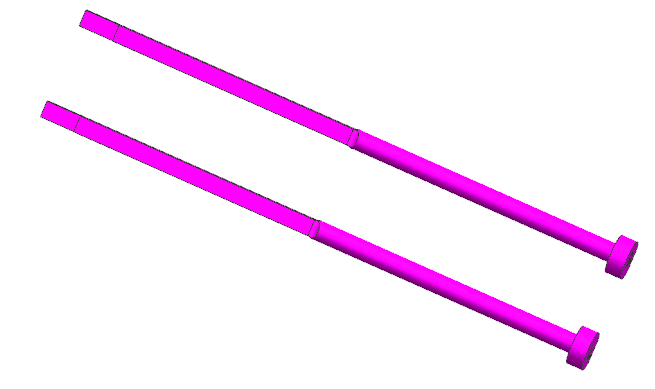
Flat ejector pins are common in injection molds.
Their main advantage is simple: they need little space and offer flexible ejection.
For small and precision parts, a round ejector pin may not fit into a narrow rib. A flat ejector pin can solve this problem.
That is why flat ejector pins are often useful in precision injection mold design.
But flat ejector pins also have a clear limit.
The longer and thinner the pin, the lower its rigidity.
This is why we do not recommend using too many long and thin flat ejector pins in large molds.
What Are the Advantages of Flat Ejector Pins?
The biggest advantage is their small size.
They can fit into narrow areas where a round ejector pin cannot.
They offer three main benefits:
- Small installation space
- Flexible ejection positions
- Good for narrow ribs and precision parts
These benefits are especially useful in small molds.
Why Can Large Molds Cause Problems?
Large parts usually need more ejection force.
A long and thin flat ejector pin can bend under high loads.
The risk becomes higher when the part has strong shrinkage around the core, the ejector layout is not balanced, or the ejection force is too high.
After long-term production, you may see:
- Bent ejector pins
- Broken ejector pins
- Sticking pins
- Uneven ejection
- More mold maintenance
The most common problems are bending and breakage.
This is why large molds need careful ejector design.
More Flat Ejector Pins Are Not Always Better
Some engineers add more flat ejector pins when they see an ejection problem.
This does not always solve the problem.
For large molds, the whole ejection system needs enough rigidity.
Depending on the part design, a mold may use a combination of:
- Round ejector pins
- Flat ejector pins
- Sleeve ejectors
- Ejector blocks
- Lifters
- Ejector plates
Use flat ejector pins where precise local ejection is needed.
For areas with higher loads, use a stronger ejection structure.
This approach is more reliable than simply adding more flat pins.
For more information about ejection design and mold manufacturing, see Fentormold’s injection mold manufacturing service.
Large Molds Need Long-Term Reliability
A flat ejector pin may work perfectly during the mold trial.
But a production mold may run for hundreds of thousands or even millions of cycles.
So, the key question is not only:
“Can we fit this ejector pin here?”
We should also ask:
“Can it work reliably for a long time?”
This is an important part of Fentormold’s mold design approach. We consider the part structure, ejection force, pin size, and production requirements before choosing the right ejection solution.
Learn more about Fentormold’s Injection Mold Manufacturing service.
Conclusion
Flat ejector pins are not bad.
They work very well for small, precision molds with limited space.
However, long and thin flat pins have lower rigidity. In large molds and high-load applications, too many thin pins can bend or break.
Good mold design is not about using more flat ejector pins.
It is about choosing the right ejection method for each part.
Small molds need flexibility. Large molds need rigidity.
That is the right way to use flat ejector pins.