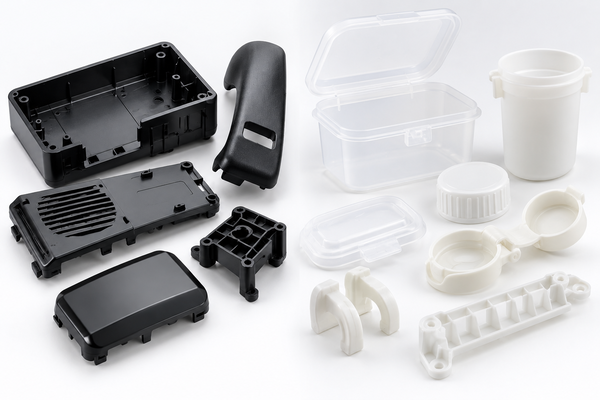
Choosing between ABS vs polypropylene can have a major effect on part strength, appearance, weight, cost, and long-term performance. Both materials are widely used for injection molded plastic parts. However, they behave very differently.
ABS is known for rigidity, impact strength, and good surface appearance. Polypropylene, or PP, is lighter, more flexible, and more resistant to chemicals.
Therefore, the better material depends on the product, working environment, and performance requirements.
In this guide, we compare ABS and polypropylene for injection molded parts, including strength, heat resistance, chemical resistance, cost, surface finish, and common applications.
What Is ABS Plastic?
ABS stands for acrylonitrile butadiene styrene.
It is a common engineering thermoplastic used in many consumer and industrial products.
ABS offers a good balance of:
- Impact strength
- Rigidity
- Surface quality
- Dimensional stability
- Easy processing
- Good machinability
Because of this, ABS is often used for housings, covers, electronic products, automotive interior parts, toys, and appliance components.
In addition, ABS can be painted, plated, textured, or printed relatively easily.
What Is Polypropylene?
Polypropylene, commonly called PP, is a lightweight thermoplastic.
It is widely used because of its low cost and strong chemical resistance.
PP offers:
- Low density
- Good chemical resistance
- Good fatigue resistance
- Good moisture resistance
- High flexibility
- Low material cost
As a result, PP is common in containers, caps, living hinges, automotive parts, household products, and packaging.
However, its surface is usually more difficult to paint or bond than ABS.
ABS vs Polypropylene: Main Differences
The table below gives a simple comparison.
| Property | ABS | Polypropylene |
|---|---|---|
| Rigidity | High | Moderate |
| Impact Strength | High | Good |
| Flexibility | Lower | High |
| Density | Higher | Lower |
| Chemical Resistance | Moderate | Very Good |
| Surface Finish | Excellent | Good |
| Paintability | Good | Difficult |
| Moisture Resistance | Good | Excellent |
| Fatigue Resistance | Moderate | Excellent |
| Cost | Moderate | Low |
| Living Hinge Performance | Poor | Excellent |
Both materials work well for injection molding. However, their final applications are often very different.
ABS vs Polypropylene Strength
ABS is generally more rigid than PP.
Therefore, it is often used when the part needs to feel solid or maintain its shape under load.
For example, ABS is common in:
- Electronic housings
- Appliance covers
- Structural plastic parts
- Automotive interior trims
- Handheld devices
PP is more flexible.
As a result, it can bend further before breaking.
This makes PP useful for parts that need repeated flexing.
Examples include:
- Living hinges
- Flexible clips
- Caps
- Containers
- Automotive trim components
Therefore, strength should not be judged by one number alone. Rigidity, impact, and flexibility should all be considered.
Impact Resistance of ABS and PP
ABS offers good impact resistance.
It can absorb shock without cracking easily, especially at normal room temperature.
For this reason, ABS is common in protective housings and covers.
PP also offers good impact performance. However, it usually feels softer and more flexible.
The exact result depends on the resin grade and temperature.
Therefore, impact needs should be tested under real working conditions.
ABS vs Polypropylene Heat Resistance
Heat resistance depends on the exact material grade.
In general, both ABS and PP can handle normal indoor product temperatures.
However, neither material is designed for very high-temperature applications.
PP may soften under load as temperature rises.
ABS can also lose stiffness at elevated temperatures.
Therefore, if the part will operate near a heat source, material data should be checked carefully.
For higher temperatures, materials such as PC, PA, PPS, or PEEK may be more suitable.
Chemical Resistance
PP generally offers better chemical resistance than ABS.
It performs well against many:
- Acids
- Bases
- Cleaning chemicals
- Moisture
- Detergents
Therefore, PP is common in chemical containers and fluid-contact parts.
ABS has more limited chemical resistance.
Some solvents can cause cracking, swelling, or surface damage.
As a result, chemical exposure should be checked before using ABS.
ABS vs Polypropylene Surface Finish
ABS usually offers better cosmetic surface quality.
It can produce:
- Smooth surfaces
- Fine textures
- High-gloss finishes
- Painted surfaces
- Plated surfaces
Therefore, ABS is often selected for visible consumer products.
PP can also produce a good molded surface. However, its lower surface energy makes painting and bonding more difficult.
Special surface treatment may be required.
For this reason, ABS is often easier to use when appearance is a key requirement.
Painting and Secondary Finishing
ABS works well with many secondary processes.
These include:
- Painting
- Printing
- Chrome plating
- Laser marking
- Gluing
PP is more difficult.
Because of its low surface energy, paint and adhesive may not bond easily.
Therefore, flame treatment, plasma treatment, or special primers may be needed.
If the product requires extensive decoration, ABS may reduce secondary processing difficulty.
ABS vs Polypropylene Weight
PP is lighter than ABS.
This is one of its biggest advantages.
Because PP has a lower density, the same part volume can weigh less.
As a result, PP is useful for:
- Automotive parts
- Portable products
- Packaging
- Large plastic components
Lower weight can also reduce material usage by mass.
Therefore, PP may help lower both product weight and material cost.
Material Cost
PP is generally cheaper than ABS.
This makes it attractive for high-volume production.
However, the cheapest resin does not always create the lowest total cost.
For example, a PP part may require extra surface treatment if it needs painting.
In contrast, ABS may cost more per kilogram but reduce finishing work.
Therefore, total manufacturing cost should include:
- Resin cost
- Mold cost
- Cycle time
- Secondary processing
- Scrap rate
- Assembly cost
ABS vs Polypropylene Shrinkage
PP usually has higher shrinkage than ABS.
This can make dimensional control more difficult.
Higher shrinkage may also increase:
- Warpage
- Flatness variation
- Hole position changes
- Assembly problems
ABS normally offers better dimensional stability.
Therefore, it is often easier to control on tight-tolerance parts.
However, mold design and processing conditions still play a major role.
Warpage Control in PP Parts
PP parts can warp if the design is not balanced.
Common causes include:
- Uneven wall thickness
- Poor gate position
- Uneven cooling
- Long flow paths
- Uneven packing
Therefore, ribs and wall transitions should be designed carefully.
Gate location is also important.
For complex parts, Moldflow analysis can help predict filling and warpage before mold manufacturing.
Our injection mold manufacturing process includes DFM review, mold design, machining, assembly, and mold trials to help reduce these risks.
ABS Injection Molding Considerations
ABS is generally easy to mold.
However, good drying is important.
Wet material can cause:
- Silver streaks
- Bubbles
- Poor surface quality
- Lower strength
Therefore, ABS resin should be dried before molding.
Mold temperature and injection speed also affect appearance.
For cosmetic parts, process settings should remain stable.
Polypropylene Injection Molding Considerations
PP is also easy to injection mold.
It flows well and can fill thin sections.
However, shrinkage is higher than ABS.
Therefore, mold dimensions must account for the selected PP grade.
Cooling balance is also important.
Uneven cooling may increase warpage.
Fentor Mold provides injection molding production for plastic components using ABS, PP, PC, PA, and other engineering plastics.
Living Hinges: Why PP Is Better
PP is one of the best plastics for living hinges.
A living hinge is a thin flexible section that bends repeatedly.
Common examples include:
- Flip-top caps
- Storage boxes
- Small covers
- Packaging parts
PP can survive repeated bending because of its strong fatigue resistance.
ABS is much less suitable for this feature.
Therefore, PP is usually the better choice when a part needs an integrated hinge.
ABS vs Polypropylene for Automotive Parts
Both materials are widely used in automotive products.
ABS is often used for:
- Interior trim
- Covers
- Decorative panels
- Dashboard components
- Housings
PP is commonly used for:
- Door trim
- Interior panels
- Battery components
- Under-hood covers
- Larger molded parts
In addition, PP is often modified with fillers or elastomers to improve stiffness or impact performance.
Therefore, the final grade should match the specific automotive requirement.
ABS vs Polypropylene for Consumer Products
ABS is often preferred when appearance and rigidity are important.
For example:
- Electronic housings
- Appliance parts
- Cosmetic covers
- Handheld products
PP is more suitable when low weight, flexibility, or chemical resistance matter.
Typical examples include:
- Containers
- Storage products
- Caps
- Household products
- Flexible components
Therefore, product function should guide material selection.
Which Material Is Better for Tight Tolerances?
ABS is often easier to control for tight dimensions.
This is mainly because its shrinkage is lower and more stable than PP.
However, part geometry still matters.
Large flat parts may warp even when ABS is used.
For tight-tolerance projects, engineers should review:
- Wall thickness
- Gate position
- Cooling
- Mold temperature
- Packing pressure
- Material shrinkage
For early projects, prototype injection molding can help test material and design before full production.
When Should You Choose ABS?
ABS may be a better choice when:
- Good surface appearance is important.
- The part needs high rigidity.
- Painting or plating is required.
- Tight dimensions are important.
- The product needs a solid feel.
- Impact resistance is needed.
It is especially suitable for visible housings and structural consumer parts.
When Should You Choose Polypropylene?
PP may be a better choice when:
- Low weight matters.
- Material cost must stay low.
- Strong chemical resistance is required.
- The part needs flexibility.
- Living hinges are needed.
- Moisture exposure is common.
- Production volume is high.
It is especially useful for containers, flexible parts, automotive components, and high-volume products.
ABS vs Polypropylene: Which Material Should You Choose?
Before choosing between ABS and PP, consider these questions:
- Does the part need high rigidity?
- Is flexibility important?
- Will the part contact chemicals?
- Is surface appearance critical?
- Does the part need painting?
- Are tight tolerances required?
- Is low weight important?
- Does the design include a living hinge?
- What is the target production volume?
- What is the material budget?
Once these requirements are clear, material selection becomes much easier.
Final Thoughts
The choice between ABS vs polypropylene depends on how the plastic part will be used.
ABS offers higher rigidity, better cosmetic appearance, and easier secondary finishing. Therefore, it works well for housings, covers, and visible consumer parts.
Polypropylene is lighter, more flexible, and more chemically resistant. In addition, it costs less and performs very well for living hinges and high-volume molded parts.
Neither material is best for every product.
The right choice should consider strength, weight, appearance, chemical exposure, tolerance, and cost.
At Fentor Mold, we support material review, DFM, mold manufacturing, and injection molding production. You can learn more about our capabilities on the Fentor Mold homepage.