
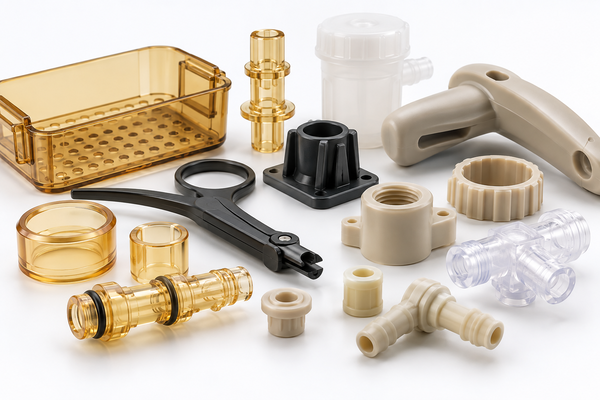
Choosing the right autoclavable plastic is important for medical and laboratory parts. These parts may face repeated steam sterilization, high heat, pressure, and moisture.
However, not every heat-resistant plastic performs well in an autoclave. Some materials can survive only a few cycles. Others can handle repeated sterilization with much better stability.
Therefore, material choice should consider heat, steam, strength, dimensions, and service life.
In this guide, we compare PPSU, PSU, PEI, PEEK, and PP. We also explain which material may be suitable for different injection molded parts.
What Is an Autoclavable Plastic?
An autoclavable plastic is a plastic that can handle high-temperature steam sterilization without serious damage.
Autoclave sterilization usually involves:
- High heat
- Steam
- Pressure
- Moisture
- Repeated heating and cooling
Typical sterilization temperatures are often around 121°C or 134°C.
However, the exact cycle depends on the equipment and product.
A good material should keep its shape and strength after repeated cycles.
Important properties include:
- Heat resistance
- Steam resistance
- Hydrolysis resistance
- Dimensional stability
- Mechanical strength
- Chemical resistance
- Impact strength
Why Autoclavable Plastic Selection Matters
A plastic may resist dry heat but still fail in hot steam.
This is because steam adds moisture to the process. In addition, repeated heating and cooling can create stress inside the part.
As a result, poor material choice may lead to:
- Warpage
- Cracking
- Color change
- Loss of strength
- Surface damage
- Dimensional change
Therefore, the working environment should be clear before a material is selected.
Cycle count also matters.
For example, a disposable part has different needs from a reusable surgical device.
PPSU as an Autoclavable Plastic
PPSU, or polyphenylsulfone, is widely used for repeated steam sterilization.
It offers strong heat resistance and very good impact strength.
Advantages of PPSU
PPSU provides:
- Excellent steam resistance
- High impact strength
- Good dimensional stability
- Good chemical resistance
- Good hydrolysis resistance
- Good long-term sterilization performance
Because of these properties, PPSU is common in reusable medical products.
Typical applications include:
- Surgical handles
- Sterilization trays
- Medical housings
- Dental parts
- Reusable medical components
Another advantage is its toughness.
However, PPSU costs more than standard engineering plastics.
PSU for Autoclave Sterilization
PSU, or polysulfone, is another heat-resistant plastic.
It offers good strength and stable dimensions.
Therefore, it can be used for:
- Medical equipment parts
- Laboratory components
- Fluid handling parts
- Sterilizable housings
However, PSU usually has lower impact strength than PPSU.
For this reason, PPSU may be better when the part must handle repeated drops or rough use.
PEI as an Autoclavable Plastic
PEI, or polyetherimide, is a high-performance engineering plastic.
It provides high heat resistance and good stiffness.
In addition, PEI offers stable dimensions at high temperatures.
Main Benefits of PEI
PEI offers:
- High heat resistance
- Good dimensional stability
- Good stiffness
- Good flame resistance
- Good electrical properties
- Good sterilization resistance
Common applications include:
- Medical equipment
- Electrical parts
- Sterilization trays
- Laboratory devices
- High-temperature housings
However, PEI is usually less impact resistant than PPSU.
Therefore, impact needs should be checked before selection.
PEEK for Repeated Sterilization
PEEK is one of the highest-performance engineering plastics.
It offers excellent heat resistance, chemical resistance, and mechanical strength.
As a result, PEEK can work well in repeated sterilization.
Advantages of PEEK
PEEK provides:
- Very high heat resistance
- Excellent chemical resistance
- Good dimensional stability
- High mechanical strength
- Low moisture absorption
- Good wear resistance
- Good fatigue resistance
PEEK is often used in demanding medical and industrial applications.
However, its price is much higher than PP, PSU, and many other plastics.
Therefore, PEEK is usually chosen only when its performance is really needed.
Polypropylene for Autoclavable Applications
PP is a lower-cost option.
Some PP grades can handle autoclave sterilization.
For this reason, PP is often used for simpler applications such as:
- Laboratory containers
- Medical trays
- Caps
- Fluid containers
- Limited-use parts
However, PP does not offer the same long-term heat resistance as PPSU, PEI, or PEEK.
Its dimensional stability is also lower.
Therefore, PP is more suitable for less demanding sterilization needs.
Autoclavable Plastic Material Comparison
The table below gives a simple comparison.
| Material | Heat Resistance | Repeated Steam Resistance | Impact Strength | Dimensional Stability | Relative Cost |
|---|---|---|---|---|---|
| PP | Moderate | Moderate | Good | Moderate | Low |
| PSU | High | Good | Moderate | Good | Medium |
| PPSU | High | Excellent | Excellent | Good | Medium-High |
| PEI | Very High | Very Good | Good | Very Good | High |
| PEEK | Extremely High | Excellent | Very Good | Excellent | Very High |
These values are general.
Actual performance depends on resin grade, part design, cycle temperature, and processing conditions.
Therefore, final material choice should be based on real application needs.
How Many Autoclave Cycles Can Plastic Handle?
There is no single number for every plastic.
Cycle life depends on many factors, including:
- Material grade
- Sterilization temperature
- Cycle time
- Steam conditions
- Part thickness
- Internal stress
- Cleaning chemicals
- Mechanical load
For example, one grade may work well for a few cycles but lose strength after many cycles.
Another grade may stay stable much longer.
Therefore, the expected cycle count should be defined before tooling starts.
For reusable medical parts, real cycle testing is strongly recommended.
Temperature Is Not the Only Factor
A common mistake is to choose a plastic only by its heat rating.
However, autoclave use involves more than heat.
Steam adds moisture. Repeated cycles also add thermal stress.
Because of this, two materials with similar heat resistance may perform very differently after many cycles.
Therefore, hydrolysis resistance and dimensional stability are also important.
Moisture and Hydrolysis Resistance
Hot steam can damage some plastics over time.
This process is called hydrolysis.
As hydrolysis increases, the material may lose:
- Strength
- Toughness
- Surface quality
- Dimensional stability
- Service life
PPSU and PEEK generally perform well in demanding steam conditions.
On the other hand, some lower-cost materials may degrade faster.
Therefore, hydrolysis resistance should be checked for repeated sterilization.
Dimensional Stability After Sterilization
Dimensional stability is important for precision parts.
Repeated heat can cause:
- Warpage
- Flatness problems
- Hole position changes
- Assembly issues
- Size variation
These problems are more serious in:
- Snap-fit features
- Sealing surfaces
- Precision connectors
- Thin walls
- Long parts
- Tight-tolerance assemblies
Therefore, material and mold design should be reviewed together.
Our injection mold manufacturing process includes DFM review, mold design, machining, assembly, and mold trials. This helps reduce risk before production.
Injection Molding Challenges with Autoclavable Plastic
High-performance plastics often need tighter molding control than standard plastics.
Common challenges include:
- High melt temperature
- High mold temperature
- Material drying
- Tool wear
- Warpage
- Internal stress
- Surface defects
Each resin has different processing needs.
Therefore, the machine, mold temperature system, drying process, and tooling materials should match the selected resin.
Drying High-Performance Plastics
Many engineering plastics absorb moisture before molding.
If the material is too wet, defects may appear.
For example:
- Silver streaks
- Bubbles
- Poor surface quality
- Lower strength
- Material degradation
Therefore, the resin should be dried according to the supplier’s instructions.
After drying, it should also stay protected from moisture.
Mold Temperature Control
Mold temperature has a strong effect on part quality.
High-performance plastics often need higher mold temperatures than PP or ABS.
Stable mold temperature can improve:
- Surface finish
- Filling
- Weld line strength
- Dimensional consistency
- Internal stress control
However, uneven mold temperature can increase warpage.
Therefore, cooling channels should be designed carefully.
Fentor Mold provides injection molding production support for engineering plastic parts that need stable process control.
Wall Thickness and Part Design
Material alone cannot solve every sterilization problem.
Part design also matters.
Uneven wall thickness can create different cooling rates.
As a result, the part may develop:
- Internal stress
- Sink marks
- Warpage
- Weak areas
Therefore, wall thickness should be as even as possible.
Ribs can improve stiffness without making the whole part too thick.
In addition, smooth wall transitions can reduce stress concentration.
Gate Design for High-Performance Plastics
Gate position affects flow, shrinkage, and weld lines.
A poor gate location may create weak areas.
After repeated sterilization, these weak areas may become more serious.
Therefore, gate design should consider:
- Flow length
- Weld line location
- Part appearance
- Fiber direction
- Packing balance
- Warpage
For complex parts, Moldflow analysis can help find risks before mold manufacturing.
Glass-Filled Autoclavable Plastic
Some autoclavable grades contain glass fiber.
Glass fiber can improve:
- Stiffness
- Strength
- Heat resistance
- Creep resistance
- Dimensional stability
However, reinforced plastics are harder to process.
Possible problems include:
- Faster tool wear
- More warpage
- Fiber marks
- Directional shrinkage
Therefore, gate position and cooling design become more important.
Chemical Resistance Is Also Important
Medical parts may contact more than steam.
They can also contact:
- Alcohol
- Detergents
- Disinfectants
- Cleaning agents
- Body fluids
- Laboratory chemicals
Therefore, chemical resistance should be checked together with sterilization resistance.
A material may survive heat but still crack after chemical exposure.
Surface Appearance After Repeated Sterilization
Repeated sterilization can also change appearance.
Possible changes include:
- Yellowing
- Loss of gloss
- Haze
- Whitening
- Small cracks
For visible medical parts, appearance testing is important.
This is especially true for transparent or light-colored plastics.
PPSU vs PEI vs PEEK for Autoclavable Parts
These three materials are often considered for demanding parts.
Choose PPSU When:
- High impact strength is important.
- Repeated steam sterilization is needed.
- Medical appearance matters.
- Cost should stay below PEEK.
Choose PEI When:
- High stiffness is needed.
- Heat resistance is important.
- Electrical properties matter.
- Amber appearance is acceptable.
Choose PEEK When:
- Very high heat resistance is needed.
- Chemical resistance is critical.
- Tight dimensional control is required.
- High material cost is acceptable.
However, there is no single best material.
The best choice depends on the actual part and sterilization cycle.
How to Choose the Right Autoclavable Plastic
Before selecting a material, check these points:
- What is the sterilization temperature?
- How long is each cycle?
- How many cycles are required?
- Is steam pressure involved?
- Are cleaning chemicals used?
- Is high impact strength needed?
- Are tight tolerances required?
- Is transparency important?
- Is food or medical compliance required?
- What is the material budget?
Once these questions are clear, material selection becomes easier.
Prototype Testing Before Mass Production
For critical parts, a material data sheet is not enough.
Actual molded samples should also be tested.
A simple test plan can include:
- Mold sample parts.
- Measure key dimensions.
- Run sterilization cycles.
- Check appearance.
- Measure again.
- Test strength or function.
- Repeat the process.
This gives more useful data for the real product.
For early projects, prototype injection molding can help test material and design before full tooling.
Final Thoughts
The right autoclavable plastic depends on heat, steam, cycle count, strength, chemical resistance, and cost.
PP can work for lower-demand applications. PSU offers good heat resistance. PPSU is often chosen for repeated steam sterilization because of its impact strength. PEI offers high heat resistance and good stability. PEEK gives excellent overall performance, but its cost is much higher.
Therefore, the best material should match the real sterilization process.
At Fentor Mold, we support material review, DFM, mold manufacturing, and injection molding production. You can learn more about our capabilities on the Fentor Mold homepage.