
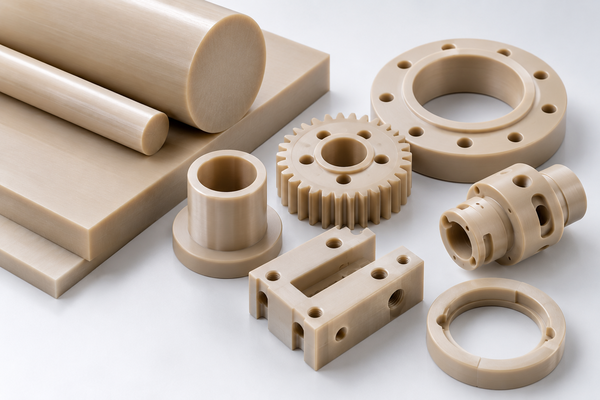
PEEK plastic machining can produce strong and precise parts for demanding applications. However, PEEK is not always easy to machine. Heat, tool wear, internal stress, and poor cutting settings can all reduce part quality.
Because of this, good results depend on more than CNC machine accuracy. The PEEK grade, cutting tool, fixture, feed rate, cooling method, and machining order all matter.
In this guide, we explain how to improve accuracy, surface finish, and part stability when machining PEEK plastic.
What Is PEEK Plastic?
PEEK stands for polyether ether ketone. It is a high-performance engineering plastic.
The material offers several useful properties:
- High mechanical strength
- Excellent heat resistance
- Good chemical resistance
- Low moisture absorption
- Good wear resistance
- Good dimensional stability
- Strong fatigue resistance
Because of these properties, PEEK is used in aerospace, medical, semiconductor, automotive, electrical, and industrial parts.
Several grades are available, such as:
- Unfilled PEEK
- Glass-filled PEEK
- Carbon-filled PEEK
- Bearing-grade PEEK
- Medical-grade PEEK
Each grade machines differently. Therefore, the material grade should be confirmed before process planning starts.
Why Is PEEK Plastic Machining Difficult?
PEEK is machinable, but it does not behave like metal.
One key challenge is heat. PEEK does not transfer heat as quickly as steel or aluminum. As a result, heat can stay around the cutting area.
Too much heat may cause:
- Local softening
- Dimensional change
- Poor surface finish
- Burrs
- Smearing
- Faster tool wear
Internal stress is another concern. PEEK stock may contain stress from extrusion or molding. When material is removed, that stress can be released.
As a result, the part may move after machining.
This risk becomes more serious with thin walls, flat plates, long parts, and tight tolerances.
PEEK Plastic Machining and Dimensional Accuracy
High accuracy starts with stable material.
If the stock moves during machining, even a precise CNC machine may not hold the final size.
Several factors can affect accuracy:
- Material condition
- Part shape
- Cutting heat
- Fixture pressure
- Tool condition
- Machining order
- Stress relief
- Inspection temperature
Therefore, dimensional control should continue through the whole process, not only during final inspection.
Choose the Right PEEK Grade
The first step in PEEK plastic machining is choosing the correct material grade.
Unfilled PEEK
Unfilled PEEK is often easier to machine than reinforced grades.
It offers:
- Good toughness
- Good chemical resistance
- Good electrical properties
- Smooth surface potential
- Good dimensional stability
However, too much cutting heat can still cause movement or softening.
Glass-Filled PEEK
Glass-filled PEEK offers higher stiffness and better dimensional stability.
However, the glass fibers are abrasive. Therefore, tools can wear faster.
As tool wear increases, heat and surface defects may also increase.
For this reason, tool condition should be checked often.
Carbon-Filled PEEK
Carbon-filled PEEK offers high stiffness and good wear resistance.
It can work well for precision mechanical parts. However, the carbon fibers can also increase tool wear.
Therefore, tool choice becomes more important when machining this grade.
Stress Relief Before PEEK Plastic Machining
Residual stress can cause a part to move after material is removed.
For critical parts, stress-relief annealing may help.
A common process is:
- Rough machine the part.
- Perform stress relief.
- Allow the part to cool.
- Semi-finish the main features.
- Finish machine the final dimensions.
- Inspect the part.
This method gives the material time to relax before the final cut.
As a result, dimensional stability may improve.
However, the annealing temperature and time should follow the material supplier’s recommendation.
Use Sharp Cutting Tools
Sharp tools are very important when machining PEEK.
A dull tool creates more friction. Therefore, cutting temperature rises.
This can cause:
- Poor surface finish
- Melted edges
- Burrs
- Dimensional change
- Higher cutting force
Carbide tools are commonly used for PEEK.
For reinforced grades, more wear-resistant tools may be needed.
In addition, operators should replace worn tools before part quality starts to change.
Carbide vs HSS Tools for PEEK Plastic Machining
Both carbide and high-speed steel tools can machine PEEK.
However, carbide is often preferred for production work because it keeps a sharp edge longer.
Main advantages include:
- Better wear resistance
- Stable cutting edges
- Longer tool life
- Good performance at higher cutting speeds
HSS can still work for drilling or low-volume jobs.
Therefore, the best tool depends on part shape, PEEK grade, tolerance, and production quantity.
For precision plastic parts, our plastic components manufacturing services include CNC machining support for engineering plastics and metal parts.
Control Heat During PEEK Plastic Machining
Heat control is one of the most important parts of PEEK plastic machining.
Too much heat can soften the cutting area. It may also change part size.
Several steps can help.
Use Suitable Cutting Parameters
Do not copy metal machining settings directly.
Instead, use settings that reduce heat and keep the cut clean.
In general, PEEK machining requires:
- Sharp tools
- Controlled spindle speed
- Suitable feed rate
- Low cutting pressure
- Good chip removal
Very high speed may create too much heat.
On the other hand, feeding too slowly can increase rubbing.
Therefore, speed and feed should work together.
Remove Chips Quickly
Chips can trap heat near the cutting zone.
For this reason, fast chip removal is important.
Air blast or suitable coolant can help. In addition, good chip flow reduces the chance of scratches on the part surface.
Coolant Use in PEEK Plastic Machining
Coolant can improve process stability.
It may help:
- Reduce cutting heat
- Remove chips
- Improve tool life
- Improve surface finish
- Reduce thermal movement
Water-based coolants are often used for industrial PEEK parts.
However, some medical or food-contact parts may need special cleaning rules.
Therefore, the end use of the part should be checked before coolant is selected.
How to Improve PEEK Surface Finish
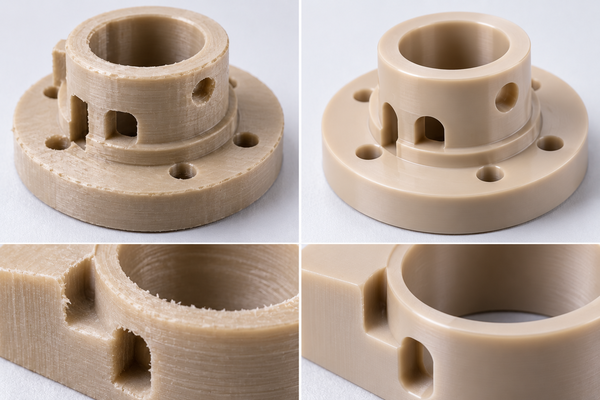
A good surface finish depends on several factors.
The machine is important, but tool condition, feed rate, vibration, and workholding also matter.
Use a Sharp Finishing Tool
A sharp tool cuts the surface cleanly.
In contrast, a worn tool rubs the material and creates more heat.
For the final pass, use a tool with little or no wear.
This is especially important for sealing surfaces and visible areas.
Use a Light Final Cut
A heavy final pass can increase heat and cutting force.
Instead, leave a small amount of stock before finishing.
Then remove it with a light, stable cut.
As a result, the surface may become smoother and the size easier to control.
Reduce Tool Vibration
Vibration can create:
- Chatter marks
- Rough surfaces
- Poor roundness
- Dimensional errors
To reduce vibration, use rigid fixturing and keep tool overhang as short as possible.
Workholding for PEEK Plastic Parts
Fixture design can directly affect accuracy.
PEEK is softer than steel or aluminum. Therefore, too much clamping force can deform the part.
This problem is common with:
- Thin plates
- Rings
- Thin-wall housings
- Long parts
- Large flat components
The fixture should hold the part firmly without bending it.
Soft jaws can help. Larger contact areas can also reduce local pressure.
In addition, controlled clamping force is important for thin sections.
Thin-Wall PEEK Plastic Machining
Thin-wall PEEK parts need extra care.
If too much material is removed from one side, the part may warp.
A better method is to remove material step by step.
For example:
- Rough both sides first.
- Leave extra stock.
- Allow the part to relax.
- Finish each side gradually.
- Measure again after unclamping.
This process takes more time. However, it can improve flatness and dimensional stability.
PEEK Machining Tolerances
PEEK can hold tight tolerances when the process is stable.
However, the correct tolerance depends on:
- Part size
- Part geometry
- Wall thickness
- Material grade
- Working temperature
- Inspection method
- Production quantity
For many machined PEEK parts, tolerances around ±0.05 mm may be possible.
However, this is only a general reference.
A large plate and a small bushing behave very differently.
Therefore, tolerances should match the real function of the part.
Tighter is not always better. In fact, unnecessary tight tolerances can increase cost and inspection time.
Temperature Matters During Inspection
Plastic dimensions can change with temperature.
Therefore, the part should reach a stable temperature before final measurement.
Measuring a warm part directly after machining may give a false result.
For critical dimensions, a controlled inspection area can improve consistency.
In addition, the same measurement method should be used during production.
Drilling PEEK Plastic
Drilling PEEK requires good chip control.
Deep holes can trap both chips and heat.
Therefore, peck drilling may be useful for deeper holes.
The drill should also remain sharp.
A dull drill may cause:
- Oversized holes
- Poor roundness
- Melted surfaces
- Burrs
- Rough hole walls
For deep holes, chip removal becomes even more important.
Milling PEEK Plastic
Milling works well for many PEEK parts.
However, stable cutting conditions are important.
During milling:
- Use sharp cutters.
- Control heat.
- Keep the tool rigid.
- Remove chips quickly.
- Use suitable feed rates.
- Avoid tool rubbing.
For finishing, a light final pass can improve surface quality.
In addition, the machining order should be planned carefully when several tight-tolerance features are involved.
Turning PEEK Plastic
PEEK can also be turned on CNC lathes.
Typical turned parts include:
- Bushings
- Rings
- Seals
- Sleeves
- Insulators
- Valve parts
The cutting edge should remain sharp during turning.
In addition, chip control is important because long plastic chips may wrap around the part.
Therefore, cutting settings should help produce manageable chips.
Avoid Burrs During PEEK Plastic Machining
Burrs often form around holes, edges, and thin sections.
They become more common when the tool wears.
To reduce burrs:
- Use sharp tools.
- Support thin edges.
- Use a suitable feed rate.
- Control heat.
- Use light finishing cuts.
- Plan the tool exit direction.
Deburring should also be gentle.
Otherwise, manual deburring may change important dimensions.
Surface Finish vs Dimensional Accuracy
A smooth surface does not always mean the part is accurate.
Likewise, a part can be within tolerance but still have poor surface quality.
Therefore, these requirements should be listed separately on the drawing.
For example, the drawing may define:
- Dimensional tolerance
- Flatness
- Roundness
- Surface roughness
- Sealing areas
- Cosmetic surfaces
Clear drawings help both the buyer and supplier understand the real quality target.
Common PEEK Plastic Machining Problems
The table below shows several common issues.
| Problem | Possible Cause | Possible Solution |
|---|---|---|
| Poor surface finish | Dull tool | Replace or sharpen tool |
| Dimensional drift | Too much heat | Reduce cutting heat |
| Part warpage | Internal stress | Use stress relief and staged machining |
| Burrs | Worn tool | Use a sharper tool |
| Chatter marks | Tool vibration | Improve rigidity |
| Hole size variation | Heat or chip buildup | Improve drilling settings |
| Fast tool wear | Reinforced PEEK | Use wear-resistant tools |
| Flatness problems | Uneven material removal | Machine both sides gradually |
Finding the real cause is important.
Otherwise, changing one CNC setting may only hide the problem for a short time.
PEEK Machining vs PEEK Injection Molding
Machining and injection molding serve different production needs.
Machining is often suitable for:
- Low-volume production
- Prototypes
- Precision parts
- Stock-material parts
- Designs that may still change
Injection molding is often more suitable when production volume increases.
Tooling requires an initial investment. However, the unit cost can become much lower at higher quantities.
Fentor Mold provides prototype injection molding and custom injection mold manufacturing for projects that move from prototype to larger-volume production.
Therefore, the best process depends on quantity, part design, tolerance, and cost target.
When Should You Choose PEEK Plastic Machining?
PEEK machining can be a good choice when:
- Production volume is low.
- Tight dimensions are needed.
- Tooling cost should be avoided.
- The design may change.
- The part is suitable for CNC machining.
- Short development time is important.
- Stock PEEK properties are required.
It is also useful during product development before investing in injection molding tooling.
How to Improve PEEK Plastic Machining Quality
Better results come from controlling the full process.
A practical checklist includes:
- Choose the correct PEEK grade.
- Use stable material stock.
- Consider stress relief for critical parts.
- Use sharp cutting tools.
- Control cutting heat.
- Avoid too much clamping force.
- Remove material in balanced steps.
- Use light finishing cuts.
- Remove chips quickly.
- Measure parts at a stable temperature.
- Inspect critical dimensions.
- Use realistic drawing tolerances.
By following these steps, manufacturers can reduce rework and improve part consistency.
Final Thoughts
Good PEEK plastic machining depends on heat control, sharp tools, stable fixtures, and a suitable machining order.
Machine accuracy alone is not enough. Material stress, tool wear, cutting heat, and clamping force can also change the final result.
Unfilled PEEK is usually easier to machine. In contrast, glass-filled and carbon-filled grades may wear tools faster.
For thin-wall or tight-tolerance parts, staged machining and stress relief can improve stability.
Most importantly, tolerances should match the real function of the part. This helps control cost while still achieving reliable quality.
Fentor Mold supports CNC-machined plastic parts, mold manufacturing, and injection molding production for engineering projects. You can learn more about our capabilities on the Fentor Mold homepage.