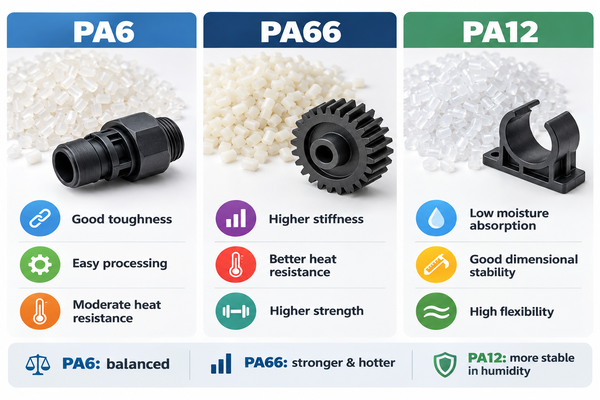
Choosing the right nylon for injection molding is important because different nylon grades can perform very differently under heat, moisture, load, wear, and chemical exposure. PA6, PA66, and PA12 are three of the most common nylon materials used for molded plastic parts, but each one has its own advantages.
For buyers and engineers, material selection should not depend only on strength. You also need to consider dimensional stability, moisture absorption, processing temperature, impact resistance, cost, and the final working environment.
In this guide, we compare PA6, PA66, PA12, and several other nylon grades to help you choose a suitable material for your injection molded parts.
What Is Nylon for Injection Molding?
Nylon is a family of engineering thermoplastics also known as polyamide, or PA.
It is widely used in injection molding because it provides a strong balance of mechanical strength, wear resistance, toughness, and chemical resistance.
Common nylon grades include:
- PA6
- PA66
- PA12
- PA11
- PA46
- PA6/66
- Glass fiber reinforced nylon
Each grade behaves differently during molding and in the final application.
Therefore, choosing the correct nylon material is an important part of both product design and mold development.
PA6 Nylon for Injection Molding
PA6 is one of the most commonly used nylon materials.
It offers good mechanical strength, toughness, wear resistance, and relatively easy processing.
Main Advantages of PA6
PA6 provides:
- Good impact strength
- Good wear resistance
- Good surface quality
- Relatively easy injection molding
- Good chemical resistance
- Competitive material cost
Because of these properties, PA6 is often used for gears, covers, brackets, clips, housings, and industrial components.
Main Limitation of PA6
The main issue with PA6 is moisture absorption.
PA6 absorbs water from the environment. As a result, the dimensions and mechanical properties of the molded part may change after production.
For tight-tolerance components, this behavior must be considered during product and mold design.
In addition, PA6 normally has lower heat resistance than PA66.
PA66 Nylon for Injection Molding
PA66 is another widely used nylon for injection molding, especially when higher temperature resistance and stiffness are required.
Compared with PA6, PA66 generally provides higher strength and better heat resistance.
Main Advantages of PA66
PA66 offers:
- Higher stiffness than PA6
- Better heat resistance
- Good fatigue resistance
- Good wear resistance
- Strong mechanical performance
- Good electrical insulation
Therefore, PA66 is commonly used for automotive components, electrical parts, connectors, gears, fasteners, and mechanical components.
PA66 Processing Considerations
PA66 usually requires a higher processing temperature than PA6.
The material must also be dried carefully before molding. If moisture remains in the resin, it can cause defects such as:
- Silver streaks
- Bubbles
- Reduced mechanical strength
- Surface defects
- Material degradation
Good drying control is therefore essential.
PA12 Nylon for Injection Molding
PA12 has lower moisture absorption than PA6 and PA66.
This is one of its biggest advantages.
Because PA12 absorbs less water, molded parts can maintain dimensions more consistently in humid environments.
Main Advantages of PA12
PA12 offers:
- Very low moisture absorption
- Good dimensional stability
- High flexibility
- Good impact resistance
- Good chemical resistance
- Good fatigue resistance
PA12 is often used for tubing, clips, connectors, pneumatic components, automotive parts, and precision plastic components.
Main Limitation of PA12
PA12 is usually more expensive than PA6 and PA66.
It also has lower stiffness and heat resistance than some PA66 grades.
Therefore, PA12 is usually selected when dimensional stability, flexibility, or low moisture absorption is more important than maximum stiffness.
PA6 vs PA66 vs PA12
The table below shows the main differences between these common nylon materials.
| Property | PA6 | PA66 | PA12 |
|---|---|---|---|
| Mechanical Strength | High | Very High | Medium |
| Stiffness | High | Very High | Lower |
| Heat Resistance | Good | Very Good | Moderate |
| Moisture Absorption | High | High | Low |
| Dimensional Stability | Moderate | Moderate | Very Good |
| Impact Resistance | Very Good | Good | Very Good |
| Flexibility | Moderate | Moderate | High |
| Processing Difficulty | Moderate | Higher | Moderate |
| Cost | Lower | Moderate | Higher |
However, actual performance depends on the specific resin grade, reinforcement, additives, and operating environment.
When Should You Choose PA6?
PA6 is usually a good choice when cost, toughness, and general mechanical performance are important.
Typical PA6 applications include:
- Industrial covers
- Mechanical brackets
- Clips
- Gears
- Housings
- Consumer products
- General engineering components
PA6 can also provide good surface appearance compared with some reinforced nylon materials.
Therefore, it is often suitable for both functional and semi-visible parts.
When Should You Choose PA66?
PA66 is often better when the molded part must handle higher temperatures or higher mechanical loads.
Typical applications include:
- Automotive engine-area components
- Electrical connectors
- Mechanical gears
- Structural brackets
- High-load clips
- Industrial components
If the application requires more stiffness than standard PA6 can provide, PA66 may be a better option.
However, moisture absorption still needs to be considered.
When Should You Choose PA12?
PA12 is suitable when dimensional stability and low moisture absorption are critical.
For example, it may be preferred for:
- Precision connectors
- Fluid handling components
- Pneumatic fittings
- Flexible clips
- Tubing components
- Automotive fluid systems
PA12 is also useful when the product will operate in changing humidity conditions.
Although the resin cost is higher, it can reduce dimensional variation and improve long-term part stability.
Glass Fiber Reinforced Nylon for Injection Molding
Standard nylon may not provide enough stiffness for some applications.
In these cases, glass fiber reinforced nylon can be used.
Common examples include:
- PA6 GF30
- PA66 GF30
- PA66 GF35
- PA6 GF40
Adding glass fiber can significantly improve:
- Stiffness
- Strength
- Heat resistance
- Creep resistance
- Dimensional stability
However, reinforced nylon also creates new molding challenges.
For example, glass fiber can increase mold wear and make surface appearance more difficult to control.
It may also cause stronger warpage because fiber orientation affects shrinkage.
Therefore, the mold design and gate position must be carefully evaluated.
Our injection mold manufacturing process includes DFM review, mold design, machining, assembly, and mold trials to help identify these risks before mass production.
Nylon Moisture Absorption and Dimensional Stability
Moisture absorption is one of the most important factors when selecting nylon for injection molding.
PA6 and PA66 are hygroscopic materials.
This means they absorb moisture from the surrounding environment after molding.
As moisture content increases, several properties can change.
For example:
- Dimensions may increase slightly.
- Stiffness may decrease.
- Impact resistance may increase.
- Strength may change.
- Tight tolerances may become harder to maintain.
Therefore, engineers should define whether dimensions are measured in the dry-as-molded condition or after moisture conditioning.
This is especially important for precision parts.
If your project requires tight dimensional control, our plastic components manufacturing team can review material behavior, tolerance requirements, and mold structure before tooling begins.
Drying Nylon Before Injection Molding
Proper material drying is essential.
Nylon absorbs moisture quickly, especially when stored in open air.
If wet nylon is molded directly, moisture can break down the polymer chains at high temperatures.
As a result, the molded part may look acceptable but have weaker mechanical properties.
Common molding problems caused by poor drying include:
- Silver streaks
- Surface marks
- Bubbles
- Reduced strength
- Poor surface quality
- Material degradation
Therefore, resin should be dried according to the material supplier’s recommendations before molding.
In addition, the dried resin should remain in a closed material handling system where possible.
Nylon Shrinkage and Warpage
Shrinkage is another important design consideration.
Unfilled nylon typically has higher shrinkage than glass fiber reinforced nylon.
However, glass fiber reinforced nylon can show more directional shrinkage.
This happens because the fibers align with the material flow.
As a result, shrinkage in the flow direction can be different from shrinkage across the flow direction.
This difference may cause:
- Warpage
- Flatness problems
- Hole position variation
- Assembly issues
- Uneven dimensions
Therefore, gate location and part geometry should be reviewed carefully.
For complex parts, Moldflow analysis may also help predict filling behavior, fiber orientation, pressure, and warpage risks.
Mold Design Considerations for Nylon Parts
A good nylon material does not automatically guarantee a good molded part.
The mold design is equally important.
Gate Design
The gate should support stable filling and balanced material flow.
Poor gate location may create:
- Weld lines
- Air traps
- Flow marks
- Warpage
- Uneven fiber orientation
For reinforced nylon, gate position becomes even more important because fiber direction can strongly affect final part deformation.
Venting
Nylon often requires good mold venting.
Trapped gas can cause:
- Burning
- Short shots
- Poor weld lines
- Surface defects
Proper vent depth and vent position can improve both appearance and filling stability.
Cooling
Cooling channels should be designed to maintain even mold temperature.
Uneven cooling can increase warpage and cycle time.
For larger parts or precision components, cooling balance should be reviewed early during mold design.
Fentor Mold provides mold design and injection molding production support for engineering plastic parts using materials such as PA6, PA66, and glass fiber reinforced nylon.
Surface Appearance of Nylon Molded Parts
Standard nylon can provide a relatively smooth molded surface.
However, glass fiber reinforced nylon may show more visible fiber marks.
Surface appearance can also be affected by:
- Mold temperature
- Injection speed
- Gate location
- Material drying
- Fiber percentage
- Mold surface texture
If appearance is important, the selected nylon grade should be tested before final mold approval.
For cosmetic parts, it may also be useful to evaluate alternative materials such as PC/ABS, ABS, or modified nylon depending on the performance requirements.
Which Nylon Is Best for High-Temperature Applications?
PA66 usually performs better than PA6 and PA12 at higher temperatures.
However, standard PA66 may still not be sufficient for very demanding applications.
In these cases, engineers may consider:
- PA66 GF
- PA46
- PPA
- PPS
- PEEK
The right choice depends on continuous service temperature, mechanical load, chemical exposure, and cost.
Therefore, it is important to evaluate actual operating conditions instead of selecting a material only from a general material comparison chart.
Which Nylon Is Best for Precision Parts?
PA12 is often attractive for precision parts because of its low moisture absorption.
However, reinforced PA6 or PA66 can also provide excellent dimensional stability when properly designed.
Material choice depends on:
- Part size
- Wall thickness
- Tolerance
- Reinforcement percentage
- Operating temperature
- Humidity
- Load direction
For precision molded parts, mold structure, cooling design, and processing consistency can be just as important as the resin itself.
How to Choose the Right Nylon for Injection Molding
Before selecting a nylon grade, consider the following questions:
- What temperature will the part experience?
- Will the part operate in a humid environment?
- Does the part require high stiffness?
- Does it need strong impact resistance?
- Are tight tolerances required?
- Does the part have a cosmetic surface?
- Will the part contact oil, fuel, or chemicals?
- Is glass fiber reinforcement acceptable?
- What is the target production volume?
- What is the acceptable material cost?
Once these conditions are clear, it becomes much easier to compare PA6, PA66, PA12, and other engineering plastics.
Final Thoughts
There is no single best nylon for injection molding.
PA6 is a cost-effective and versatile material with good toughness and wear resistance. PA66 provides better stiffness and heat resistance. Meanwhile, PA12 offers much lower moisture absorption and better dimensional stability.
For higher mechanical or temperature requirements, glass fiber reinforced nylon may provide better performance.
However, material selection should always consider the complete application, including temperature, humidity, load, tolerance, surface requirements, and molding conditions.
At Fentor Mold, we support customers from material evaluation and DFM review through mold manufacturing and injection molding production. You can also learn more about our manufacturing capabilities on the Fentor Mold homepage.