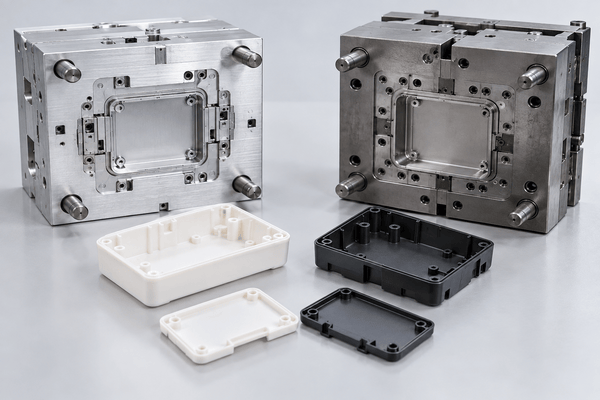
Aluminum injection mold cost is often lower than steel tooling at the beginning of a project. Aluminum is easier to machine, so CNC time can be shorter. The mold can also require less initial investment.
However, this does not mean aluminum is always the cheaper choice.
Production volume, plastic material, part complexity, mold life, surface finish, and future design changes all affect the final cost.
For prototypes and low-volume production, aluminum tooling can be very attractive. For long production runs, steel tooling often provides better long-term value.
So, the real question is not simply which mold costs less.
The better question is: which tooling material gives the lowest total cost for your production plan?
What Is an Aluminum Injection Mold?
An aluminum injection mold uses aluminum alloy for the main cavity, core, or mold inserts instead of conventional mold steel.
The basic injection molding process remains the same.
Molten plastic enters the cavity under pressure. The material cools inside the mold. Then, the molded part is ejected.
The main difference is the tooling material.
Aluminum is softer and easier to machine than common mold steels. Therefore, it can reduce machining time and make mold modifications easier.
For this reason, aluminum molds are commonly considered for:
- Prototype injection molding
- Product validation
- Low-volume production
- Bridge production
- Market testing
- Projects with frequent design changes
- Projects that need shorter tooling development
For projects that are still in the validation stage, Fentor Mold’s prototype injection molding service can help evaluate whether prototype tooling or production tooling is more suitable.
Why Is Aluminum Injection Mold Cost Usually Lower?
The largest difference often comes from machining.
Steel is harder than aluminum.
Therefore, machining a steel cavity usually requires more cutting time. Tool wear may also be higher.
Aluminum can often be:
- Milled faster
- Drilled faster
- Finished faster
- Modified more easily
- Reworked with less machining time
As a result, labor and machine-hour costs can decrease.
The material itself is only one part of the mold price.
A mold quotation also includes:
- Mold design
- CNC machining
- EDM
- Wire cutting
- Standard components
- Hot runner system
- Mold fitting
- Polishing
- Assembly
- Mold trials
- Dimensional inspection
Therefore, changing from steel to aluminum does not automatically reduce every part of the mold quotation.
The saving mainly comes from the areas where aluminum reduces machining difficulty and development time.
Aluminum Injection Mold Cost vs Steel Mold Cost
The two tooling options have different cost structures.
| Factor | Aluminum Mold | Steel Mold |
|---|---|---|
| Initial tooling cost | Usually lower | Usually higher |
| Machining time | Shorter | Longer |
| Tool life | Lower | Higher |
| Modification | Easier | More difficult |
| Wear resistance | Lower | Higher |
| Abrasive materials | Less suitable | More suitable |
| Prototype production | Very suitable | Often unnecessary |
| High-volume production | Limited | Better choice |
| Long-term maintenance | May increase | Usually more stable |
| Design changes | Easier to manage | More costly to modify |
The initial aluminum injection mold cost may look attractive.
However, production quantity should always be considered before making the final decision.
Production Volume Has the Biggest Impact
The cheapest mold is not always the mold with the lowest quotation.
Imagine two projects.
Project A
The customer needs:
- 2,000 parts
- Product testing
- No confirmed long-term demand
- Possible future design changes
In this case, spending heavily on hardened production tooling may not make sense.
An aluminum mold could reduce the initial investment and allow the customer to test the market first.
Project B
The customer expects:
- Continuous production
- Large annual quantities
- Several years of production
- Stable product design
Here, steel tooling may cost more initially.
However, the cost can be spread across a much larger number of molded parts.
Therefore, the tooling cost per part can become lower over time.
This is why aluminum injection mold cost should always be evaluated together with expected lifetime production volume.
When Is Aluminum Tooling More Economical?
Aluminum tooling makes the most sense when speed and flexibility are more important than maximum mold life.
Typical situations include:
Prototype Validation
A company may need real injection molded parts before approving mass production.
These parts can be used for:
- Assembly testing
- Functional testing
- Customer samples
- Certification
- Packaging tests
- Market evaluation
In this stage, the product design may still change.
An expensive production mold can create unnecessary risk.
Low-Volume Production
Some products simply do not require hundreds of thousands of units.
Industrial equipment, specialty electronics, medical equipment housings, and custom components may have relatively low annual demand.
In these cases, an aluminum mold may provide enough capacity.
Bridge Production
A company may need parts before its final production mold is ready.
An aluminum tool can sometimes support early production while the long-life mold is being developed.
This can help shorten the gap between product validation and full-scale manufacturing.
When Is Steel Tooling Cheaper in the Long Run?
Steel tooling becomes more attractive when the production volume increases.
A steel mold usually offers better:
- Wear resistance
- Dimensional stability
- Surface durability
- Shut-off life
- Gate life
- Long-term repeatability
This is especially important when the mold runs continuously.
Suppose an aluminum mold needs major repair or replacement during a long production program.
The customer may then pay for:
- The original aluminum mold
- Mold maintenance
- Replacement inserts
- Production downtime
- A second mold
At that point, the original saving may disappear.
Therefore, steel tooling may have a higher initial price but a lower total tooling cost for long-term production.
Fentor Mold evaluates mold structure, production quantity, material, and expected tool life before starting custom injection mold manufacturing.
Plastic Material Can Change Aluminum Injection Mold Cost
The molded material is another important factor.
Not every plastic is equally friendly to aluminum tooling.
Standard materials may create relatively low tool wear.
However, filled engineering plastics can be much more abrasive.
Examples include plastics reinforced with:
- Glass fiber
- Carbon fiber
- Mineral filler
- Other abrasive additives
These materials can increase wear around:
- Gates
- Core pins
- Shut-off surfaces
- Thin inserts
- Cavity details
Therefore, an aluminum mold that works well for an unfilled resin may have a much shorter life with a heavily reinforced material.
The resin must be reviewed before choosing the mold material.
Part Complexity Also Affects the Cost Difference
A simple plastic cover may be easy to machine in aluminum.
However, another part may require:
- Multiple sliders
- Lifters
- Deep ribs
- Thin core pins
- Tight shut-offs
- Complex inserts
- Fine textures
- High-polish surfaces
In these cases, mold construction becomes more complicated.
The base material saving may represent only a small part of the total mold price.
For example, a mold with four complex sliders still needs:
- Slide machining
- Wear plates
- Guide components
- Fitting
- Assembly
- Mold trials
These costs remain even if the cavity uses aluminum.
Therefore, aluminum injection mold cost depends heavily on the complete mold structure.
Surface Finish Can Affect Tooling Choice
Surface requirements also matter.
Some prototype parts only need a standard machined or polished finish.
Others require:
- High gloss
- Fine texture
- Cosmetic surface control
- Precise grain
- Long-term appearance consistency
Aluminum can produce good surface quality.
However, steel usually provides better durability when the mold must maintain a demanding cosmetic surface over a long production run.
Therefore, the expected number of parts should be considered together with the finish requirement.
A cosmetic prototype and a mass-production automotive appearance part have very different tooling requirements.
Cooling Can Be an Advantage of Aluminum Molds
Aluminum transfers heat efficiently.
This can help the mold remove heat from the plastic part.
In some applications, better heat transfer can support shorter cooling time.
However, mold cooling performance still depends on:
- Cooling channel location
- Channel diameter
- Water flow
- Mold temperature
- Part wall thickness
- Plastic material
Simply using aluminum does not guarantee a fast cycle.
Poor cooling design can still create:
- Warpage
- Sink marks
- Hot spots
- Uneven shrinkage
- Long cooling time
The mold material and cooling system must therefore be designed together.
Aluminum Molds Are Easier to Modify
This can be a major cost advantage during product development.
Prototype projects often change after the first mold trial.
A customer may need to modify:
- Rib thickness
- Hole position
- Snap fit
- Boss diameter
- Surface shape
- Assembly clearance
Aluminum is relatively easy to machine.
Therefore, some modifications can be completed faster than similar changes in hardened steel.
This flexibility reduces the financial risk of changing a design too early.
For products that have not reached final design approval, this can be more valuable than maximum mold life.
Do Aluminum Molds Always Use Simple Structures?
No.
An aluminum mold can still include:
- Multiple cavities
- Slides
- Lifters
- Inserts
- Ejector systems
- Hot runners
- Cooling circuits
However, every additional feature adds cost.
For example, a four-cavity aluminum mold may cost more than a simple single-cavity steel mold.
Therefore, buyers should not compare mold material alone.
The entire mold specification must be the same before comparing quotations.
What Determines the Final Aluminum Injection Mold Cost?
The most important cost factors include:
| Cost Factor | Effect on Mold Price |
|---|---|
| Part size | Larger parts require larger tooling |
| Part complexity | More machining and fitting |
| Number of cavities | Increases mold size and machining |
| Sliders and lifters | Increase mechanical complexity |
| Surface finish | Adds polishing or texture work |
| Tolerance | Higher precision needs more machining and inspection |
| Hot runner | Adds system cost |
| Plastic material | Abrasive resin may require stronger inserts |
| Mold life | Higher life requirements increase tooling specification |
| Design changes | Can add modification cost |
Therefore, asking only for an aluminum mold price does not provide enough information.
A reliable quotation should be based on the 3D part data and production requirements.
Aluminum Mold vs Steel Mold: Which Should You Choose?
A simple way to make the decision is to look at the project stage.
Choose Aluminum When:
- Production quantity is relatively low
- The design may still change
- Faster tooling is important
- Initial investment must stay low
- You need real molded parts for validation
- The plastic is not extremely abrasive
Choose Steel When:
- Production volume is high
- The project will run for years
- The material contains abrasive fillers
- Tight dimensions must remain stable
- The mold has high-wear shut-offs
- Long mold life is a priority
Neither solution is automatically better.
The correct choice depends on the complete production plan.
Do Not Compare Mold Price Alone
A common purchasing mistake is comparing only the tooling quotation.
Instead, calculate the total project cost.
Consider:
Total Cost = Mold Cost + Part Cost + Maintenance + Modification + Replacement Risk
A cheaper mold may become expensive if it needs frequent repair.
On the other hand, an expensive production mold may be unnecessary for a project that only needs several thousand parts.
The tooling strategy should match the business case.
You can also review Fentor Mold’s injection molding project examples to see how tooling decisions can vary according to part structure and production requirements.
Can You Start With Aluminum and Change to Steel Later?
Yes. In some projects, this is a practical strategy.
The first mold can support:
- Product validation
- Early orders
- Customer testing
- Market launch
- Process development
Meanwhile, the engineering team can collect production data.
Once demand becomes stable, the company can invest in a steel production mold with more confidence.
The lessons from the first tool can also improve the final mold design.
This reduces the risk of investing heavily before the product is fully validated.
At Fentor Mold, we prefer to review the expected production quantity, resin, part structure, quality requirements, and future production plan before recommending a tooling approach.
Final Thoughts
So, is aluminum injection tooling cheaper than steel tooling?
For the initial mold investment, aluminum is often the lower-cost option.
However, aluminum injection mold cost should not be judged by the first quotation alone.
Aluminum tooling can be a strong choice for prototypes, low-volume production, bridge tooling, and projects that may still change.
Steel tooling usually becomes more attractive when production volume increases or when the mold must handle abrasive materials and long production runs.
The best tooling decision balances:
- Initial mold cost
- Required quantity
- Mold life
- Plastic material
- Lead time
- Part complexity
- Modification risk
- Long-term production cost
Choosing the right mold material at the beginning can reduce both tooling risk and total manufacturing cost.