
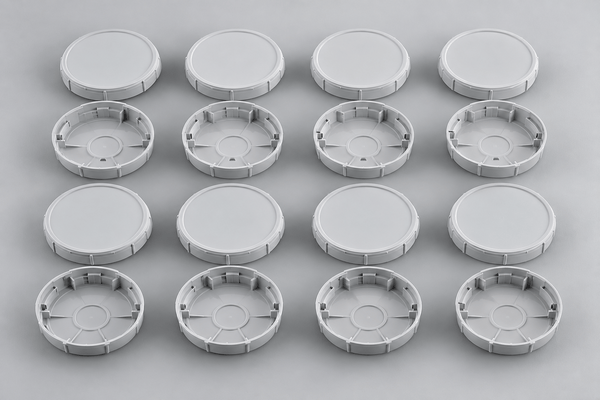
A multi-cavity injection mold can produce several plastic parts in one molding cycle. This makes it an effective solution for medium- and high-volume production.
However, adding more cavities also makes the mold more difficult to control.
If the runner, gate, cooling, or ejection system is not balanced, one cavity may fill faster than another. As a result, parts from the same mold can have different dimensions, weights, surface quality, or shrinkage.
A good multi-cavity mold design must keep every cavity working under similar conditions.
This article explains the main factors that affect mold balance and part consistency.
What Is a Multi-Cavity Injection Mold?
A multi-cavity injection mold contains two or more cavities that produce the same part during one injection cycle.
For example, a mold may have:
- 2 cavities
- 4 cavities
- 8 cavities
- 16 cavities
- 32 cavities or more
The main advantage is higher output.
If one cycle produces eight parts instead of one, production efficiency can increase significantly.
However, the mold must distribute plastic melt, cooling, packing pressure, and ejection force evenly across all cavities.
Otherwise, the increased output can come with unstable quality.
Why Balance Matters in a Multi-Cavity Injection Mold
Balance is one of the most important parts of multi-cavity mold design.
Every cavity should fill at nearly the same time.
If one cavity fills earlier, it may receive more packing pressure.
Meanwhile, another cavity may fill later and receive less pressure.
This can create differences in:
- Part weight
- Shrinkage
- Warpage
- Sink marks
- Flash
- Short shots
- Surface appearance
- Final dimensions
For precision parts, even a small imbalance can become a serious problem.
Therefore, a multi-cavity injection mold should be designed as one balanced system rather than several cavities placed together.
Runner Balance Is the First Design Priority
The runner system controls how melt reaches each cavity.
If the runner lengths are different, the flow resistance will also be different.
This can cause some cavities to fill faster.
A naturally balanced runner system is usually the best option.
For example, the melt path from the sprue to each cavity should have similar:
- Length
- Diameter
- Number of turns
- Pressure loss
This is easier in a symmetrical mold layout.
However, some part shapes or mold sizes do not allow perfect symmetry.
In that case, engineers may need to adjust runner diameters or use Moldflow analysis.
Multi-Cavity Injection Mold Gate Design
Gate design has a major effect on cavity balance.
Even if the runner is balanced, different gate sizes can create different filling speeds.
Each cavity should normally have the same gate:
- Type
- Size
- Length
- Position
The gate location should also support stable filling.
Common gate types include:
- Pin gates
- Submarine gates
- Edge gates
- Hot tip gates
- Valve gates
For small parts, pin gates and hot runner gates are often used.
For larger parts, edge gates or valve gates may provide better control.
The gate should not be placed only for easy mold construction.
It should also consider flow direction, weld lines, air traps, and packing behavior.
Hot Runner or Cold Runner for Multi-Cavity Molds?
Both systems can work.
However, the right choice depends on production volume, part size, material, and quality requirements.
| System | Advantages | Limitations |
|---|---|---|
| Cold runner | Lower mold cost, simple structure | More material waste |
| Hot runner | Less waste, faster cycles | Higher tooling cost |
| Valve gate | Better gate control | More complex system |
| Hot tip | Compact and efficient | Gate vestige may remain |
For high-volume production, a hot runner multi-cavity injection mold often provides better material efficiency.
It also gives more flexibility when balancing the flow.
However, the hot runner system itself must also be balanced.
Poor manifold design can create the same filling problems as an unbalanced cold runner.
Keep Cavity Dimensions Consistent
All cavities should produce the same part.
However, cavity dimensions can vary because of:
- CNC machining tolerance
- EDM tolerance
- Polishing differences
- Steel deformation
- Assembly error
- Insert fitting error
These differences may seem small.
However, they can become visible in precision production.
For example, if one cavity is slightly larger, the part may have a different weight or dimension.
For this reason, cavity machining should use the same process standard whenever possible.
At Fentor Mold, we also check critical cavity dimensions during mold manufacturing and fitting. Our injection mold manufacturing process includes mold design review, precision machining, assembly, and trial validation.
Cooling Balance Is Just as Important as Flow Balance
Many mold designers focus heavily on runner balance.
However, cooling balance is equally important.
If one cavity cools faster, the part may shrink differently.
If another cavity stays hotter, it may need a longer cooling time.
This can create cavity-to-cavity variation.
Cooling channels should therefore provide similar cooling conditions around each cavity.
Engineers should check:
- Distance from cooling channel to cavity
- Channel diameter
- Water flow
- Number of cooling circuits
- Cooling direction
- Hot spots
- Core cooling
Each cavity does not always need exactly the same cooling layout.
However, the final mold temperature should remain as consistent as possible.
Multi-Cavity Injection Mold Temperature Control
Temperature affects both flow and shrinkage.
If one cavity area runs hotter, the material may flow more easily into that cavity.
This can disturb filling balance.
At the same time, different mold temperatures can cause different shrinkage rates.
That may lead to:
- Different part dimensions
- Uneven gloss
- Warpage
- Longer cycle time
For this reason, cooling circuits should be easy to monitor and control.
Large multi-cavity molds may also need separate cooling circuits for different cavity groups.
This gives engineers more control during mold trials.
Venting Must Be Consistent Across All Cavities
Air must escape from every cavity.
If one cavity has poor venting, it may fill later even when the runner system is balanced.
Poor venting can also cause:
- Burn marks
- Short shots
- Weld line problems
- High injection pressure
- Surface defects
Each cavity should have adequate venting at:
- End-of-flow areas
- Deep ribs
- Parting lines
- Ejector locations
- Insert areas
Vent depth and width should be consistent.
If one cavity has better venting than the others, the filling pattern may change.
Ejection Must Be Balanced Too
Part consistency does not end when filling is complete.
The ejection system must also work evenly.
If one cavity requires more ejection force, that part may deform.
This can happen because of:
- Different draft angles
- Uneven polishing
- Core surface differences
- Ejector pin layout
- Local undercuts
Ejector pin positions should be similar across cavities.
The force should also be spread evenly over the part.
For cosmetic parts, ejector marks must remain consistent.
A well-designed ejection system improves both part quality and mold stability.
Use Moldflow for Complex Multi-Cavity Injection Mold Design
For simple molds, experienced engineers may balance the runner manually.
However, complex multi-cavity molds are more difficult.
Moldflow analysis can help predict:
- Filling time
- Pressure loss
- Flow front
- Weld lines
- Air traps
- Shear rate
- Clamp force
- Temperature distribution
It can also compare cavity balance before steel is cut.
This is especially useful for:
- 8-cavity molds
- 16-cavity molds
- Large runner systems
- Thin-wall parts
- High-flow materials
- Tight-tolerance parts
A small design change before machining is much cheaper than repeated mold modification later.
Watch the Pressure Difference Between Cavities
Pressure should be similar when each cavity reaches the end of filling.
A large pressure difference is often a warning sign.
Possible causes include:
- Runner imbalance
- Gate size difference
- Poor venting
- Uneven temperature
- Cavity dimension variation
During mold trials, engineers should compare part weights from each cavity.
This is one of the simplest ways to check mold balance.
If one cavity consistently produces a heavier part, it may be receiving more material or packing pressure.
Part Weight Is a Useful Quality Indicator
Part weight can help identify cavity imbalance quickly.
For example, an eight-cavity mold should not produce eight noticeably different part weights.
A small variation may be acceptable.
However, a large difference may indicate a process or tooling problem.
Engineers can record:
- Cavity number
- Part weight
- Key dimensions
- Visual defects
This makes it easier to identify which cavity needs adjustment.
For production molds, cavity identification numbers are useful for quality tracking.
Common Multi-Cavity Mold Problems
| Problem | Possible Cause | Improvement |
|---|---|---|
| One cavity short shot | Higher flow resistance | Check runner, gate and venting |
| Different part weights | Uneven packing | Improve flow balance |
| Different dimensions | Cooling or cavity variation | Check temperature and machining |
| Flash in one cavity | Local pressure or shut-off issue | Check cavity fit |
| Warpage difference | Uneven cooling | Improve cooling layout |
| Burn marks | Poor venting | Add or clean vents |
| Different gate marks | Gate size variation | Standardize gate dimensions |
These problems should be investigated cavity by cavity.
Changing the injection process alone may hide the real mold issue.
How Many Cavities Should a Mold Have?
More cavities do not always mean a better mold.
The correct cavity number depends on several factors:
- Annual demand
- Injection machine size
- Shot capacity
- Clamp force
- Part size
- Mold size
- Cycle time
- Tooling budget
- Quality requirements
For example, a 16-cavity mold may have a lower part cost.
However, the mold will also be larger and more complex.
It may require a bigger injection molding machine.
Therefore, cavity number should be decided based on total production cost, not only maximum output.
Multi-Cavity Injection Mold Maintenance
A multi-cavity injection mold needs regular maintenance.
If one gate, vent, or ejector pin starts to wear, the cavity balance may change.
Important maintenance points include:
- Gates
- Runners
- Vents
- Ejector pins
- Slides
- Inserts
- Cooling channels
- Parting surfaces
It is also useful to compare part weight and dimensions after long production runs.
This can identify cavity wear before it creates serious quality problems.
For projects that need both tooling and molded part production, Fentor Mold also provides injection molding production support for mold trials and stable production.
Final Thoughts
A multi-cavity injection mold can greatly improve production efficiency.
However, the mold must keep every cavity working under similar conditions.
The most important factors are:
- Balanced runners
- Consistent gates
- Stable cooling
- Good venting
- Accurate cavity machining
- Balanced ejection
- Regular cavity monitoring
When these factors are controlled, part weight, dimensions, and appearance become more consistent.
A good multi-cavity mold does not simply produce more parts.
It produces multiple parts with the same quality in every cycle.