
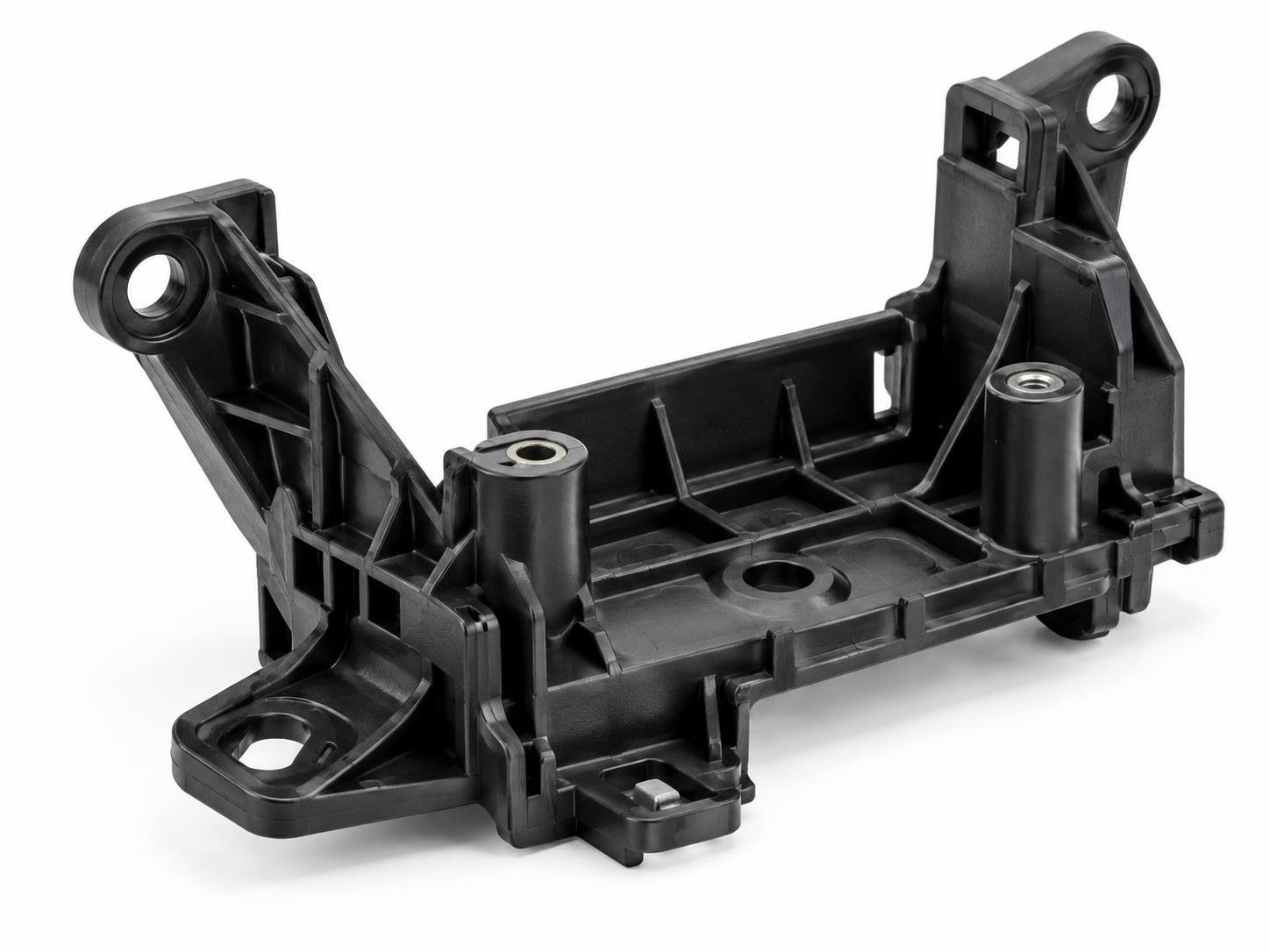
Automotive plastic brackets support many parts inside a vehicle. They hold sensors, wiring, electronic modules, interior panels, and other components in place. Although these brackets look simple, they must handle vibration, heat, and daily loads.
However, poor design can cause cracks, broken mounting points, or unwanted bending. These problems may lead to assembly failures and costly repairs.
To improve automotive plastic brackets, engineers need the right material, strong mounting features, and a reliable injection mold.
This guide explains how to improve bracket strength, reduce defects, and achieve stable production.
What Are Automotive Plastic Brackets?
Automotive plastic brackets are molded parts that support or connect vehicle components.
They often replace metal brackets when weight, cost, and corrosion resistance are important.
Common applications include:
- Sensor mounting brackets
- Wiring harness supports
- Electronic module brackets
- Interior panel supports
- Dashboard mounting parts
- Lighting component brackets
- Air duct mounting brackets
- Battery system component supports
Some brackets carry light loads. Others must support heavier parts or work in hot areas.
Therefore, the material and design must match the actual application.
Best Materials for Automotive Plastic Brackets
Material choice has a direct effect on bracket strength, weight, and service life.
Common options include PA6, PA66, PP, PC/ABS, and glass-filled engineering plastics.
However, no single material works best for every bracket.
PA6 and PA66 Automotive Plastic Brackets
PA6 and PA66 are common engineering plastics used in automotive parts.
They offer good strength, toughness, and wear resistance.
PA6 often provides a useful balance of strength and flexibility. In contrast, PA66 usually offers better heat resistance in comparable grades.
Main advantages:
- Good mechanical strength
- Good impact resistance
- Useful toughness
- Heat-stabilized grades available
- Suitable for many automotive parts
However, nylon absorbs moisture.
This can change its dimensions and mechanical properties. As a result, engineers should check both dry and moisture-conditioned parts.
Glass-Filled Nylon for Stronger Brackets
Glass-filled PA6 and PA66 are common choices for brackets that need high stiffness.
For example, PA66 GF30 may suit certain structural mounting applications.
Adding glass fibers can improve:
- Tensile strength
- Stiffness
- Heat resistance
- Resistance to deformation under load
However, glass-filled nylon also has limits.
It may be less flexible than unfilled nylon. In addition, fiber direction can affect part strength and shrinkage.
Therefore, engineers must consider both the material grade and the bracket shape.
A stronger material cannot always fix a poor design.
PP and Talc-Filled PP Brackets
PP is light, affordable, and resistant to many chemicals.
It is often useful for interior brackets and parts that carry low loads.
Talc-filled PP can provide higher stiffness than standard PP.
However, it may not offer enough strength for brackets exposed to high stress or heat.
For this reason, PP works best when the load and working conditions are suitable.
PC/ABS for Automotive Mounting Brackets
PC/ABS combines toughness with useful molding performance.
It can work well for selected interior brackets and electronic mounting components.
Main benefits include:
- Good impact strength
- Good toughness
- Suitable dimensional performance
- Good surface quality
- Heat-resistant grades available
However, PC/ABS requires proper drying before molding.
The final grade should also meet the required heat and chemical resistance.
Automotive Plastic Brackets Material Comparison
| Material | Main Advantage | Main Limitation | Typical Use |
|---|---|---|---|
| PA6 | Toughness and strength | Moisture absorption | General mounting brackets |
| PA66 | Strength and heat performance | Moisture affects properties | Higher-temperature brackets |
| PA66 GF30 | High stiffness | Fiber-related warpage | Structural supports |
| PP | Low cost and weight | Lower stiffness | Interior brackets |
| Talc-filled PP | Better stiffness | Limited high-load performance | Lightweight supports |
| PC/ABS | Impact resistance | Grade and drying requirements | Electronic brackets |
The best material depends on the load, temperature, assembly method, and service environment.
How to Improve Automotive Plastic Brackets Strength
Good automotive plastic brackets need more than thick walls.
In fact, adding too much plastic may increase weight, cooling time, and shrinkage.
A better approach is to improve the overall structure.
1. Optimize Wall Thickness
Wall thickness affects strength, filling, and cooling.
A very thin wall may bend or break under load.
However, an overly thick wall can cause sink marks and uneven shrinkage.
Therefore, engineers should keep wall thickness as consistent as possible.
Where extra strength is needed, ribs or local support features may be better than a thick solid wall.
2. Add Reinforcing Ribs
Reinforcing ribs help improve stiffness without adding too much material.
They are especially useful for brackets with long arms or flat support sections.
However, ribs must have the right size and location.
A common starting point is to make rib thickness about 50–70% of the main wall thickness. The final value depends on the material and design.
For example, a bracket with a 3 mm wall may start with ribs around 1.5–2.1 mm thick.
However, engineers must still check the expected load and molding behavior.
Good rib design should:
- Support high-load areas
- Avoid large material buildup
- Use smooth connections
- Reduce unnecessary weight
- Limit sink marks
- Allow proper mold filling
For more details, read our Guide to Rib and Boss Design for Preventing Sink Marks.
3. Improve Mounting Boss Design
Many automotive brackets use screw bosses to connect parts.
These bosses often carry assembly loads and vibration.
However, a thick solid boss may cause cracks or sink marks.
A better design often uses a hollow boss with support ribs.
In addition, the boss should have enough wall thickness for the selected screw or insert.
Important design factors include:
- Boss outer diameter
- Hole diameter
- Boss height
- Rib support
- Root radius
- Screw insertion force
For brackets with metal inserts, engineers must also check local stress during assembly.
4. Use Smooth Corners and Fillets
Sharp corners create areas of high stress.
For example, a bracket arm may crack where it connects to the main body.
Adding a smooth radius can help spread the load.
This reduces local stress and may improve fatigue resistance.
Therefore, avoid sharp internal corners in high-load areas.
However, the radius must still allow proper mold design and assembly clearance.
5. Improve Load Distribution
A bracket should transfer loads through strong sections.
If all the force acts on one thin arm or mounting hole, that area may fail.
To improve load distribution:
- Add ribs along the main load path
- Support long bracket arms
- Avoid weak narrow connections
- Use enough mounting points
- Reduce sharp changes in section thickness
In addition, engineers should review how the bracket connects to other parts.
A strong bracket can still fail if the mounting points create uneven loads.
Why Do Automotive Plastic Brackets Break?
Automotive plastic brackets can fail during assembly or after long-term use.
The failure often starts near a screw hole, thin arm, or sharp corner.
Common causes include:
- Wrong material selection
- Excessive tightening torque
- Weak mounting bosses
- Poor rib design
- Sharp internal corners
- Weld lines near stressed areas
- Poor molding conditions
- Heat and vibration
- Material aging
For example, a screw boss may crack if the hole is too small or the tightening torque is too high.
Meanwhile, a long bracket arm may break if it lacks proper support.
Therefore, engineers should identify the load and failure location before changing the design.
Simply choosing a stronger material may not solve the problem.
How Injection Mold Design Affects Automotive Plastic Brackets
A reliable injection mold helps produce brackets with stable dimensions and consistent strength.
Poor mold design may cause weak weld lines, warpage, sink marks, or difficult ejection.
At Fentor Mold, our engineering team reviews part geometry, material, mounting features, and mold structure during the DFM stage.
This helps identify possible manufacturing problems before mold machining begins.
Gate Location and Bracket Strength
Gate location controls how molten plastic enters the mold cavity.
Poor gate placement may cause weld lines near mounting bosses or high-load areas.
These weld lines can reduce local strength.
Therefore, engineers should check the filling pattern before finalizing the gate location.
For complex brackets, Moldflow analysis can help predict weld lines, filling pressure, and possible air traps.
Cooling Design and Warpage
Automotive plastic brackets often have uneven shapes.
They may include thick mounting bosses, thin support arms, and reinforcing ribs.
These areas can cool at different speeds.
As a result, the bracket may bend after leaving the mold.
Good cooling design helps reduce this risk.
Engineers should focus on:
- Balanced cooling
- Stable mold temperature
- Proper packing
- Uniform wall thickness
- Cooling near thick bosses
For glass-filled materials, fiber orientation also affects warpage.
Therefore, cooling and gate design should be reviewed together.
Slider and Lifter Design
Some automotive brackets include side holes, hooks, or locking features.
These structures may create undercuts.
Depending on the geometry, the mold may need sliders, lifters, or moving inserts.
However, complex mold mechanisms increase tooling cost and maintenance needs.
For this reason, engineers should check whether small design changes can simplify the mold.
Ejection Design for Plastic Brackets
Thin bracket arms may bend during ejection.
In addition, tall bosses may stick to the mold core.
If ejector pins push against weak areas, the part may crack or deform.
Therefore, the ejection system should apply force to stronger sections.
Good draft angles and balanced ejection can also reduce damage.
For more information, see our Automotive Injection Mold Design Guide.
Common Automotive Plastic Brackets Molding Defects
Even a good bracket design may fail if the molding process is unstable.
The following table shows common defects and possible solutions.
| Defect | Main Cause | Possible Solution |
|---|---|---|
| Cracks near screw bosses | High local stress | Improve boss design and assembly torque |
| Warpage | Uneven cooling or shrinkage | Optimize cooling and gate location |
| Sink marks | Thick ribs or bosses | Reduce local wall thickness |
| Weld lines | Flow fronts meeting | Improve gate position |
| Flash | Poor mold fitting | Check shut-off surfaces |
| Short shots | Poor filling or venting | Improve gates and vents |
| Ejection damage | High release force | Improve draft and ejection |
However, process changes cannot correct every design problem.
For example, increasing packing pressure will not repair a weak mounting arm.
Therefore, engineers should review the part design, mold, and process together.
How to Improve Automotive Plastic Brackets Durability
A bracket must stay strong throughout its intended service life.
It may face repeated vibration, heat, moisture, and mechanical loads.
For this reason, initial strength alone is not enough.
Reduce Stress Around Mounting Points
Mounting holes often carry high loads.
If the bracket is too stiff or the mounting points are not aligned, extra stress may build up.
To reduce this risk, use proper support ribs and smooth transitions.
In addition, avoid excessive screw torque.
Improve Heat Resistance
Some brackets sit near engines, lights, or electronic modules.
These areas may become hot during use.
As temperature rises, some plastics lose stiffness and strength.
Therefore, engineers should select grades that meet the expected working temperature.
For long-term loads, creep resistance is also important.
Improve Vibration Resistance
Vehicles face vibration during normal driving.
Over time, repeated movement can weaken a bracket.
To improve durability, designers should avoid thin, unsupported arms.
Ribs, suitable materials, and correct mounting locations can help reduce bending stress.
However, the design must still be tested under realistic conditions.
How to Test Automotive Plastic Brackets
Testing helps confirm whether the bracket meets the project requirements.
Common tests include:
| Test | Purpose |
|---|---|
| Load test | Check bracket strength |
| Bending test | Measure stiffness |
| Vibration test | Check fatigue resistance |
| Temperature cycling | Evaluate heat and cold effects |
| Impact test | Check sudden load resistance |
| Assembly test | Confirm correct mounting |
| Dimensional inspection | Check critical hole positions |
| Aging test | Evaluate long-term performance |
For brackets with glass-filled nylon, engineers may also test material strength in different directions.
The test plan should match the actual vehicle application.
For critical brackets, simulation and physical tests should work together.
How to Reduce Automotive Plastic Brackets Manufacturing Cost
A well-designed bracket can lower material, tooling, and assembly costs.
However, the lowest tooling price does not always give the lowest total production cost.
Several improvements can help control cost.
Optimize rib design. Use ribs to increase stiffness instead of making the entire bracket thicker.
Simplify undercuts. Reduce unnecessary sliders and lifters when possible.
Choose the right material. Avoid expensive reinforced plastics when a lower-cost grade meets the requirements.
Control cavity count. A balanced multi-cavity mold may reduce cost for high-volume projects.
Reduce molding defects. Better cooling and gate design can lower scrap rates.
Fentor Mold provides custom injection mold manufacturing for automotive and industrial plastic parts.
In addition, our injection molding production services can support customers who need finished molded brackets after tooling development.
Conclusion
Strong automotive plastic brackets require the right material, good part design, and a reliable injection mold.
PA6, PA66, glass-filled nylon, PP, and PC/ABS can all work for different bracket applications.
However, material strength alone does not guarantee long service life.
Good rib design, strong mounting bosses, smooth corners, and proper load distribution can help prevent cracks.
Meanwhile, balanced cooling, suitable gate locations, and good ejection design can improve part quality.
By reviewing these factors before mold manufacturing, automotive suppliers can reduce defects, improve bracket durability, and achieve more stable production.