
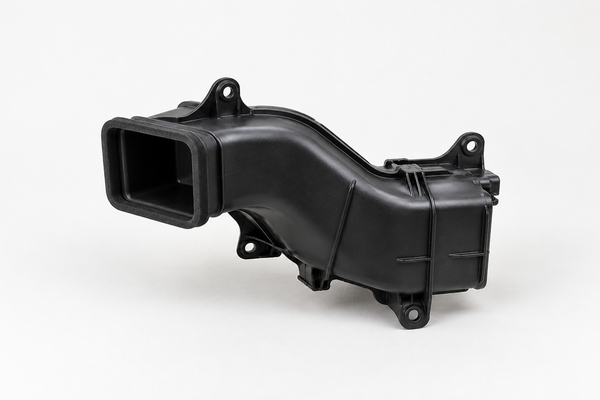
Automotive HVAC plastic parts play an important role in vehicle heating, ventilation, and air conditioning systems. These parts control airflow, support air distribution, and help maintain cabin comfort. However, complex shapes, thin walls, and tight assembly requirements can make injection molding difficult.
Common defects include warpage, short shots, weld lines, sink marks, and flash. These problems can affect airflow, sealing, and assembly. As a result, even a small molding defect may lead to noise, air leakage, or poor component fit.
At Fentor Mold, we help customers improve automotive plastic parts through DFM analysis, mold design, precision machining, and injection molding support. In this guide, we explain the main defects in automotive HVAC plastic parts and how to prevent them before mass production.
What Are Automotive HVAC Plastic Parts?
Automotive HVAC plastic parts are components used in vehicle air conditioning, heating, and ventilation systems. They guide air through the dashboard and support the movement of air control mechanisms.
Common examples include:
- HVAC housings: Hold heating and cooling components within the air distribution system.
- Air ducts: Carry air toward dashboard, floor, and windshield outlets.
- Air vents: Direct airflow into the vehicle cabin.
- Blend doors: Control airflow paths and help regulate air temperature.
- HVAC brackets: Support and position system components.
- Air control levers: Connect mechanical or motor-driven airflow controls.
These parts often contain ribs, clips, bosses, and mounting features. In addition, some parts have long flow paths and thin walls.
Therefore, manufacturers must consider both part design and mold performance to achieve stable quality.
Common Molding Defects in Automotive HVAC Plastic Parts
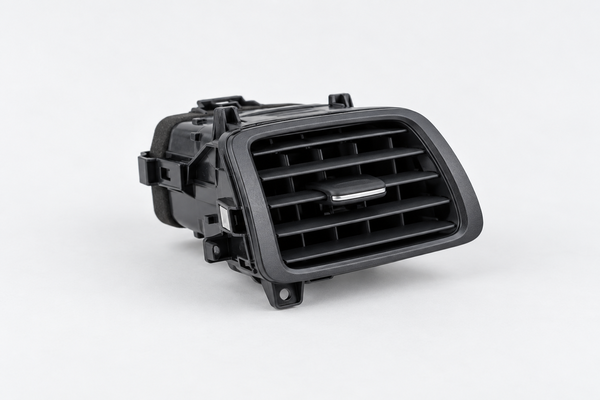
Automotive HVAC plastic parts can develop several defects during injection molding. The type of defect often depends on the part shape, material, and mold design.
| Molding Defect | Common Cause | Main Risk |
|---|---|---|
| Warpage | Uneven cooling or shrinkage | Poor assembly fit |
| Short shots | Poor filling or trapped air | Incomplete air ducts |
| Weld lines | Separate melt fronts meeting | Weak local areas |
| Sink marks | Thick ribs or bosses | Surface defects |
| Flash | Mold gaps or high cavity pressure | Poor sealing or assembly |
| Burn marks | Trapped gas or material damage | Surface discoloration |
| Dimensional variation | Unstable shrinkage or processing | Assembly problems |
Although these defects are common, many can be reduced through better mold design and process control.
How to Prevent Warpage in Automotive HVAC Plastic Parts
Warpage is a major concern for large HVAC housings and air ducts. It occurs when different areas of a part shrink at different rates.
For example, a long air duct may bend after ejection. As a result, its mounting holes may no longer align with the vehicle assembly.
Common Causes of Warpage
- Uneven wall thickness
- Poor cooling channel design
- Incorrect gate location
- Uneven packing pressure
- Material shrinkage
- Fiber orientation in reinforced plastics
- Insufficient cooling time
How to Reduce Warpage
First, keep wall thickness as uniform as possible. Sudden changes in thickness can create uneven cooling.
Next, improve the cooling system. Balanced cooling helps different areas of the part shrink more evenly.
Gate location also matters. A suitable gate can improve filling and reduce shrinkage differences.
For glass-fiber-reinforced parts, engineers should also review fiber orientation. Uneven fiber alignment can cause the part to bend in certain directions.
Finally, use Moldflow analysis when the part has a complex shape or strict dimensional requirements.
For more details, read our guide on How to Prevent Injection Molding Warpage After Cooling.
How to Prevent Short Shots in HVAC Air Ducts
Short shots occur when molten plastic fails to fill the mold cavity.
This problem often appears in automotive HVAC plastic parts with long, narrow flow paths. Thin walls and complex internal features can make filling more difficult.
An incomplete air duct may fail to seal or connect with other components.
Common Causes
- Low melt temperature
- Low mold temperature
- Incorrect gate size
- Long flow distance
- Insufficient injection pressure
- Poor mold venting
- Material with unsuitable flow properties
How to Prevent Short Shots
Start by reviewing the gate location and runner system. A suitable gate can shorten the flow path and improve filling.
Also, check the wall thickness. Extremely thin sections may freeze before the cavity fills.
Next, improve mold venting. Air trapped at the end of the flow path can stop the plastic from filling the cavity.
Injection speed and melt temperature should also match the material supplier’s recommended processing range.
For complex HVAC air ducts, filling simulation can help identify difficult areas before mold manufacturing begins.
How to Reduce Weld Lines in Automotive HVAC Plastic Parts
Weld lines form when two melt fronts meet inside the cavity.
Automotive HVAC housings often contain mounting holes, ribs, and internal walls. As molten plastic flows around these features, separate flow fronts may form.
When the fronts meet, they can leave a visible line or a locally weak area.
Why Weld Lines Matter
Weld lines may affect:
- Structural strength
- Clip durability
- Mounting features
- Surface appearance
- Long-term part reliability
However, not every weld line causes a serious problem. Its effect depends on the material, molding conditions, and location.
How to Improve Weld Line Quality
First, review the gate position. Moving the gate may shift the weld line away from critical areas.
Next, maintain suitable melt and mold temperatures. This helps the flow fronts join before they cool too much.
Proper venting is also important because trapped air can reduce weld line quality.
In addition, avoid placing major mounting features directly in weak weld line areas when the product design allows it.
For critical parts, strength testing should confirm whether the weld line meets the product requirements.
How to Prevent Sink Marks in Automotive HVAC Housings
Sink marks are small depressions that appear on the part surface.
They often form near thick ribs, bosses, or mounting structures.
For example, a thick mounting boss on an HVAC housing may cool more slowly than the surrounding wall. As the material shrinks, a visible sink mark can appear.
Main Causes of Sink Marks
- Excessive wall thickness
- Thick rib bases
- Poor boss design
- Insufficient packing pressure
- Early gate freeze
- Uneven cooling
How to Reduce Sink Marks
Keep the main wall thickness consistent wherever possible.
Also, avoid making ribs too thick. Rib thickness should suit the base wall, material, and structural needs.
Where possible, hollow out thick bosses and use support ribs to improve strength without adding too much material.
Next, optimize the gate location and packing conditions. The gate must remain open long enough to allow effective packing.
Finally, improve cooling around thick sections to reduce uneven shrinkage.
How Automotive HVAC Mold Design Helps Prevent Defects
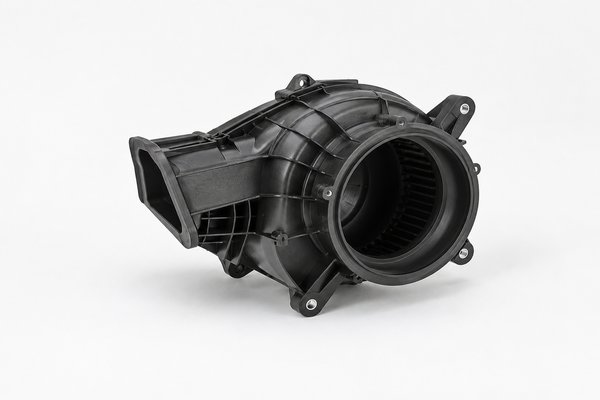
Good mold design is one of the best ways to improve part quality before production begins.
For automotive HVAC plastic parts, mold engineers should focus on gate location, cooling, venting, and ejection.
Gate Location and Runner Design
Gate location affects how plastic flows through the cavity.
A poor gate position can lead to short shots, weld lines, and uneven packing.
Therefore, gate design should consider:
- Part geometry
- Flow length
- Wall thickness
- Weld line location
- Packing requirements
- Gate removal
- Assembly surfaces
For long HVAC housings, engineers may need to evaluate several gate options before selecting the best layout.
Cooling System Design
Cooling has a direct effect on part dimensions and cycle time.
Uneven cooling may cause large HVAC parts to twist or bend.
As a result, cooling channels should provide balanced temperature control across the cavity and core.
Areas with deep ribs, bosses, and thicker walls may require extra attention.
Mold Venting Design
Air must escape as molten plastic enters the mold.
Without proper venting, trapped gas may cause short shots, burn marks, and poor weld lines.
Therefore, vents should be placed near the end of filling and other areas where air may become trapped.
Learn more about Injection Mold Venting Design.
Ejection System Design
Large HVAC plastic parts can deform during ejection if the force is not distributed properly.
To reduce this risk, mold designers should use suitable ejector locations and support the part during release.
Adequate draft angles are also important, especially for textured surfaces and deep ribs.
For complex automotive components, our custom injection mold manufacturing service supports DFM reviews, mold design, and tooling development.
Best Materials for Automotive HVAC Plastic Parts
Material selection affects the performance and molding quality of automotive HVAC plastic parts.
The best material depends on temperature, strength, chemical exposure, noise requirements, and part design.
| Material | Main Advantages | Typical HVAC Applications |
|---|---|---|
| PP | Lightweight, cost-effective, good chemical resistance | Air ducts and non-structural housings |
| Talc-filled PP | Improved stiffness and dimensional control | HVAC housings and ducts |
| ABS | Good surface finish and dimensional stability | Air vents and control components |
| PC/ABS | Good toughness and heat resistance | Interior HVAC components |
| PA66-GF | High stiffness and strength | Functional brackets and levers |
| PBT-GF | Good stiffness and dimensional performance | Selected electrical and actuator housings |
Each material also has molding challenges.
For example, PP may shrink more than some filled engineering plastics. Therefore, mold designers must account for shrinkage and warpage.
Glass-fiber-reinforced materials offer greater stiffness. However, fiber orientation can create uneven shrinkage.
ABS and PC/ABS can provide good surface quality. Still, their processing conditions must be controlled to prevent defects.
In addition, moisture-sensitive grades require proper drying before molding.
Material choice should always follow the actual operating temperature, mechanical load, OEM specifications, and approved resin grade.
How to Improve Dimensional Accuracy in HVAC Plastic Parts
Dimensional accuracy is especially important for HVAC housings, blend doors, and air ducts.
These components must fit together without creating unwanted air gaps.
A small dimensional error may lead to air leakage, vibration, or noise during vehicle operation.
Focus on Critical Dimensions
Not every dimension needs the same tolerance.
Engineers should identify important features such as:
- Mounting holes
- Sealing surfaces
- Clip positions
- Assembly interfaces
- Shaft supports
- Moving door clearances
Next, they should define suitable tolerances based on the assembly requirements.
Control Material Shrinkage
Different materials shrink at different rates.
Therefore, mold shrinkage allowances should match the selected resin grade and part geometry.
For reinforced materials, flow direction can also affect shrinkage.
Verify Parts After Cooling
Some molded components may change shape after ejection.
As a result, dimensional inspection should follow a defined cooling and conditioning procedure.
For critical assemblies, engineers should compare measured parts with the CAD model and inspect functional fit.
How to Control Automotive HVAC Injection Molding Quality
Even a well-designed mold requires stable processing conditions.
Automotive HVAC plastic parts should be produced with a controlled molding process to reduce variation.
1. Control Material Conditions
Use the approved material grade and maintain stable material handling conditions.
For moisture-sensitive plastics, follow the supplier’s drying instructions.
2. Optimize Injection Parameters
Review injection speed, melt temperature, mold temperature, and packing pressure.
These settings affect filling, shrinkage, and part appearance.
However, changing several settings at once makes troubleshooting difficult.
Therefore, engineers should adjust parameters systematically and record the results.
3. Perform Mold Trials
During T0 and T1 trials, inspect part appearance, dimensions, filling, and ejection.
Also, check assembly features and sealing surfaces.
If problems appear, identify the root cause before changing the mold.
4. Maintain Stable Production
Once the mold meets the quality requirements, document the approved process settings.
Regular mold maintenance, dimensional checks, and process monitoring help reduce defects during ongoing production.
Fentor Mold also supports customers through injection molding production for custom plastic components.
Automotive HVAC Plastic Parts: Mold Design Checklist
Before mold manufacturing, engineers should review the following points.
| Design Item | What to Check |
|---|---|
| Material | Shrinkage, heat resistance, and strength |
| Wall thickness | Uniformity and flow length |
| Gate design | Filling balance and weld lines |
| Cooling | Temperature balance and warpage |
| Venting | Trapped air and burn marks |
| Ribs and bosses | Sink marks and stiffness |
| Ejection | Part deformation and scratches |
| Tolerances | Critical assembly dimensions |
| Moldflow | Filling, packing, and warpage risks |
| Mold trials | Dimensions, appearance, and function |
A careful review helps reduce the risk of expensive mold changes after tooling is completed.
Frequently Asked Questions About Automotive HVAC Plastic Parts
What materials are used for automotive HVAC plastic parts?
Common materials include PP, talc-filled PP, ABS, PC/ABS, PA66-GF, and PBT-GF. The correct choice depends on temperature, strength, stiffness, and application requirements.
What causes warpage in automotive HVAC housings?
Warpage often results from uneven cooling, wall thickness differences, poor gate location, or material shrinkage. Glass-fiber orientation can also contribute to the problem.
How can short shots in HVAC air ducts be prevented?
Engineers can improve gate design, venting, material flow, and injection parameters. Filling simulation can also help identify difficult flow areas before mold manufacturing.
Why are weld lines important in HVAC plastic parts?
Weld lines can reduce local strength, especially near clips, mounting holes, and structural features. Their location and quality should be reviewed during mold design and validation.
Can Moldflow analysis reduce HVAC molding defects?
Yes. Moldflow analysis can help predict filling problems, weld line positions, cooling behavior, and warpage risks. However, actual mold trials are still needed to confirm the results.
Conclusion
Automotive HVAC plastic parts require careful material selection, mold design, and process control. Common problems such as warpage, short shots, weld lines, and sink marks can affect assembly quality and product performance.
However, many of these defects can be reduced before mass production through proper DFM reviews, gate design, cooling, venting, and mold trials.
For automotive HVAC projects, the goal is not only to produce a complete plastic part. It is also to maintain stable dimensions, reliable assembly, and consistent quality throughout production.
Fentor Mold provides custom injection mold manufacturing and molding support for automotive plastic components. Contact our engineering team to discuss your HVAC plastic part drawings, tooling requirements, or upcoming RFQ.