
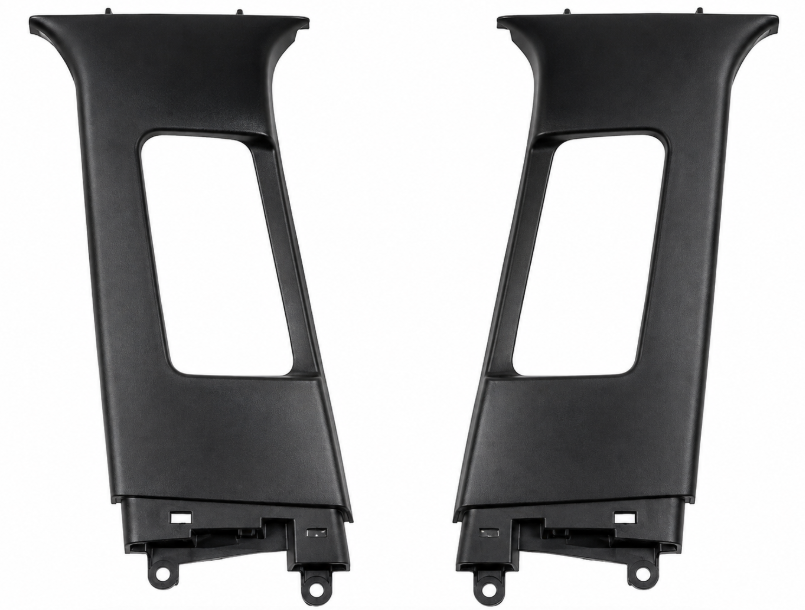
The automotive plastic B-pillar is an important interior trim part located between the front and rear doors.
The part usually has a long shape, several undercuts, and many mounting features. Because of this, the mold often uses multiple sliders and lifters.
For a B-pillar mold, the key points are not only the part shape. Slider positioning, lifter positioning, zero parting line control, and cooling are much more important.
These details directly affect the final appearance and assembly quality of the product.
For this type of automotive plastic parts project, the mold structure must stay accurate and stable during repeated production.
B-Pillar Molds Usually Have Many Sliders and Lifters
A B-pillar part often contains many clips, hooks, side holes, ribs, and local undercuts.
A simple mold opening direction cannot release all these features.
For this reason, the mold usually needs several sliders and lifters.
Some sliders are used for side features.
Some lifters release internal clips or undercuts.
The mold structure can become quite complex because these moving parts are close to each other.
The movement sequence must also be safe.
If one slider or lifter moves in the wrong direction or at the wrong time, it can damage the molded part or even damage the mold.
So the slider and lifter design must be clear, stable, and easy to maintain.
Slider Positioning Is the Key to a Successful B-Pillar Mold
The positioning of the sliders is one of the most important points in a B-pillar mold.
The outside surface of the B-pillar normally has high appearance requirements.
If the slider does not return to exactly the same position every cycle, a small mismatch can appear between the slider and the front mold.
This creates a visible step on the product surface.
For this reason, the slider needs accurate positioning when the mold closes.
The outside slider should also be locked firmly with the front mold.
This helps keep the two surfaces at the same level during injection.
Good slider positioning controls:
- Surface mismatch
- Local steps
- Parting line quality
- Product dimensions
- Long-term molding stability
For injection mold manufacturing, accurate slider positioning is one of the main checks during mold fitting and trial.
The Outside Surface Needs Zero Parting Line Control
For the visible outside surface of a B-pillar, a normal parting line may not be acceptable.
The slider and front mold need to match very closely.
The goal is to achieve what is often called a zero parting line, or at least make the line almost invisible on the final part.
This requires more than accurate CNC machining.
The slider must return to the correct position every time.
The locking surface must be stable.
The contact between the slider and the front mold must also be fitted carefully.
If the slider is slightly higher or lower than the front mold, the product will show a step.
Even a very small mismatch can become obvious on a textured or semi-gloss B-pillar surface.
For this reason, the slider should not only move smoothly. It must also have repeatable and accurate final positioning.
Slider and Lifter Cooling Must Be Sufficient
Cooling is another important point in a B-pillar mold.
The part often has several large sliders and lifters.
These moving components are not only used for demolding. They also form part of the product surface.
If the cooling inside the slider or lifter is not sufficient, its temperature can become higher than the surrounding mold area.
This temperature difference can create visible gloss marks or bright marks on the product surface.
The part may look normal in shape but still show an obvious surface difference.
This is especially easy to see on dark interior trim parts.
For this reason, the sliders and lifters need enough cooling.
Cooling water should reach the forming area as closely as possible.
The mold should avoid large temperature differences between:
- Main cavity surfaces
- Slider forming surfaces
- Lifter forming surfaces
- Local insert areas
Stable mold temperature helps keep the surface appearance consistent.
Good CNC Accuracy and Mold Fitting Are Also Important
A B-pillar mold has many separate moving components.
If the CNC accuracy is poor, the slider and lifter fitting work becomes much more difficult.
The main cavity, slider surfaces, locking surfaces, and positioning areas all need good machining accuracy.
After machining, mold fitting is also important.
The slider should move smoothly without too much clearance.
At the same time, it cannot be too tight.
The locking surface should have enough contact to hold the slider firmly during injection.
The parting areas should also be checked carefully to avoid flash and mismatch.
For this type of injection molding production project, good machining and fitting make the mold much easier to control during mold trials.
Key Characteristics of an Automotive B-Pillar Mold
An automotive plastic B-pillar mold usually has a more complex moving structure than many simple interior trim molds.
The main characteristics include:
- Multiple sliders and lifters
- High requirements for slider positioning
- Outside slider locked with the front mold
- Zero or nearly invisible parting line on visible areas
- Strict control of surface mismatch
- Good cooling inside sliders and lifters
- Temperature control to avoid bright marks
- Accurate CNC machining
- Careful mold fitting
- Stable repeatability during long-term production
For a B-pillar mold, slider positioning is the key point.
If the slider positioning is accurate, the outside surface can stay flush with the front mold.
If the sliders and lifters also have enough cooling, the mold can avoid many temperature-related surface problems.
A good B-pillar mold should therefore focus on two things first: accurate moving-component positioning and stable temperature control.