
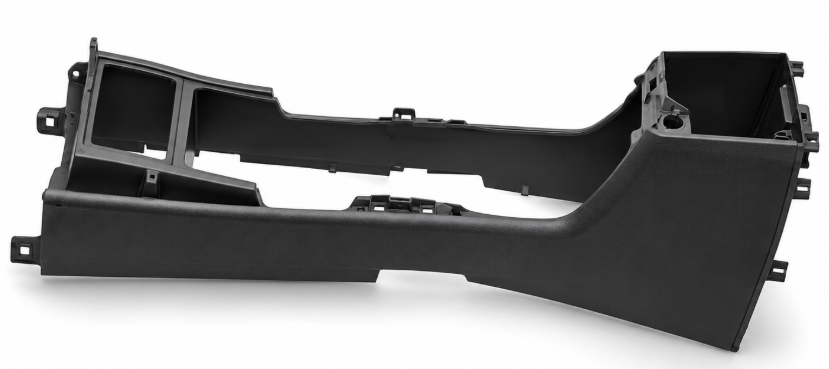
The automotive plastic console is an important interior part located between the driver and passenger seats.
It is usually a large plastic part with high appearance requirements.
The mold is also much more complex than a normal interior trim mold.
A typical console mold may have two very large sliders on the left and right sides. The upper and lower sides may also use slider structures.
In addition, the front mold can have its own ejection structure.
Because of these features, the console mold is a large and complex automotive injection mold.
For this type of automotive plastic parts project, the key points are mold strength, slider stability, front mold ejection, and accurate movement of the textured undercut areas.
Console Molds Usually Have Several Large Sliders
An automotive console often has a deep and complicated shape.
The two sides usually contain large undercuts, so the mold commonly uses two large sliders on the left and right sides.
The upper and lower areas may also need sliders.
This means the mold can have several large moving components working together.
These sliders form a large part of the product surface.
They must move smoothly, but more importantly, they must return to the correct position every cycle.
If a large slider moves even slightly during injection, the product may show:
- Surface mismatch
- Flash
- Local steps
- Dimensional problems
- Poor assembly
So the slider structure needs strong locking and accurate positioning.
A-Plate Strength Is One of the Most Important Points
One of the main challenges in a console mold is resisting injection pressure.
The side sliders are very large.
During injection, high cavity pressure pushes against these sliders.
If the mold structure is not strong enough, the sliders can move slightly.
Even a small movement can create flash or mismatch on the product.
For this reason, the mold must have enough steel thickness around the cavity and slider areas.
The A-plate needs enough strength and rigidity.
It should not deform under injection pressure.
Good injection mold manufacturing for a console project starts with the correct mold structure, not only accurate machining.
The designer needs to consider:
- A-plate thickness
- Steel thickness behind the cavity
- Slider locking area
- Support around large side openings
- Injection pressure
- Mold size and total weight
The goal is simple: the sliders must stay completely stable during injection.
Steel Material and Hardness Need Careful Selection
Steel selection is also important for a large console mold.
The mold contains large forming surfaces, large sliders, locking areas, and many moving components.
The steel must have enough strength and wear resistance.
The hardness process also needs to match the mold design.
If the steel is too soft, locking areas may wear quickly.
If the heat treatment is not stable, large plates may deform.
For this reason, steel material and hardness cannot be selected only by cost.
The mold maker should consider the working position of each steel component.
The A-plate and large structural areas need strength.
The slider locking surfaces need good wear resistance.
The forming surfaces need stable machining and polishing or texturing performance.
A good steel and hardness combination helps the mold keep its accuracy during long-term production.
Front Mold Ejection Makes the Console Mold More Complex
Another special feature of a console mold is the front mold ejection structure.
Some undercuts cannot be released from the rear mold side.
For example, the cup holder area may have reverse features or undercuts that need front mold lifters.
These front mold lifters make the mold structure more complex.
The movement must be carefully controlled.
The lifter needs to move out of the undercut without damaging the product.
At the same time, it must return to the correct position before the next molding cycle.
The guiding structure must therefore be stable and accurate.
Loose movement is not acceptable.
Textured Cup Holder Areas Must Not Be Scratched
The cup holder area is one of the most difficult parts of many console molds.
This area may contain an undercut.
It may also have a textured surface.
The front mold lifter needs to release this undercut while protecting the texture.
This is not easy.
If the lifter movement direction is wrong, or the clearance is not controlled well, the textured surface can be scratched during ejection.
Once the surface is scratched, the defect becomes very obvious.
For this reason, the movement direction and guiding system of the front mold lifter are critical.
The mold designer needs to consider the real demolding direction.
The lifter should move away from the textured surface instead of dragging across it.
Enough draft also helps, but the mechanical movement still needs to be correct.
Accurate Machining Is Critical for Front Mold Lifters
Good design alone is not enough.
The front mold lifter and its guiding structure also need accurate machining.
The angle, guiding surface, fitting area, and final position must all be precise.
If the machining has too much error, the lifter may shake during movement.
This can create surface mismatch or scratching.
It can also make the mold difficult to assemble and adjust.
CNC machining accuracy is therefore very important for:
- Lifter guide surfaces
- Slider locking surfaces
- Large parting surfaces
- Insert positioning
- Textured forming areas
- Front mold ejection components
Good machining reduces the need for excessive manual correction during mold fitting.
Key Characteristics of an Automotive Console Mold
An automotive plastic console mold is a large and complex interior mold with high appearance requirements.
The main characteristics usually include:
- Large mold size
- Two very large side sliders
- Additional upper and lower sliders
- Front mold ejection structure
- High appearance requirements
- Strong A-plate design
- Enough steel thickness to resist injection pressure
- Good steel material and hardness selection
- Stable slider locking
- Front mold lifters for cup holder undercuts
- Textured surfaces that cannot be scratched
- Accurate lifter movement and guiding
- High CNC machining accuracy
For a console mold, two points are especially important.
First, the mold must have enough strength to keep all large sliders stable during injection.
Second, the front mold lifters must release the textured undercuts smoothly without dragging or scratching the product.
If these two areas are handled correctly, the mold has a much better chance of running stably and producing a clean, high-quality console part.