
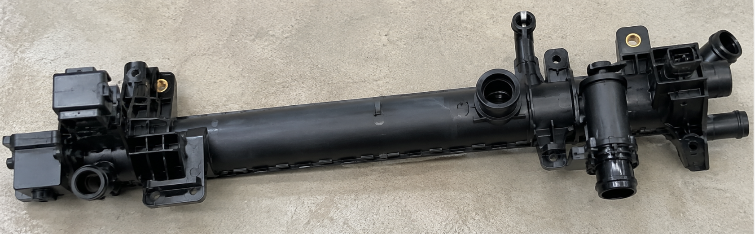
The automotive plastic water tank is a functional part.
Its main requirements are not appearance. The most important points are flatness, straightness, strength, and sealing performance.
If the sealing surface is not flat enough, the product may leak after assembly.
For this reason, the mold development process is often more difficult than it looks.
A water tank project usually needs careful material selection, repeated mold flow analysis, several mold trials, dimensional checks, and multiple mold corrections before the final result becomes stable.
For this type of automotive plastic parts project, dimensional control is the main target from the beginning.
Water Tank Parts Need Very Good Flatness and Sealing
An automotive plastic water tank is a functional part.
The sealing surface must stay flat.
The product also needs good straightness after molding.
If the part bends or twists too much, the sealing area may not contact evenly after assembly.
This can create a leakage problem.
Because of this, the mold cannot only focus on filling the cavity.
The mold maker needs to control:
- Product flatness
- Product straightness
- Sealing surface dimensions
- Local deformation
- Overall shrinkage
- Assembly position
These dimensions need to remain stable after the part cools down.
For a water tank mold, even a small dimensional change can affect sealing performance.
Glass-Filled Nylon Is Commonly Used for Water Tanks
Automotive water tank parts often use glass-filled nylon.
Common choices include glass-filled PA6 or PA66.
Adding glass fiber improves the stiffness and strength of the plastic.
This is important because the water tank needs enough structural strength during use.
However, glass-filled nylon also makes mold design more difficult.
The material has stronger directional shrinkage.
The fiber orientation can affect warpage.
Different gate positions can produce different deformation results.
This is why the gate design cannot be decided only by experience.
The mold should use mold flow analysis before finalizing the gating system.
Several Mold Flow Analyses May Be Needed to Find the Best Gate Design
For a water tank mold, the gate position and gate quantity can strongly affect the final part shape.
A different gate location can change:
- Melt flow direction
- Fiber orientation
- Weld line position
- Packing pressure
- Shrinkage
- Product warpage
For this reason, one mold flow analysis is often not enough.
The mold designer may need to compare several gate layouts.
One design may use fewer gates.
Another may move the gates closer to the center.
Another may change the filling direction.
The goal is to find the best balance between filling and deformation.
This work is especially important for glass-filled nylon because fiber orientation has a strong effect on the final product shape.
A careful gate study before injection mold manufacturing can reduce unnecessary mold correction later.
Flatness Usually Needs Several Rounds of Mold Trial and Correction
Even with mold flow analysis, the final product shape still needs to be confirmed through real mold trials.
For a water tank, flatness and straightness often need several rounds of correction.
A common development process is:
Mold trial → Measurement → 3D correction → Mold modification → Mold trial again
This process may repeat several times.
After each trial, the molded parts need to be measured carefully.
The actual product data is compared with the required dimensions.
Then the 3D model is adjusted based on the measurement results.
The mold inserts are modified according to the new model.
After that, another mold trial checks the new result.
This cycle continues until the product reaches the required flatness and sealing condition.
The process is time-consuming, but it is often necessary for this type of functional automotive part.
Repeated Welding, CNC, and EDM Can Reduce Insert Life
During several rounds of correction, the mold inserts may go through many modifications.
The work can include:
- Welding
- CNC machining
- EDM
- Grinding
- Local fitting
- Re-machining
After several rounds, the insert may contain many repaired and reworked areas.
The final dimensions may be correct, but the insert is no longer in its best condition.
Repeated welding can affect steel quality.
Repeated machining can also leave limited steel in some areas.
The insert may have many visible repair marks by the end of development.
This can reduce the long-term life of the mold.
So the final successful mold should not simply keep every modified insert forever.
Drawing Control and Machining Accuracy Must Stay Consistent
During repeated mold corrections, one of the biggest risks is losing control of the latest data.
The mold may have several versions of:
- Product 3D
- Mold insert 3D
- CNC data
- EDM data
- Measurement reports
- Correction records
If the workshop uses an old version by mistake, the mold can easily go backwards.
For this reason, the physical insert and the latest 3D data must always stay consistent.
Every correction should be updated in the final model.
The mold shop also needs good machining accuracy.
When the part already requires several rounds of compensation, another machining error can make the result much harder to control.
Good dimensional management is therefore just as important as CNC accuracy.
For complex injection molding production projects, this consistency helps keep the final mold stable and repeatable.
Final Inserts Should Be Rebuilt from the Final 3D
Once the product reaches the required flatness, straightness, and sealing performance, the final mold geometry is confirmed.
At this stage, the best solution is to rebuild the key inserts from new steel according to the final 3D data.
This is important.
The development inserts may already have several welds, EDM corrections, and CNC modifications.
They are useful for finding the correct shape, but they may not be ideal for long-term production.
New final inserts give the mold a cleaner starting condition.
They also provide:
- Better steel integrity
- Better dimensional accuracy
- Fewer repaired areas
- Better wear resistance
- Longer mold life
- Easier future maintenance
The final 3D should include all successful compensation from the mold trials.
Then the new inserts can be ordered and machined directly from that confirmed data.
Key Characteristics of an Automotive Water Tank Mold
An automotive plastic water tank mold is mainly a dimensional and functional mold.
The most important points include:
- Very strict flatness requirements
- Very strict sealing requirements
- Good straightness control
- Glass-filled nylon material
- Several rounds of mold flow analysis
- Careful gate position and gate quantity selection
- Repeated mold trials and dimensional measurement
- Multiple rounds of 3D correction
- Strict control between the latest 3D and actual mold inserts
- Accurate CNC and EDM work
- Final rebuilding of important inserts after geometry is confirmed
For a water tank mold, the development process is often more important than the first mold design.
The mold may need several correction cycles before the product becomes stable.
The key is to keep the measurement data, 3D files, and actual mold condition fully consistent during every modification.
Once the final geometry is confirmed, rebuilding the important inserts from the final 3D can restore the mold quality and give the production mold a better service life.