
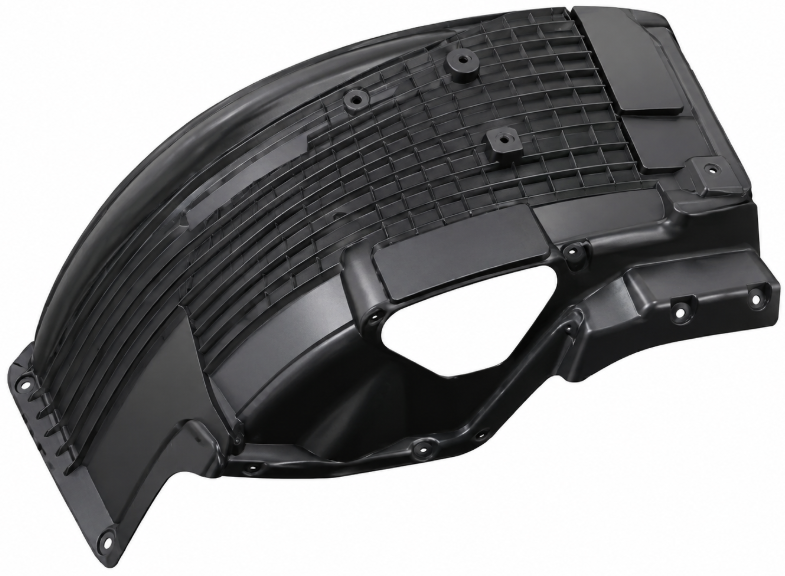
Automotive Plastic Parts – Fender Mold Design and Key Features
The automotive plastic fender, also called a mudguard or wheel arch liner in some applications, is a large injection molded automotive part.
HDPE is one of the most common materials for this type of product. PP and modified PP materials can also be used.
Compared with a grille, the appearance requirement is usually lower. However, the mold itself needs very good cooling, strength, machining accuracy, and fitting quality.
For this type of automotive plastic parts mold, several mold details are much more important than surface appearance.
Hot Runner Valve Pin Cooling Is a Key Point
One of the most important points in a fender mold is the cooling around the hot runner valve pin and gate area.
The gate area receives a lot of heat from the hot runner system.
If the cooling is not strong enough, the temperature around the gate can stay too high. This can create an unstable molding condition and may affect the gate quality and production cycle.
For this reason, the gate area should have separate cooling.
A common solution is to use a beryllium copper cooling insert around the gate area.
Beryllium copper transfers heat much faster than normal mold steel. It helps remove heat from the valve gate area and keeps the temperature more stable.
This insert should have its own cooling circuit.
The cooling water should reach the gate area directly instead of relying only on the main mold cooling channels.
For large HDPE fender parts, this detail can make a big difference during continuous production.
The Mold Must Have Enough Strength
A fender mold is a large automotive mold.
It is usually smaller than a bumper mold or dashboard mold, but the total mold weight can still be very high.
In many cases, the complete mold can weigh more than 20 tons.
Because of this size, mold strength is very important.
The cavity plate, core plate, support plate, and mold base must have enough thickness and rigidity.
The areas close to the product edge also need special attention.
If the steel around the product edge is too thin, the mold can move or deform under injection pressure.
This can create flash along the parting line.
For this reason, the steel around the product boundary must have enough thickness and support.
Good mold strength also helps keep the mold stable during long-term production.
CNC Accuracy Is Critical for Large Fender Molds
A large mold needs good machining accuracy.
Even a small machining error can become a bigger problem when the parting line is very long.
The main cavity and core surfaces should therefore be machined with stable CNC accuracy.
The mold base and large inserts also need good positioning.
For injection mold manufacturing, CNC accuracy is especially important on:
- Large parting surfaces
- Product edge areas
- Shut-off surfaces
- Large cavity and core inserts
- Slider matching areas
- Insert positioning surfaces
If these areas are machined correctly, the mold fitting work becomes much easier.
Good CNC machining also reduces the amount of manual correction needed later.
Good Mold Fitting Can Prevent Flash
Flash is a common concern on large automotive plastic parts.
However, flash is not only a molding parameter problem.
For a large fender mold, the main reasons often come from mold strength, machining accuracy, and mold fitting.
If the mold has enough rigidity, the product edge has enough steel support, and the CNC machining is accurate, the final step is proper mold fitting.
The parting surface should be checked carefully during spotting and fitting.
High spots need to be corrected.
The contact surface should be even and stable.
When the large parting surface has good contact, the mold can close correctly under production conditions.
With sufficient mold strength, good CNC accuracy, and proper mold fitting, flash can be effectively avoided.
This is especially important because the fender has a long outer edge.
A small mismatch along the parting line can create a long flash line on the molded part.
Other Basic Features of Fender Molds
Other mold features are still important, but they are usually secondary compared with cooling, strength, machining, and fitting.
HDPE is the most common material for many fender applications.
PP, PP/EPDM, and other modified PP materials can also be used depending on the project requirements.
The appearance requirement is normally lower than a grille because many areas are not directly visible after assembly.
Some fender designs may also need sliders or lifters for mounting features or undercuts.
Cooling and ejection still need good balance because the part is large and can deform easily.
However, for a large fender mold, the main mold quality still comes back to a few basic points:
- Good cooling around the hot runner valve pin
- Separate beryllium copper cooling insert at the gate
- Enough mold strength
- Enough steel thickness around the product edge
- Accurate CNC machining
- Good mold fitting
- Stable parting surface contact
- Effective flash prevention
For this type of injection molding production project, these mold details have a direct effect on long-term production stability.
A fender mold does not need the same surface appearance control as a grille mold.
But it does need very solid mold construction.
If the cooling, mold strength, CNC accuracy, and fitting are done correctly, the mold can run much more reliably and the flash problem can be controlled from the beginning.